By Scooter M. · Last updated August 31, 2026
Mud & Mat earns a commission when you buy through the links on this page, at no extra cost to you. It does not change what we recommend, and we publish a skip-this verdict on products we could otherwise earn from. Full disclosure.
Standing water is what damages a hardwood floor, and a saturated dog mat left in place holds water against the boards for hours. The fix is not a different mat - it is lifting the mat to dry rather than leaving it down, running two mats in rotation so one is always dry, and choosing a backing that does not trap moisture underneath. Grit is a secondary problem: it scratches the finish, and it is worst when it collects under a mat and gets ground in by every footstep.
Almost everything written about dog mats and wood floors is about scratches, and scratches are the smaller problem. The one that costs money is water reaching the seams between boards, swelling the wood, and cupping or lifting the finish - and unlike a scratch it is not repairable by buffing.
How water gets into a wood floor
Finished hardwood is water-resistant on its face and not on its edges. Water sitting on the surface has time to travel to the joint between two boards and wick down into the unfinished sides and the substrate. What follows is swelling, then cupping, then in bad cases a finish that separates.
The variable is time, not volume. A splash wiped up in a minute does nothing. A quarter cup of water held under a mat for six hours does real damage, because the mat prevents evaporation and holds the water in contact with the same square inch of floor the entire time.
Why the mat is often the culprit
A deep chenille mat that has just dried a wet dog is holding several times its own weight in water. It sits on your floor. It is impermeable underneath, because a rubber backing is the whole point of the backing. So the water in the pile evaporates upward slowly, and the water that has reached the bottom of the pile sits against the boards and does not evaporate at all.
This is the mechanism nobody mentions when recommending the most absorbent mat available for a wood-floored hallway. The mat is doing exactly what it was bought to do; the problem is leaving it in place afterward.
What to actually do
- Run two mats in rotation. One at the door, one drying elsewhere. This is the single change that fixes the problem, and it costs less than one premium mat.
- Lift the mat after a wet arrival, do not just leave it. Hang it over a rail or stand it against a wall for an hour. Air on both faces is what dries a mat; air on one face is what holds water against your floor.
- Sweep under the mat weekly. Grit that has fallen through the pile is now between an abrasive and a finish, and every footstep grinds it in. This is the real scratch mechanism, and it is entirely preventable.
- Prefer a fast-drying mat for a wood-floored position. Drying speed is not a comfort feature here - it directly determines how long water sits on the boards. Dog Gone Smart is the only mat in our set that publishes a drying claim.
- Do not use a rubber-backed mat on an unsealed or waxed floor for long periods. Some backings can mark or react with a wax finish. On a modern polyurethane finish this is rarely an issue; on an older wax finish it can be.
Quick picks
Ranked against the criteria below. Tap a row to jump to the full write-up; the price button goes straight to Amazon.
| # | Product | Best for | Score | Price |
|---|---|---|---|---|
| 1 |  Dog Gone Smart Dirty Dog Doormat The only mat here that publishes a measurable absorbency figure | Fastest drying turnaround | 8.7/10 | |
| 2 |  OLANLY Low-Profile Indoor Door Mat The published 0.4-inch profile is the number that matters here: it is the mainstream absorbent mat most likely to actually clear an inward-opening door. | Tight door clearance | 8.3/10 | $9.99 - View on Amazon #ad affiliate link · Price as of October 18, 2026 |
| 3 | 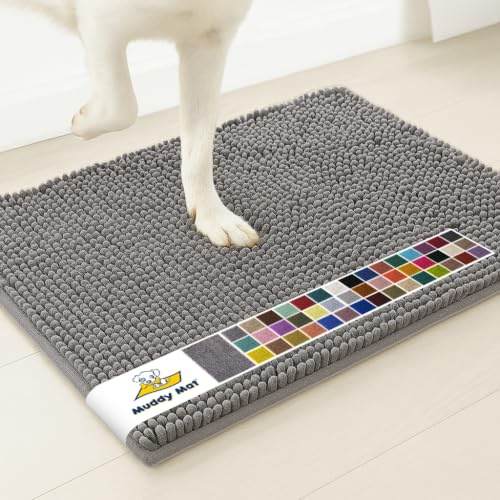 Muddy Mat Original Absorbent Door Mat A one-inch chenille pile the maker says absorbs five times its own weight | Wet dog paws | 8.5/10 | $22.70 - View on Amazon #ad affiliate link · Price as of October 18, 2026 |
Fastest drying turnaround
Dog Gone Smart Dirty Dog Doormat
The only mat here that publishes a measurable absorbency figure - 3000 GSM - instead of a marketing multiple, and it dries fast enough to be usable twice in a day.
Grams per square meter is the figure this category should be using and almost never does. Dog Gone Smart publishes 3000 GSM for the Dirty Dog Doormat and states that competing mats sit in the 900 to 1500 GSM range. Treat the comparison as the maker's framing rather than an independent test - but the number on their own product is a specification, and a specification is checkable in a way that super absorbent is not.
Density is also the more honest measure of absorbency than pile height. A deep but sparse pile holds less water than a shallow dense one. The claim that follows from 3000 GSM - roughly seven times its own weight in water and mud - is at least arithmetically consistent with the density figure, which is more than can be said for most claims in this category.
The specification that actually changes daily life, though, is drying speed. The maker claims five times faster than an ordinary mat. Drying speed is what determines whether one mat covers a household or you need two in rotation, because a mat that is still damp at four in the afternoon is a mat that does nothing for the second walk. In a wet climate with more than one dog, this is the single most valuable property a mat can have, and it is the reason this one is here despite the price.
The gap is clearance. No pile height is published anywhere we could find, and a 3000 GSM microfiber mat is not going to be thin. If it is going behind an inward-opening door, assume it will not fit and plan the placement past the swing - or use our door clearance guide to pick a thinner mat for that specific spot and put this one where it can work properly.
What works
- 3000 GSM is a real, checkable density figure, not a marketing multiple
- Drying speed is the spec that decides whether one mat is enough for your household
- Thermoplastic rubber backing survives washing better than PVC or glued backings
What does not
- No published pile height, so door clearance is unknowable before it arrives
- The 900-1500 GSM competitor comparison is the maker's own framing, not an independent test
- Sits at the top of the price band for this size class
Tight door clearance
OLANLY Low-Profile Indoor Door Mat
The published 0.4-inch profile is the number that matters here: it is the mainstream absorbent mat most likely to actually clear an inward-opening door.
Almost nobody in this category publishes a thickness. OLANLY does - 0.4 inches - and that single number is why this mat is on the list. A standard interior door is hung with roughly half an inch to three-quarters of an inch of clearance above the finished floor. At 0.4 inches, this mat fits under the common three-quarter-inch undercut comfortably and squeezes under a half-inch undercut. Most absorbent mats do not, and most of them will not tell you before you buy.
The trade is real and you should go in knowing it. A 0.4-inch woven surface cannot hold what a one-inch chenille pile holds. If a soaked retriever comes through your back door twice a day, this mat alone will not cope. What it does well is the job at the door swing: catch grit, take the first pass of water, and let the door close.
The surface is a grooved woven polyester rather than a plush chenille, and that changes the cleaning routine. Grooves hold sand and grit efficiently, which is the point, but it means shaking or vacuuming the mat is the maintenance that matters - not washing. Wash it when it looks dirty; shake it out weekly regardless.
The correct way to buy this mat is as one half of a pair. Put it at the swing where clearance is the constraint, and put a deep-pile mat like the Muddy Mat or a chenille absorber immediately past it, where clearance no longer applies. That is the household version of the three-zone entry system commercial buildings have used for decades, and it is explained in full in our layered entryway defense guide.
What works
- One of the few mats in this category that publishes a profile figure at all
- 0.4in clears a three-quarter-inch door undercut with room, and a half-inch undercut just barely
- Grooved surface traps grit rather than only absorbing water
What does not
- A shallow pile holds far less water than a 1-inch chenille mat - this is physics, not a defect
- Grooves need shaking out; they hold sand and grit well enough that it stays
- Works best paired with a deeper mat further inside, not as the only mat
Wet dog paws
Muddy Mat Original Absorbent Door Mat
A one-inch chenille pile the maker says absorbs five times its own weight - the deepest-pile mainstream option, and the one that most often will not clear a door.
Muddy Mat is the brand most people in this category have already heard of, and the demand data agrees - it is the single highest-volume product query in the entryway-mat space. The reason it earns that position is the pile. The maker states roughly a one-inch chenille layer that soaks up to five times its own weight, and depth is genuinely what separates a mat that holds a wet dog from a mat that smears one down the hall.
That same inch is the reason this mat needs a placement decision rather than a purchase decision. A standard interior door is hung with roughly half an inch to three-quarters of an inch of clearance above the finished floor. A one-inch pile does not fit under that. It will compress a little, and it will still catch. If the mat is going behind an inward-opening door, this is the wrong mat and no amount of liking it changes the arithmetic - put a low-profile mat at the swing and put this one just past it.
Where it belongs is the strip immediately inside the door, past the swing, or in a mudroom where the door opens outward. That is also where a wet dog actually shakes. The 60 by 24 inch runner is the size worth considering for a dog household: paw prints are not a doorway problem, they are a first-four-strides problem, and a 28-inch mat gets you one stride.
Cleaning is straightforward but has one rule people skip: shake or hose the mat before it goes in the machine. Chenille holds grit as effectively as it holds water, and washing a mat still full of dry mud puts that mud into your drum and back into the pile. Drying is the other honest limitation - a one-inch pile takes meaningfully longer to dry than a quarter-inch one, so a single mat in a two-dog household will spend part of its week damp. Two mats in rotation is the practical answer, and it is cheaper than a replacement floor. See our dog and paw mat picks for the full comparison.
What works
- The deepest published pile in this comparison - it holds a genuinely wet dog
- Runner size covers the first strides after the door, where paw prints actually land
- Machine washable, so the mud leaves rather than accumulating
What does not
- A 1-inch pile will not clear a standard interior door undercut - a placement decision, not a preference
- Deep pile takes noticeably longer to dry than a low-profile mat
- Needs shaking out before washing or the mud goes into your machine
The trade you cannot avoid
The mat that protects a wood floor best from water arriving is the deep absorbent one. The mat that is safest to leave lying on wood is the thin fast-drying one. Those are different mats, and there is no product that resolves it.
The resolution is behavioral rather than material: buy the absorbent mat because it stops the water reaching the floor in the first place, and then lift it. If nobody in the household will lift a mat - which is a completely reasonable thing to know about your household - buy a thinner, faster-drying mat and accept that more water gets past it. Our hardwood floor guide covers the general case beyond dogs.
Questions people ask
Do dog mats damage hardwood floors?
What kind of mat is safest for hardwood?
Can a rubber-backed mat mark a wood floor?
Why is the floor around my mat scratched?
Sources
About the author
Scooter M.
An enthusiast who is genuinely into this. I read the manuals, compile the published specs, and do the math on door clearances. No lab coat, no test bench, and nothing here is a product I have used - which is exactly why every claim carries a source.
Published by Slate Mill Group, with the Mud & Mat team. Published August 31, 2026; last updated August 31, 2026. Editorial policy.
Read next
Hardwood Guide
Mats for hardwood floors
Standing water and trapped grit - the two ways a mat damages the floor it was bought to protect.

Best for Muddy Paws
Best dog door mats for muddy paws
Six mats ranked on pile depth, published density and drying speed - plus the placement that makes any of them work.
Cleanability
Washable vs hoseable mats
Machine washable or hoseable - decided by the routine your household will realistically keep up.
Start Here
How to keep dirt out of the house
The whole entry as a procedure rather than a shopping list - what to change first and why.