By Scooter M. · Last updated September 6, 2026
Mud & Mat earns a commission when you buy through the links on this page, at no extra cost to you. It does not change what we recommend, and we publish a skip-this verdict on products we could otherwise earn from. Full disclosure.
Buy a free-standing bristle scrubber if you can put one outside your door, and a mounted one if you have a surface you are willing to drill. A boot scraper works by getting bristles between the lugs of a tread, which no flat mat can do - and the mud that ruins a floor is the mud packed into that lug pattern, not the loose grit sitting on top of it. Add a coir mat behind the scraper for the dry, gritty days, and an absorbent mat inside for the water that remains.
Almost every product sold as a boot scraper mat is a mat. It is stiff, it has ridges or coir fiber, and it works well on dried, loose material. What it cannot do is reach into a tread pattern - and a lug tread on a walking boot or a rain boot is deliberately designed so that soil packs into it and is then released by flexing, which is exactly what does not happen when somebody walks over a doormat.
This is the page for the households where that distinction matters: farms, gardens, building sites, dog walks on clay, kids on a muddy playing field. If your problem is grit and dust rather than clay, you want the coir roundup instead and you will spend a lot less money.
How we picked
How we picked
- Bristles that reach into a tread, not across it. The only mechanism that gets packed soil out of a lug pattern is a bristle entering the gap. We rank brush units above bristle mats, and bristle mats above stiff-fiber doormats, because that is the order in which they contact the part of the sole that matters.
- Whether it stays where you put it. A scraper that slides is a scraper that is dangerous, because you are standing on one foot and pushing. We split the field between units that mount with supplied hardware, units held down by step plates and your own weight, and mats that rely on a weighted or gripping base.
- Published construction in a permanently wet position. A scraper lives outdoors and never dries. Wood edges rot, uncoated steel rusts and thin plastic goes brittle. We give weight to makers that state their frame and edge material and to coatings that are named rather than described.
- Whether the debris goes somewhere. A bare brush deposits everything it removes on the step around it, which is why the area beside a boot scraper is usually filthier than the scraper. A tray or base changes that, and it is the difference between a solved problem and a moved one.
- Honest scope. None of these products absorbs anything. We do not rank them on water and we say plainly, on every pick, that a scraper is stage one of a system rather than a whole answer.
We have not physically tested these products. We do not own them, we have no lab, and we do not accept free product. Everything above is compiled from published manufacturer specifications, published care guidance and live retailer data - and we tell you which is which on every claim. How we pick.
Why a mat cannot do this job
Put a boot on a flat mat and think about what is actually touching. The sole meets the mat at the high points of the tread - the lugs themselves - and the mat surface never enters the channels between them. Coir is stiff enough to abrade the lug faces, and a ridged rubber mat can catch a lug edge, but neither reaches the recess where wet clay compacts and stays.
A bristle does. It is thin, it is long relative to the gap, and it deflects - so it enters the channel, sweeps along it, and springs back. That is the entire mechanical difference, and it explains why a fifteen-dollar brush outperforms a fifty-dollar mat on caked mud while being useless at everything the mat is good at.
How each format actually removes material. Mechanism, not marketing.
Quick picks
Ranked against the criteria below. Tap a row to jump to the full write-up; the price button goes straight to Amazon.
| # | Product | Best for | Score | Price |
|---|---|---|---|---|
| 1 | 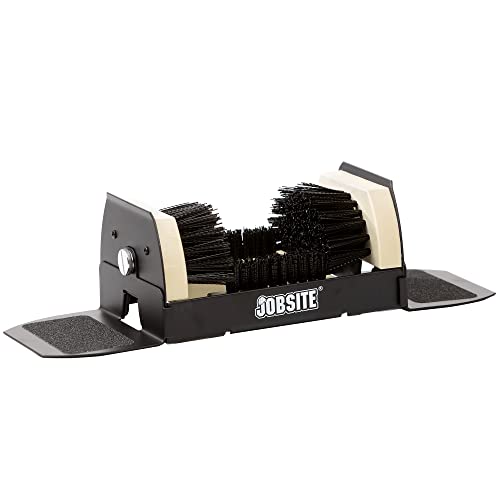 JobSite Boot Scrubber, Extra Wide The same welded-frame construction as the Original with side step plates instead of screws, so it holds itself down while you use it | Renters and big boots | 8.8/10 | $31.99 - View on Amazon #ad affiliate link · Price as of October 18, 2026 |
| 2 | 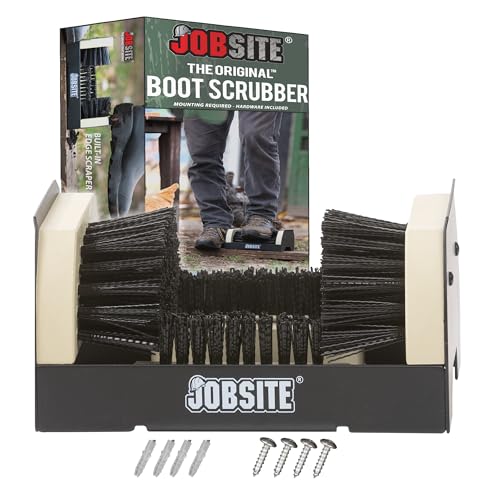 JobSite The Original Boot Scrubber A welded metal frame with composite plastic sides that bolts to a deck, a porch or a truck step, and a bristle gap deliberately tight enough that the brush does the work instead of your ankle. | The mounted scrubber that stays put | 8.6/10 | |
| 3 |  Scrusher Deluxe Boot Scraper with Brushes The only scraper here that publishes its bristle strategy | Cleaning the uppers, not just the soles | 8.4/10 | $100.95 - View on Amazon #ad affiliate link · Price as of October 18, 2026 |
| 4 |  Gardenised Shoe and Boot Scraper Mat with Tray The hybrid: coir bristles to sweep loose grit, a built-in wire brush for caked mud, and a rubber base tray that catches what comes off instead of leaving it on the step. | Scraping without bolting anything down | 7.8/10 | |
| 5 |  Kempf 1-Inch Thick Natural Coco Coir Doormat Stiff coconut fiber at a published one-inch thickness Our skip-this pick | Scraping dried mud | 8.0/10 | $39.95 - View on Amazon #ad affiliate link · Price as of October 18, 2026 |
Renters and big boots
JobSite Boot Scrubber, Extra Wide
The same welded-frame construction as the Original with side step plates instead of screws, so it holds itself down while you use it - the version to buy if drilling is not an option.
This is the version most households should buy, and the reason is a design detail rather than a performance claim. The Original has to be bolted down. This one has side step plates: you stand on the plate with one foot while you scrub with the other, and your own weight holds the unit in place. No drill, no anchors, no permanent hole in a deck you may not own.
The width is the second reason. A compact scraper is fine for a sneaker and frustrating for a size 12 work boot, and JobSite states plainly that the wide design is there to fit large boots. Published dimensions of 17.91 by 5.98 by 1.92 inches let you check that against the step or porch corner you are planning to put it on, which is more than most of this category will tell you.
Construction is the same argument as the Original: a welded metal frame with high-density composite molded plastic sides, specifically because wood-edged scrapers rot and crack in the position a scraper lives in. Nothing here is fabric, nothing here absorbs, and nothing here needs to dry out.
The honest limitation of any free-standing unit is that free-standing means movable. On a sloped, icy step it can slide before your weight is on the plate, and it will migrate over a season the way any unfixed outdoor object does. If you have a surface you are happy to drill and a spot you will never change, the bolted Original is the more permanent answer. If you rent, this is the one.
What works
- No drilling - the step plates mean a renter can use it and take it with them
- Wide enough for a work boot, which the compact scrapers are genuinely not
- Published dimensions, which most of this category does not bother with
What does not
- Unbolted means it can still shift on ice or a slick deck if you are careless
- No published bristle length or bristle material
- Costs more than the version that bolts down
The mounted scrubber that stays put
JobSite The Original Boot Scrubber
A welded metal frame with composite plastic sides that bolts to a deck, a porch or a truck step, and a bristle gap deliberately tight enough that the brush does the work instead of your ankle.
A boot scraper and a door mat are not competing products, and this is the clearest example of why. A mat gets walked over. A scrubber gets used: you put a boot into it, you move the foot back and forth, and the bristles reach into the tread where a flat surface never does. If the mess arriving at your door is caked rather than loose, that difference is the whole game.
JobSite makes a point of the fit being tight. The listing says the brush is designed so that it should be hard to get your shoe in, and that the friction is what gives the unit its power to fling mud off. That reads like a warning and it is really a specification - a loose brush is a brush that strokes the surface of a sole without touching the bottom of a lug.
The construction argument is about edges. The maker calls out that other scrapers use wood that rots and cracks; this one uses composite plastic sides on a welded metal frame. That matters in the position a scraper lives in, which is permanently outdoors and permanently wet. What it does not publish is bristle length or bristle material, which is the number we would most like to have and do not.
The catch is that it has to be bolted down - four screws and four concrete anchors are supplied, and the mounting surface can be timber, a deck, a concrete porch or a truck step. If you cannot drill, buy the free-standing version instead. And do not expect it to replace a mat: it removes solids, and the water still has to come off somewhere inside, which is what an absorbent mat is for.
What works
- The friction is the feature - the maker states the snug fit is what flings mud off
- Composite sides instead of the wood edges that rot and split on cheaper scrapers
- Mounting hardware is in the box for both timber and concrete
What does not
- Has to be bolted down, so it is not for a rental or a shared entry
- No published bristle length or bristle material
- It scrapes and brushes only - nothing here absorbs water
Cleaning the uppers, not just the soles
Scrusher Deluxe Boot Scraper with Brushes
The only scraper here that publishes its bristle strategy - stiff nylon underneath for soles, softer bristles on the sides for leather - on a UV powder-coated steel frame made in the USA.
Every other scraper in this category treats a boot as a sole with something attached. The Scrusher treats it as a sole plus two sides, and it uses different bristles for each: stiff nylon underneath to dig into a tread, softer bristles on the two side brushes so that the leather upper of a work boot is cleaned rather than scoured. Whether you need that depends entirely on what you are wearing.
The published detail that matters most is the three inches between the side brushes. That is the number that tells you whether your boot fits, and almost nobody else in this category states it. The bottom brushes are also described as spaced specifically to keep themselves free of debris, which addresses the failure mode of every bristle product - a brush packed solid with dried mud has become a flat surface.
Weatherproofing is a UV powder-coated steel frame and six rubber feet. The feet are the detail worth noticing if this is going on a finished deck or a painted porch, because a bare steel frame in that position leaves marks. The maker states the unit is made and assembled in the USA.
The reasons not to buy it are price and size. It costs several times what the composite scrapers cost, and its published footprint of roughly nine inches square is a one-boot-at-a-time device. For a garden gate or a workshop door where somebody arrives genuinely filthy, that is fine. For a family front door in February, a wider unit moves people through faster - and either way the water still needs a mat and a tray inside.
What works
- Two different bristle stiffnesses for two different jobs, and the maker says which is which
- The 3-inch gap between side brushes is published, so you can check it against a boot
- Six rubber feet mean it can live on a finished deck without marking it
What does not
- Several times the price of the composite scrapers it sits beside
- Compact - the published 9.16 by 9.25 inch footprint is one boot at a time
- The wood handle is a maintenance item in a position that stays wet
Scraping without bolting anything down
Gardenised Shoe and Boot Scraper Mat with Tray
The hybrid: coir bristles to sweep loose grit, a built-in wire brush for caked mud, and a rubber base tray that catches what comes off instead of leaving it on the step.
This is the format most people picture when they search for a boot scraper mat: something you step onto rather than something you bolt to a wall. It combines stiff coconut coir bristles, which sweep loose dirt, grass and gravel off a sole, with a built-in wire brush for the caked material that coir simply slides over.
The base tray is the part worth paying attention to. A bare bristle mat pushes the debris out onto the step, which is why the area around a scraper mat is usually filthier than the mat itself. A tray catches it, and the maker states the textured rubber base is designed to grip on wet, muddy or uneven ground - which is exactly where a loose scraper mat skates out from under you.
At 18 by 30 inches it is genuinely large enough to do both boots without repositioning, and it weighs six pounds, which is enough to stay put in wind. Cleaning is the honest, low-effort kind: shake it out, hose it, done.
Two limits are worth stating plainly. The wire brush will mark soft leather, so this is a tool for work boots and rain boots rather than for good shoes. And coir is an organic fiber - in a fully exposed position that never dries, it will eventually soften and rot, which is the same trade-off we set out in the coir versus chenille versus rubber comparison. Under a porch roof it lasts years.
What works
- Two surfaces in one unit - coir for loose material, wire for what coir will not shift
- The tray catches the debris rather than depositing it on the step
- Big enough at 18 by 30 inches to clean both feet without shuffling
What does not
- A wire brush will mark soft leather - this is a work-boot tool, not a dress-shoe tool
- Coir is organic and will eventually rot in a position that never dries out
- No published bristle height, and no stated wire gauge
Scraping dried mud
Kempf 1-Inch Thick Natural Coco Coir Doormat
Stiff coconut fiber at a published one-inch thickness - the best mechanical scraper on this list and, at that thickness, an outdoor-only mat by definition.
Skip this one
Skip coir if what you are dealing with is genuinely caked. This is one of the best mats on this site and it is not a scraper - it is a stiff surface that a boot passes over, and a passing boot only ever contacts the high points of a tread. Wet clay packed into a lug pattern will not come out that way; it needs bristles reaching between the lugs, which is a brush and not a mat. Buy the coir for the boots that arrive dusty and gritty, which is most of them most of the year. Buy a brush for the ones that arrive genuinely loaded.
Coir is the only material on this site that removes dirt mechanically rather than by absorbing it. Coconut fiber is stiff enough to act as a brush, which is why it takes caked, dried mud off a boot tread when a soft chenille mat just gets muddy. If the problem at your door is solid rather than wet - garden soil, dried clay, gravel dust - this is the material.
Kempf is on this list specifically because it publishes thickness. The standard line is one inch; there is a two-inch line for heavy scraping. Nobody else in the coir category will tell you a number, and thickness is the single most consequential spec a mat has once you consider where it has to sit.
Which brings the hard limit: at one inch, this mat cannot go under a door. Not a tight door, not any door - a standard interior door is hung with half to three-quarters of an inch of clearance and this mat is thicker than the gap. Coir lives outside the door, on the step or the porch, where the door swings away from it. That is not a compromise; that is the correct position for a scraper in a layered system.
Two honest warnings. Coir sheds, heavily, for the first few weeks - you will sweep loose fiber and it does stop. And coir is organic: left in a fully exposed position that stays wet, it will hold water and eventually rot. A covered porch or an overhang roughly doubles its usable life. If your entry has no cover at all, a rubber scraper is the more durable choice - see coir versus chenille versus rubber.
What works
- Kempf publishes an actual thickness figure, which almost no coir brand does
- Stiff coir bristles remove dried and caked mud that fabric mats simply cannot
- Natural fiber, no plastic pile, and it composts at end of life
What does not
- Sheds coir fiber for the first few weeks - this is normal and it is still a mess
- A 1-inch mat cannot go under any standard door
- Coir holds water and rots in a fully exposed position - it wants a porch or overhang
Mounted or free-standing?
This is the decision that matters more than which brand. A mounted unit does not move, which means you can put real force through it - and force is what removes packed clay. It also means drilling into a deck, a porch slab or a step, which rules it out for a rental and for anyone who might rearrange the entry later.
A free-standing unit with step plates gets most of the way there. You stand on the plate with one foot, which anchors the unit under your own weight while the other foot works. It is not quite as solid as four concrete anchors and it is close, and it can be picked up and moved or taken with you.
What we would avoid is a light unmounted brush with no plate and no mass. On a wet step it slides at exactly the moment you are least stable, which is the one genuine safety issue in this product category.
The debris problem nobody mentions
A boot scraper removes material. That material has to land somewhere, and on a bare brush it lands on the step, on the path and against the wall behind. Within a week the area around a well-used scraper looks worse than the boots did. This is not a fault; it is the physics of the thing working.
There are two answers. A scraper mat with a base tray catches what comes off, and you tip the tray out onto a border once a week. Or you accept the mess and site the scraper somewhere it does not matter - on gravel, on a path you hose anyway, at the corner of a step rather than in the middle. What you should not do is mount a bare brush directly outside a light-colored door on a clean patio and expect that to stay clean.
Bristle stiffness, and the leather problem
Stiff nylon bristles are what get clay out of a tread and they are also what will scuff a leather upper. That is the reason the better units use two different bristle stiffnesses - stiff underneath for soles, softer at the sides for uppers - and it is the single most useful published detail in this category. If a unit does not distinguish, treat all of its bristles as sole bristles and keep good shoes away from it.
A built-in wire brush is a step further again. It is genuinely effective on dried, welded-on mud and it will mark almost anything softer than a rubber rain boot. It belongs on a work-boot scraper and it does not belong on the mat by a front door where visitors arrive in normal shoes.
A scraper is stage one
Nothing on this page absorbs water. A scraper removes solid material and leaves a wet boot; the water still has to come off, and if it does not come off outside it comes off on your floor. The complete arrangement is a scraper outside, a stiff or ridged mat behind it for the last of the grit, an absorbent mat immediately inside the door, and a tray for the boots themselves.
That is four things, and it is genuinely how commercial entrances are built - the household version is set out in layered entryway defense, and how to keep dirt out of the house covers the order to buy them in if you are not doing it all at once.
Buy it this way
- Caked clay, and a surface you can drill - a mounted brush unit, bolted where you will use it for years.
- Caked clay, and a rental or a deck you will not drill - a free-standing unit with step plates.
- Leather uppers as well as soles - a unit that publishes separate side-brush and bottom-brush stiffness.
- Loose grit rather than clay - skip this page and buy coir; it costs a fraction as much and does that job better.
- Anywhere the mess must not spread - a scraper mat with a base tray, emptied weekly.
A scraper mat only works once somebody has reached it. If there is a flight of steps between the path and the door, that approach is its own problem - and a wet or iced step is the one part of an entry where somebody can actually be hurt. Best outdoor stair treads ranks them on published depth against a real 10 to 11 inch step, where the products on sale run from 4 inches to 10.
Questions people ask
Do boot scrapers actually work?
What is the difference between a boot scraper and a boot brush?
Do I need to bolt a boot scraper down?
Will a boot scraper damage my boots?
Where should a boot scraper go?
Is a coir mat a boot scraper?
Sources
- JobSite Boot Scrubber Extra Wide - Amazon detail page (step plates, published dimensions, welded frame)
- JobSite Original Boot Scrubber - Amazon detail page (mounting hardware, snug-fit brush, composite sides)
- Scrusher Deluxe - Amazon detail page (nylon bottom bristles, softer side brushes, 3in gap, UV powder coat, six rubber feet)
- Gardenised Scraper Mat with Tray - Amazon detail page (18x30in, coir bristles, wire brush, non-slip rubber base tray)
Next stage
Stage 3 - contain
A scraper gets the mud off. A tray is what holds the boot afterwards.
Keep goingAbout the author
Scooter M.
An enthusiast who is genuinely into this. I read the manuals, compile the published specs, and do the math on door clearances. No lab coat, no test bench, and nothing here is a product I have used - which is exactly why every claim carries a source.
Published by Slate Mill Group, with the Mud & Mat team. Published September 6, 2026; last updated September 6, 2026. Editorial policy.
Read next

Best Outdoor Mat
Best outdoor coir doormats
Stiff coir scrapes what fabric cannot - but it is organic, so where you put it decides how long it lasts.

Material Decision
Coir vs chenille vs rubber door mats
The material table this category never publishes - scraping, absorbency, weather and cleaning, side by side.

Start Here
How to keep dirt out of the house
The whole entry as a procedure rather than a shopping list - what to change first and why.
Best Boot Tray
Best boot trays for entryways
Wall depth, a ridged base and enough weight to stay put - the three things that separate a tray from a puddle.