
By Scooter M. · Last updated August 31, 2026
Mud & Mat earns a commission when you buy through the links on this page, at no extra cost to you. It does not change what we recommend, and we publish a skip-this verdict on products we could otherwise earn from. Full disclosure.
Every other mat on this site works by absorbing. Coir works by scraping - the coconut fiber is stiff enough to act as a brush, which is why it takes dried, caked mud off a boot tread when a soft mat just gets muddy.
If the mess arriving at your door is solid rather than wet - garden soil, dried clay, gravel dust, sand off a beach path - coir is the correct material and nothing else is close. If the mess is water, coir is close to useless and you want an absorbent mat inside instead.
Quick picks
Ranked against the criteria below. Tap a row to jump to the full write-up; the price button goes straight to Amazon.
| # | Product | Best for | Score | Price |
|---|---|---|---|---|
| 1 |  Kempf 1-Inch Thick Natural Coco Coir Doormat Stiff coconut fiber at a published one-inch thickness | Scraping dried mud | 8.0/10 | $39.95 - View on Amazon #ad affiliate link · Price as of October 19, 2026 |
| 2 |  Gorilla Grip WeatherMAX Outdoor Doormat Natural rubber that is genuinely waterproof rather than water-resistant, which is the difference between a mat that drains and a mat that becomes a sponge in November. | Rain and outdoor use | 8.4/10 | |
| 3 | 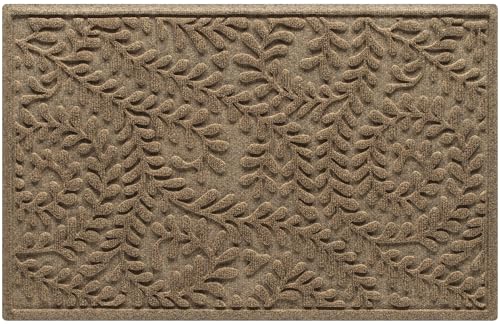 WaterHog Indoor/Outdoor Door Mat (Boxwood) The domestic version of the mat that has been in commercial lobbies for decades: published 3/8-inch construction, 24 oz per square yard PET, and made in the USA. | The commercial-grade option | 8.9/10 | $44.95 - View on Amazon #ad affiliate link · Price as of October 19, 2026 |
| 4 |  OLANLY Low-Profile Indoor Door Mat The published 0.4-inch profile is the number that matters here: it is the mainstream absorbent mat most likely to actually clear an inward-opening door. | Tight door clearance | 8.3/10 | $9.99 - View on Amazon #ad affiliate link · Price as of October 19, 2026 |
| 5 |  Smiry Natural Rubber Front Door Mat A competent low-profile rubber scraper at a lower price than the name brands, with the specification transparency to match the price Our skip-this pick | Budget outdoor scraper | 6.4/10 |
Scraping dried mud
Kempf 1-Inch Thick Natural Coco Coir Doormat
Stiff coconut fiber at a published one-inch thickness - the best mechanical scraper on this list and, at that thickness, an outdoor-only mat by definition.
Coir is the only material on this site that removes dirt mechanically rather than by absorbing it. Coconut fiber is stiff enough to act as a brush, which is why it takes caked, dried mud off a boot tread when a soft chenille mat just gets muddy. If the problem at your door is solid rather than wet - garden soil, dried clay, gravel dust - this is the material.
Kempf is on this list specifically because it publishes thickness. The standard line is one inch; there is a two-inch line for heavy scraping. Nobody else in the coir category will tell you a number, and thickness is the single most consequential spec a mat has once you consider where it has to sit.
Which brings the hard limit: at one inch, this mat cannot go under a door. Not a tight door, not any door - a standard interior door is hung with half to three-quarters of an inch of clearance and this mat is thicker than the gap. Coir lives outside the door, on the step or the porch, where the door swings away from it. That is not a compromise; that is the correct position for a scraper in a layered system.
Two honest warnings. Coir sheds, heavily, for the first few weeks - you will sweep loose fiber and it does stop. And coir is organic: left in a fully exposed position that stays wet, it will hold water and eventually rot. A covered porch or an overhang roughly doubles its usable life. If your entry has no cover at all, a rubber scraper is the more durable choice - see coir versus chenille versus rubber.
What works
- Kempf publishes an actual thickness figure, which almost no coir brand does
- Stiff coir bristles remove dried and caked mud that fabric mats simply cannot
- Natural fiber, no plastic pile, and it composts at end of life
What does not
- Sheds coir fiber for the first few weeks - this is normal and it is still a mess
- A 1-inch mat cannot go under any standard door
- Coir holds water and rots in a fully exposed position - it wants a porch or overhang
Rain and outdoor use
Gorilla Grip WeatherMAX Outdoor Doormat
Natural rubber that is genuinely waterproof rather than water-resistant, which is the difference between a mat that drains and a mat that becomes a sponge in November.
This mat has one job and it is not absorbency. It is a woven top bonded to a natural rubber backing, and the assembly sheds water rather than holding it. That sounds like a weakness until you have owned an absorbent outdoor mat through a wet November and discovered that what you actually own is a permanently saturated sponge that keeps the water at your threshold instead of away from it.
Outside the door, waterproof beats absorbent every time. Water needs to run off the mat and away; grit needs somewhere to fall out of the tread. Gorilla Grip builds this one with deep grooves, a beveled rubber border and what it calls a retention dam, then it cleans with a hose in thirty seconds - the cleaning method people will genuinely perform, unlike hauling a soaked outdoor mat into a washing machine.
Gorilla Grip also specifies stain and fade resistance, which matters more outdoors than most buyers expect. UV is what turns a black rubber mat chalky gray in a single summer, and a mat that has gone gray and stiff has usually also gone brittle around the edges.
The thing this mat cannot do is finish the job. It is stage one of a layered system - scrape outside, absorb inside. Pair it with a chenille mat immediately in from the door and you have the household version of what commercial buildings have used for decades. Buy it as the only mat and you will have clean boot treads and wet floors. Our coir versus chenille versus rubber comparison sets out which material belongs at which position.
What works
- Waterproof rather than absorbent - it never gets waterlogged and never needs drying
- Hoseable, which is the cleaning method most people will actually do
- Stain and fade resistant, so it does not go gray in a season of sun
What does not
- The woven top catches moisture but holds no useful volume - it still needs an absorbent mat inside
- One size per listing, so the 72x24in runner has to be bought separately
- Rubber goes stiff in hard frost
The commercial-grade option
WaterHog Indoor/Outdoor Door Mat (Boxwood)
The domestic version of the mat that has been in commercial lobbies for decades: published 3/8-inch construction, 24 oz per square yard PET, and made in the USA.
WaterHog is the mat you have already walked on hundreds of times without noticing - it is the standard entrance mat in commercial lobbies, and Bungalow Flooring sells domestic-sized versions of the same construction. Buying it is buying a specification rather than a look.
That specification is the most complete on this page. The Classic construction is published at three-eighths of an inch thick with a gripper backing, or closer to a quarter inch with the smooth backing intended for hard floors, using a 24 ounce per square yard PET fabric. Two numbers - thickness and fabric weight - are two more than most of this category publishes, and together they tell you almost everything: how much it holds, and whether your door will clear it.
The construction detail that matters is bi-level. The raised ridges hold the walking surface up while grit falls into the channels below, so the dirt you scrape off is not the dirt you then walk back over. That is why commercial buildings use it in the second zone of an entry system, and it works the same way at a domestic front door.
The honest downside is cleaning. This is not a mat you put in a washing machine. It hoses down well and it dries reasonably fast, but that is an outdoor job on a dry day rather than a laundry-day job. If the appeal of a mat for you is that it goes in the wash, buy chenille - see best absorbent chenille mats. If the appeal is that it will still be flat and still be working in five years, buy this.
What works
- Published thickness and published fabric weight - the most complete spec sheet here
- Bi-level construction traps grit below the walking surface instead of on it
- Beveled edges reduce the trip hazard and stop the corners curling
What does not
- Not machine washable - cleaning is a hose and a drying rack
- Costs meaningfully more than the chenille mats it sits beside
- Stiffer underfoot than an absorbent mat; it is built for traffic, not comfort
Tight door clearance
OLANLY Low-Profile Indoor Door Mat
The published 0.4-inch profile is the number that matters here: it is the mainstream absorbent mat most likely to actually clear an inward-opening door.
Almost nobody in this category publishes a thickness. OLANLY does - 0.4 inches - and that single number is why this mat is on the list. A standard interior door is hung with roughly half an inch to three-quarters of an inch of clearance above the finished floor. At 0.4 inches, this mat fits under the common three-quarter-inch undercut comfortably and squeezes under a half-inch undercut. Most absorbent mats do not, and most of them will not tell you before you buy.
The trade is real and you should go in knowing it. A 0.4-inch woven surface cannot hold what a one-inch chenille pile holds. If a soaked retriever comes through your back door twice a day, this mat alone will not cope. What it does well is the job at the door swing: catch grit, take the first pass of water, and let the door close.
The surface is a grooved woven polyester rather than a plush chenille, and that changes the cleaning routine. Grooves hold sand and grit efficiently, which is the point, but it means shaking or vacuuming the mat is the maintenance that matters - not washing. Wash it when it looks dirty; shake it out weekly regardless.
The correct way to buy this mat is as one half of a pair. Put it at the swing where clearance is the constraint, and put a deep-pile mat like the Muddy Mat or a chenille absorber immediately past it, where clearance no longer applies. That is the household version of the three-zone entry system commercial buildings have used for decades, and it is explained in full in our layered entryway defense guide.
What works
- One of the few mats in this category that publishes a profile figure at all
- 0.4in clears a three-quarter-inch door undercut with room, and a half-inch undercut just barely
- Grooved surface traps grit rather than only absorbing water
What does not
- A shallow pile holds far less water than a 1-inch chenille mat - this is physics, not a defect
- Grooves need shaking out; they hold sand and grit well enough that it stays
- Works best paired with a deeper mat further inside, not as the only mat
Budget outdoor scraper
Smiry Natural Rubber Front Door Mat
A competent low-profile rubber scraper at a lower price than the name brands, with the specification transparency to match the price - which is to say, not much.
Skip this one
Skip this one unless price is the deciding factor. It is not a bad mat - it is an unspecified one. Smiry publishes no thickness, no rubber grade and no durability testing, which means the only thing you can actually compare it on is price. Gorilla Grip's WeatherMAX costs a little more and at least tells you it is stain and fade resistant natural rubber; WaterHog costs more again and publishes both its thickness and its fabric weight. In a category where the failure mode is a mat going stiff and chalky after one summer of UV, buying the option that makes no durability claim at all is a gamble you are taking on purpose.
This is the mat we would not buy, and it is on the list because a roundup where everything wins is an advertisement rather than a comparison.
There is nothing wrong with it. It is natural rubber, it is low profile, it traps dirt and moisture in the way rubber mats do, and it hoses clean. If you bought it you would probably be fine.
The problem is that Smiry publishes nothing you can check. No thickness, so you cannot answer the door-clearance question before it arrives. No rubber grade or UV treatment, so you cannot predict whether it survives a summer. No durability claim of any kind, which in a category whose characteristic failure is exactly durability - rubber going chalky, stiff and brittle - is the specification that matters most.
Compare that with the alternatives at close to the same money. Gorilla Grip states stain and fade resistance on the WeatherMAX. WaterHog publishes thickness, fabric weight and construction. Kempf publishes coir thickness to the inch. Buying the unspecified option saves a few dollars and costs you the ability to tell whether you bought the right thing until a year has passed. That is the trade, stated plainly; if you take it knowingly, that is a legitimate choice.
What works
- Genuinely cheap for a natural rubber mat
- Hoseable, like every rubber mat, which is the easiest cleaning routine there is
- Low profile enough for most door swings
What does not
- No published thickness, no published rubber grade, no published durability claim
- One size only
- Nothing here that the better-specified rubber mats do not do better
How we picked
- Published thickness. Kempf is on this list largely because it publishes one - a 1-inch line and a 2-inch line. Nobody else in coir will give you a number, and thickness determines both scraping aggression and whether the mat can go anywhere near a door.
- Exposure tolerance. Coir is organic. In a fully exposed position that stays wet it holds water and eventually rots, which is a genuine limit rather than a quibble. Rubber alternatives are ranked here for exactly the positions coir cannot survive.
- Scraping aggression against floor safety. Stiff fiber that takes mud off a tread will also scratch a finished floor if the mat migrates indoors. Coir is an outdoor material and we score it as one.
- Realistic cleaning. Coir must never see a washing machine - the fiber breaks down and the woven backing comes apart. Shake, beat, vacuum. Any mat whose only viable cleaning method is one people will not do gets marked down.
- Shedding. New coir sheds heavily for the first few weeks. It is normal, it does stop, and it is still worth knowing before it happens on your porch.
We have not physically tested these products. We do not own them, we have no lab, and we do not accept free product. Everything above is compiled from published manufacturer specifications, published care guidance and live retailer data - and we tell you which is which on every claim. How we pick.
Coir cannot go under a door, at any thickness worth buying
This is not a close call. Kempf's standard line is one inch thick and its heavy line is two. A standard interior door is hung with roughly half an inch to three-quarters of an inch of clearance above the finished floor. There is no arrangement in which a one-inch coir mat fits under that.
That is fine, because coir belongs outside the door anyway - on the step or the porch, where the door swings away from it. The mistake is buying coir for an inside-the-door position and discovering the geometry afterwards. If the position you are shopping for is behind an inward-opening door, you are shopping for a different material entirely; see low-profile mats and door clearance.
Coir is organic, so position decides lifespan
Coconut fiber holds water. Under a porch roof or an overhang it dries between wettings and lasts years. In a fully exposed position that stays saturated through a wet season it stays wet, and organic fiber that stays wet breaks down - the backing loosens, the fiber softens, and it stops scraping.
A covered position roughly doubles the usable life of a coir mat, and it is free. If your entry genuinely has no cover, buy a molded rubber scraper instead and accept slightly less aggressive scraping in exchange for a mat that does not decompose. Our material comparison sets out the trade in full.
Snow is the exception to everything above, and it is worth knowing before you buy. A coir mat on a snowy step never gets a dry day, freezes rigid once the fiber is saturated, and cannot be washed to get dissolved road salt back out of it. In a salted winter the right move is to store the coir mat and run something synthetic until the thaw - the seasonal picks are in best door mats for snow and salt.
If the exposed position is exposed to snow specifically, there is a third option that is not a mat material question at all. A heated mat melts what lands on it and drains the water away, which removes the saturation problem that kills coir outdoors rather than working around it. It costs an outdoor outlet and roughly ten times the price of a coir mat, and the published figures that decide one are in best snow melting mats.
How the materials actually behave
Compiled from published manufacturer specifications and the physical properties of each fiber. This is the comparison the category does not publish, and it is the decision that determines whether the mat you buy works.
Full argument, with sources, in coir vs chenille vs rubber.
Coir has a hard limit worth naming. It works across the face of a sole and cannot reach into a tread pattern, so once mud is genuinely packed into the lugs you need bristles rather than fiber - which is what boot scraper mats and brushes are for. Coir also holds essentially no water, so a coir mat on its own leaves you clean treads and a wet floor - see indoor vs outdoor door mats for what the second mat has to do.
Coir is superb against dry sand and vulnerable to the position sand usually comes with. A coastal entry is wet and salty, and coir is an organic fiber that rots where it never dries - best doormats for sand sets out which surfaces let fine grains fall through and which materials survive a beach house.
What we did not do
We have not left these mats out for a winter. Thickness figures, fiber types and backing constructions are published by the makers and cited per product; the guidance on exposure and rot is drawn from the material properties of coconut fiber rather than from a test we ran. Where we are reasoning rather than reporting, we have said so. How we pick.
If the position is exposed enough that coir will not survive it, solid rubber is the material that does not care - it cannot rot, freeze into a slab or go sour. Best rubber door mats ranks them on published thickness and weight, and sets out which drainage geometry suits an uncovered step.
Questions people ask
What is the best outdoor door mat material?
How do you clean a coir doormat?
Why is my new coir mat shedding everywhere?
Can a coir mat go inside the house?
Sources
Next stage
Stage 2: absorb
Coir gets the solids off. It holds almost no water, so the mat inside the door is doing the other half of the job.
Keep goingAbout the author
Scooter M.
An enthusiast who is genuinely into this. I read the manuals, compile the published specs, and do the math on door clearances. No lab coat, no test bench, and nothing here is a product I have used - which is exactly why every claim carries a source.
Published by Slate Mill Group, with the Mud & Mat team. Published August 31, 2026; last updated August 31, 2026. Editorial policy.
Read next

Material Decision
Coir vs chenille vs rubber door mats
The material table this category never publishes - scraping, absorbency, weather and cleaning, side by side.
Best Indoor Mat
Best indoor entryway mats for mud and water
Six indoor mats ranked on absorbency, wash durability and whether your door will actually clear them.
Coir Care
How to clean a coir doormat
Shake, beat, vacuum - and the three things that will destroy a coir mat in one afternoon.
The System
Layered entryway defense
Scrape, absorb, contain, store - the four stages, and what each one can and cannot do.
Material Explained
What is a coir doormat?
Woven coconut husk fiber - what it is, why it sheds, how long it lasts, and the one position it belongs in.