
By Scooter M. · Last updated September 2, 2026
Mud & Mat earns a commission when you buy through the links on this page, at no extra cost to you. It does not change what we recommend, and we publish a skip-this verdict on products we could otherwise earn from. Full disclosure.
The first snowfall is not the problem. The problem is the four months after it, when every arrival at your door is carrying slush, grit and a chemical that was spread on the sidewalk precisely because it dissolves in water and refuses to freeze. Winter dirt is wet mud with an additive, and the additive is what changes which mat you should own.
For snow and salt, buy a synthetic mat that scrapes and drains rather than a natural fiber one that soaks. Put waterproof rubber outside the door, a ribbed synthetic mat at the threshold, and a washable absorbent mat immediately inside. Boots come off onto a tray rather than onto a mat, because salt has to be contained rather than spread.
Quick picks
Ranked against the criteria below. Tap a row to jump to the full write-up; the price button goes straight to Amazon.
| # | Product | Best for | Score | Price |
|---|---|---|---|---|
| 1 | 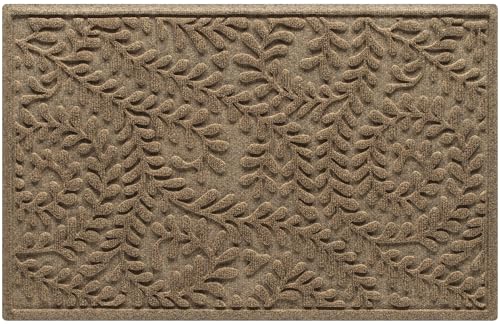 WaterHog Indoor/Outdoor Door Mat (Boxwood) The domestic version of the mat that has been in commercial lobbies for decades: published 3/8-inch construction, 24 oz per square yard PET, and made in the USA. | The commercial-grade option | 8.9/10 | $44.95 - View on Amazon #ad affiliate link · Price as of October 18, 2026 |
| 2 |  Gorilla Grip WeatherMAX Outdoor Doormat Natural rubber that is genuinely waterproof rather than water-resistant, which is the difference between a mat that drains and a mat that becomes a sponge in November. | Rain and outdoor use | 8.4/10 | |
| 3 |  Gorilla Grip SoakSTOPPER Indoor Doormat Dense chenille on a thermoplastic rubber backing that the maker says is third-party tested for repeated wash-and-dry cycles | The default indoor mat | 8.8/10 | $29.99 - View on Amazon #ad affiliate link · Price as of October 18, 2026 |
| 4 |  Kempf Large Rubber Boot Tray, 16 x 32 in Recycled rubber with raised edges and a ridged base, so boots sit above the meltwater instead of in it | Wet boots and snow melt | 8.6/10 | $24.95 - View on Amazon #ad affiliate link · Price as of October 18, 2026 |
| 5 |  OLANLY Low-Profile Indoor Door Mat The published 0.4-inch profile is the number that matters here: it is the mainstream absorbent mat most likely to actually clear an inward-opening door. | Tight door clearance | 8.3/10 | $9.99 - View on Amazon #ad affiliate link · Price as of October 18, 2026 |
| 6 |  Kempf 1-Inch Thick Natural Coco Coir Doormat Stiff coconut fiber at a published one-inch thickness Our skip-this pick | Scraping dried mud | 8.0/10 | $39.95 - View on Amazon #ad affiliate link · Price as of October 18, 2026 |
The commercial-grade option
WaterHog Indoor/Outdoor Door Mat (Boxwood)
The domestic version of the mat that has been in commercial lobbies for decades: published 3/8-inch construction, 24 oz per square yard PET, and made in the USA.
WaterHog is the mat you have already walked on hundreds of times without noticing - it is the standard entrance mat in commercial lobbies, and Bungalow Flooring sells domestic-sized versions of the same construction. Buying it is buying a specification rather than a look.
That specification is the most complete on this page. The Classic construction is published at three-eighths of an inch thick with a gripper backing, or closer to a quarter inch with the smooth backing intended for hard floors, using a 24 ounce per square yard PET fabric. Two numbers - thickness and fabric weight - are two more than most of this category publishes, and together they tell you almost everything: how much it holds, and whether your door will clear it.
The construction detail that matters is bi-level. The raised ridges hold the walking surface up while grit falls into the channels below, so the dirt you scrape off is not the dirt you then walk back over. That is why commercial buildings use it in the second zone of an entry system, and it works the same way at a domestic front door.
The honest downside is cleaning. This is not a mat you put in a washing machine. It hoses down well and it dries reasonably fast, but that is an outdoor job on a dry day rather than a laundry-day job. If the appeal of a mat for you is that it goes in the wash, buy chenille - see best absorbent chenille mats. If the appeal is that it will still be flat and still be working in five years, buy this.
What works
- Published thickness and published fabric weight - the most complete spec sheet here
- Bi-level construction traps grit below the walking surface instead of on it
- Beveled edges reduce the trip hazard and stop the corners curling
What does not
- Not machine washable - cleaning is a hose and a drying rack
- Costs meaningfully more than the chenille mats it sits beside
- Stiffer underfoot than an absorbent mat; it is built for traffic, not comfort
Rain and outdoor use
Gorilla Grip WeatherMAX Outdoor Doormat
Natural rubber that is genuinely waterproof rather than water-resistant, which is the difference between a mat that drains and a mat that becomes a sponge in November.
This mat has one job and it is not absorbency. It is a woven top bonded to a natural rubber backing, and the assembly sheds water rather than holding it. That sounds like a weakness until you have owned an absorbent outdoor mat through a wet November and discovered that what you actually own is a permanently saturated sponge that keeps the water at your threshold instead of away from it.
Outside the door, waterproof beats absorbent every time. Water needs to run off the mat and away; grit needs somewhere to fall out of the tread. Gorilla Grip builds this one with deep grooves, a beveled rubber border and what it calls a retention dam, then it cleans with a hose in thirty seconds - the cleaning method people will genuinely perform, unlike hauling a soaked outdoor mat into a washing machine.
Gorilla Grip also specifies stain and fade resistance, which matters more outdoors than most buyers expect. UV is what turns a black rubber mat chalky gray in a single summer, and a mat that has gone gray and stiff has usually also gone brittle around the edges.
The thing this mat cannot do is finish the job. It is stage one of a layered system - scrape outside, absorb inside. Pair it with a chenille mat immediately in from the door and you have the household version of what commercial buildings have used for decades. Buy it as the only mat and you will have clean boot treads and wet floors. Our coir versus chenille versus rubber comparison sets out which material belongs at which position.
What works
- Waterproof rather than absorbent - it never gets waterlogged and never needs drying
- Hoseable, which is the cleaning method most people will actually do
- Stain and fade resistant, so it does not go gray in a season of sun
What does not
- The woven top catches moisture but holds no useful volume - it still needs an absorbent mat inside
- One size per listing, so the 72x24in runner has to be bought separately
- Rubber goes stiff in hard frost
The default indoor mat
Gorilla Grip SoakSTOPPER Indoor Doormat
Dense chenille on a thermoplastic rubber backing that the maker says is third-party tested for repeated wash-and-dry cycles - the failure point that kills most washable mats.
This is the mat most households should start with, and the reason is the part nobody photographs: the backing. Gorilla Grip publishes a specific claim about it - a thermoplastic rubber backing that it says has been third-party tested to survive being washed and dried repeatedly, and it explicitly contrasts that with the PVC and hot-glue backings used elsewhere. That is the correct thing to make a claim about. A chenille mat's absorbency barely changes over its life; what changes is whether the backing is still flat and still gripping after the tenth wash.
The care label is strict and worth obeying literally: machine wash cold, tumble dry low, no bleach, no dry clean, and - the one people ignore - no fabric softener. Softener coats microfiber and is the single fastest way to turn an absorbent mat into a mat that pushes water around. If your household washes everything with a softener sheet in the drum, this mat will underperform and it will not be the mat's fault.
Size is the other reason it leads. Six sizes run from a 24 by 17 inch doormat up to a 70 by 24 inch runner, which means the same product can cover a single back door or the whole first three strides of a hallway. Walk-off distance is the variable that actually determines how much dirt gets stopped - the commercial matting industry sizes entry systems in feet of walk-off, not in mats - so being able to buy length matters more than most spec sheets suggest.
The catch is clearance. Gorilla Grip does not publish a pile height for this mat, and a dense chenille pile is not a low-profile pile. If it is going behind an inward-opening door with a standard half-inch to three-quarter-inch undercut, measure first - see our door clearance guide. The maker also states this is indoor only and specifically not recommended for concrete, which rules out the garage-door and unfinished-basement placements people often want it for.
What works
- Backing is the part the maker actually stakes a claim on - most mats fail there first
- OEKO-TEX Standard 100 tested for harmful substances
- Six sizes including a 70-inch runner, so one product covers a hallway
What does not
- No published pile height, which matters if your door clearance is tight
- Indoor only - the maker specifically warns against concrete
- Fabric softener will destroy the absorbency; the care label is strict
Wet boots and snow melt
Kempf Large Rubber Boot Tray, 16 x 32 in
Recycled rubber with raised edges and a ridged base, so boots sit above the meltwater instead of in it - the detail that separates a boot tray from a puddle.
The whole argument for a boot tray over a mat is containment: a mat spreads meltwater across its own surface and eventually onto your floor, while a tray holds it inside a raised edge until you tip it out. That is the entire product, and the Kempf tray does the two things that make it work.
First, the raised perimeter. Snow melt from two pairs of winter boots is a genuinely surprising volume of dirty water, and without an edge it goes onto the floor within an hour. Second, and more important, the ridged base. Boots sitting flat in their own meltwater do not dry - they sit in a shallow pool and stay wet until morning. Ridges hold the sole above the water line so the boot dries while the water pools below it.
Recycled rubber matters here for a reason people underrate: weight. Getting a wet boot off involves levering against it, and a light plastic tray slides across the floor and tips its contents out. A heavy rubber tray stays where you put it.
The honest limitation is capacity. Sixteen by thirty-two inches is two adult pairs, or one adult pair and two children's. A four-person household in a snow region needs two trays or a longer one - and this is exactly the point where a tray stops being enough and a bench with shoe storage starts being the better answer, because you also need somewhere to sit while the boots come off.
What works
- Ridged base is the feature that matters - boots dry instead of standing in their own melt
- Recycled rubber is heavy enough to stay put when a boot is levered off
- Genuinely multi-purpose, so it does not become clutter in summer
What does not
- 16 x 32 inches holds two adult pairs, not a family's worth
- Contained water has to be tipped out - it does not evaporate quickly in a cold hallway
- Rubber can mark a light-colored floor if grit gets underneath; sweep beneath it
Tight door clearance
OLANLY Low-Profile Indoor Door Mat
The published 0.4-inch profile is the number that matters here: it is the mainstream absorbent mat most likely to actually clear an inward-opening door.
Almost nobody in this category publishes a thickness. OLANLY does - 0.4 inches - and that single number is why this mat is on the list. A standard interior door is hung with roughly half an inch to three-quarters of an inch of clearance above the finished floor. At 0.4 inches, this mat fits under the common three-quarter-inch undercut comfortably and squeezes under a half-inch undercut. Most absorbent mats do not, and most of them will not tell you before you buy.
The trade is real and you should go in knowing it. A 0.4-inch woven surface cannot hold what a one-inch chenille pile holds. If a soaked retriever comes through your back door twice a day, this mat alone will not cope. What it does well is the job at the door swing: catch grit, take the first pass of water, and let the door close.
The surface is a grooved woven polyester rather than a plush chenille, and that changes the cleaning routine. Grooves hold sand and grit efficiently, which is the point, but it means shaking or vacuuming the mat is the maintenance that matters - not washing. Wash it when it looks dirty; shake it out weekly regardless.
The correct way to buy this mat is as one half of a pair. Put it at the swing where clearance is the constraint, and put a deep-pile mat like the Muddy Mat or a chenille absorber immediately past it, where clearance no longer applies. That is the household version of the three-zone entry system commercial buildings have used for decades, and it is explained in full in our layered entryway defense guide.
What works
- One of the few mats in this category that publishes a profile figure at all
- 0.4in clears a three-quarter-inch door undercut with room, and a half-inch undercut just barely
- Grooved surface traps grit rather than only absorbing water
What does not
- A shallow pile holds far less water than a 1-inch chenille mat - this is physics, not a defect
- Grooves need shaking out; they hold sand and grit well enough that it stays
- Works best paired with a deeper mat further inside, not as the only mat
Scraping dried mud
Kempf 1-Inch Thick Natural Coco Coir Doormat
Stiff coconut fiber at a published one-inch thickness - the best mechanical scraper on this list and, at that thickness, an outdoor-only mat by definition.
Skip this one
Skip coir at a snowy door - and this is the only page on this site where we say that about it. On a dry fall porch the Kempf is our favorite scraper, and stiff coconut fiber takes caked mud off a tread better than any fabric mat can. Winter attacks all three of its weaknesses at once. Coir is organic and holds water, so a mat that never gets a dry day stays saturated and eventually rots. Saturated fiber in a hard freeze is a rigid slab, and a rigid slab cannot flex under a boot, which is exactly how coir scrapes. And salt is the part you cannot fix: coir must never go in a washing machine, so the only way to rinse dissolved salt back out of it is to soak it, which puts you straight back at a saturated mat in a freeze. Keep the coir mat, move it under cover or into the garage for the season, and put something synthetic at the door until spring.
Coir is the only material on this site that removes dirt mechanically rather than by absorbing it. Coconut fiber is stiff enough to act as a brush, which is why it takes caked, dried mud off a boot tread when a soft chenille mat just gets muddy. If the problem at your door is solid rather than wet - garden soil, dried clay, gravel dust - this is the material.
Kempf is on this list specifically because it publishes thickness. The standard line is one inch; there is a two-inch line for heavy scraping. Nobody else in the coir category will tell you a number, and thickness is the single most consequential spec a mat has once you consider where it has to sit.
Which brings the hard limit: at one inch, this mat cannot go under a door. Not a tight door, not any door - a standard interior door is hung with half to three-quarters of an inch of clearance and this mat is thicker than the gap. Coir lives outside the door, on the step or the porch, where the door swings away from it. That is not a compromise; that is the correct position for a scraper in a layered system.
Two honest warnings. Coir sheds, heavily, for the first few weeks - you will sweep loose fiber and it does stop. And coir is organic: left in a fully exposed position that stays wet, it will hold water and eventually rot. A covered porch or an overhang roughly doubles its usable life. If your entry has no cover at all, a rubber scraper is the more durable choice - see coir versus chenille versus rubber.
What works
- Kempf publishes an actual thickness figure, which almost no coir brand does
- Stiff coir bristles remove dried and caked mud that fabric mats simply cannot
- Natural fiber, no plastic pile, and it composts at end of life
What does not
- Sheds coir fiber for the first few weeks - this is normal and it is still a mess
- A 1-inch mat cannot go under any standard door
- Coir holds water and rots in a fully exposed position - it wants a porch or overhang
How we picked
- Behavior in a freeze, not only in the wet. Every mat in this category is sold on how it handles water. Almost none of them say what happens at 20 degrees Fahrenheit, when the water in the fiber has turned solid. We weighted materials that stay flexible and shed meltwater over materials that hold it, because a mat that has frozen into a board has stopped being a mat.
- Whether the salt can get back out. Road salt does not evaporate. It dissolves, soaks into the mat with the meltwater, then dries and stays there as crystals that keep pulling moisture. That makes cleaning method a first-order winter spec: a machine-washable mat or a hoseable one can be flushed, and a mat that is neither will hold the season's salt until you throw it away.
- Drainage over absorbency at the outside position. Outdoors in winter, absorbency is a liability. A saturated outdoor mat in a freeze-thaw cycle is a block of ice by morning and a wet sponge by afternoon. We ranked waterproof, free-draining constructions above absorbent ones for anything living on the exposed side of the door.
- Published thickness, checked against a storm door as well as the main door. Winter entries frequently have two doors, and the storm door is the one that catches people out - it usually swings outward across the exact spot the outdoor mat wants to occupy. Mats that publish a thickness figure got credit for it; mats that publish nothing are marked unknown rather than assumed thin.
- Capacity for volume, not just for damp. A pair of boots off a slushy sidewalk carries far more water than a pair of shoes off a rainy one, and it arrives repeatedly through the day. We favored larger sizes, deeper walls, and constructions that hold grit below the walking surface rather than on it.
We have not physically tested these products. We do not own them, we have no lab, and we do not accept free product. Everything above is compiled from published manufacturer specifications, published care guidance and live retailer data - and we tell you which is which on every claim. How we pick.
Winter is a chemistry problem, not a water problem
Whatever is on your sidewalk in January is a salt chosen for a temperature. Plain rock salt is cheap and it is what most hardware stores sell, but it stops working well before the coldest nights of a northern winter, which is why colder regions reach for calcium or magnesium chloride instead. The Minnesota Stormwater Manual publishes the working range of each, and it is worth knowing which one is likely to be arriving at your door.
Lowest practical melting temperatures and eutectic temperatures for common deicers, per the Minnesota Stormwater Manual. The eutectic temperature is a laboratory figure; the practical figure is where the product still works on a real sidewalk.
The practical consequence for a mat is this. If your winters are mild enough that plain rock salt does the job, what arrives indoors is sodium chloride - abrasive, white when it dries, and rinsable with plain water. If your winters go below roughly 15 degrees Fahrenheit, the product on the ground is more likely to be calcium or magnesium chloride, and those behave differently once they are in your hallway.
Calcium chloride is strongly hygroscopic and in fact deliquescent: exposed to humid air it pulls in water and eventually dissolves into a solution of itself. That is the whole reason it works at low temperatures, and it is also why a mat that felt dry in the morning can feel damp again by evening with no new water having arrived. You are not imagining it and the mat has not failed. There is a salt in the fiber doing what that salt does, and the fix is to get the salt out - a cleaning problem, not a drying problem.
The steps up to the door freeze before the threshold does, because water sheets off the front edge of a tread rather than draining away. Best outdoor stair treads deals with that stage - published depth against a standard step, which tread covers the nose, and why adhesive is the first thing a freeze-thaw cycle lifts.
Why coir is the wrong mat at a snowy door
Coconut coir is the best mechanical scraper you can buy, and we recommend it without hesitation on outdoor coir doormats for a dry or covered position. Winter is the one season where we tell you to take it up.
Three things go wrong at once. Coir is an organic fiber that holds water and rots when it never gets a dry day, and a snowy porch offers no dry days for months. Saturated fiber in a hard freeze goes rigid, and rigidity is the end of scraping - coir works because stiff bristles flex and rake under a moving boot, not because the mat is hard. And coir cannot be machine washed, so once dissolved salt has soaked into the fiber there is no practical way to flush it out; the procedure in how to clean a coir doormat is shaking, beating and vacuuming, all of which move dry solids and none of which touch a dissolved salt.
None of that makes coir a bad product. It makes it a seasonal one. The right move is to keep the coir mat, store it somewhere dry over winter, and run a synthetic mat at the door from the first freeze until the thaw. A mat rotated out of the weather for four months lasts appreciably longer than one left to soak through them.
How the materials actually behave
Compiled from published manufacturer specifications and the physical properties of each fiber. This is the comparison the category does not publish, and it is the decision that determines whether the mat you buy works.
Full argument, with sources, in coir vs chenille vs rubber.
What stiffens in the cold and what keeps working
Cold changes material behavior in ways no product page discusses, because no product page wants to talk about the conditions in which its product is least impressive. Here is the honest version for each material on this page.
- Rubber stiffens. Every rubber mat gets harder and less pliable in hard frost, including the ones we recommend. It stays functional - a stiff rubber mat still sheds water and still holds grit in its pattern - but it will feel like a different product in February than it did in September, and a frozen rubber mat that is lifted and flexed hard can crack at the edge. Lift it carefully, or leave it down.
- Absorbent fiber freezes if you leave it outside. Chenille and microfiber are indoor materials. A saturated chenille mat left on an exposed step overnight in a freeze is a solid object by morning, and freeze-thaw cycling is hard on the backing bond. The absorbent mat belongs inside the door, which is where it does its best work anyway.
- Ribbed synthetic constructions are the winter compromise. A PET or polypropylene surface on a rubber base scrapes like a hard mat, holds a useful amount of water like a soft one, and drains rather than saturating. That is why the bi-level commercial constructions dominate the top of this list.
- Coir saturates and then locks up, for the reasons above. It is the one material we actively move indoors for the season.
- None of this substitutes for clearing the step. A mat sitting under two inches of packed snow is not doing anything at all. Shoveling and mat choice are not alternatives to each other.
The winter layout: three positions and a tray
The full reasoning behind zoning an entry is in layered entryway defense. Winter compresses it into a specific and slightly different arrangement, because you are handling more water, more grit and a chemical all at once.
- Outside the door: waterproof rubber. Its job is to take packed snow and grit off the tread and let the meltwater run away. Absorbency here is a liability rather than a feature. This is the WeatherMAX position.
- At the threshold: a ribbed synthetic that drains. This position takes the second pass, and it takes it from a boot that is already wet. Bi-level construction earns its keep here, because the grit falls into the channels instead of sitting on the surface you walk over next.
- Immediately inside: a washable absorbent mat. This is the mat that catches the meltwater the first two could not, and the critical word is washable. In winter this mat is holding salt as well as water, and if you cannot put it through a machine you cannot get the salt out of it.
- Beside the door: a tray with a raised wall. Boots come off and go into the tray. Everything still on them - meltwater, grit, dissolved salt - stays in one waterproof container that you tip out and wipe, rather than spreading across a walking surface. In a salt region this is the highest-value item on the page, which is why we argue it at length in boot trays for the entryway.
Published thickness vs the door gap
A standard interior door is hung with roughly 0.5 in to 0.75 in of clearance above the finished floor, and NFPA 80 caps a fire-rated door's undercut at 0.75 in. Every figure below is a manufacturer- or retailer-published specification. Nothing here is estimated, and “Not published” means the maker states no thickness at all.
Measure your own gap rather than trusting the range - flooring gets replaced and doors get rehung. A US quarter is about 0.069 in thick, so a stack of four is roughly 0.28 in. Full workings in low-profile mats and door clearance.
Storm doors change the clearance math
Our door clearance guide works from the standard interior undercut of roughly half an inch to three-quarters of an inch. Winter entries add a second door, and the storm door is the one that catches people out: it usually swings outward, across the exact area where the outdoor scraper mat wants to sit, and its bottom sweep sits closer to the threshold than an interior door does.
Measure the storm door's sweep height before buying an outdoor mat, not after. If the clearance is genuinely tight, the answer is not a thinner outdoor mat - a thin mat outdoors does very little in snow. The answer is to move the scraper off the threshold entirely, out to the step or the landing beyond the door swing, and let the ribbed synthetic mat take the threshold position where it does fit.
Getting road salt back out of a mat
This is the winter maintenance job nobody is told about, and it is the difference between a mat that lasts three winters and one that is stiff, white-streaked and finished by March. The general procedures are in how to clean a doormat; these are the winter-specific additions.
- Rinse before you wash, in cold water. Salt is dissolved into the mat, not sitting on top of it. A rinse flushes the bulk of it out before the mat goes anywhere near a machine, which means the wash is then dealing with dirt rather than brine.
- Cold water throughout, and no fabric softener. Softener coats microfiber and permanently reduces how much water it can take up - the most common way people quietly destroy an absorbent mat. Gorilla Grip's care label prohibits it explicitly.
- Wash more often than you think in winter. A mat holding salt is not merely dirty; it is damp on purpose. Washing every two weeks through the season beats monthly, and the mat you will realistically wash that often is the one to buy - the trade-off is argued in washable versus hoseable mats.
- Hose rubber and synthetic mats on both faces, on a day above freezing, and stand them on edge to drain. Salt collects under a mat as well as in it.
- Tip and wipe the tray weekly. Brine left standing in a tray for a month will mark whatever the tray is sitting on if any of it creeps over the wall. Wiping it out is a thirty-second job.
Buy before the first freeze, not after it
There is a practical reason to sort this out in the fall rather than in January. Winter entry gear is seasonal stock: sizes and colors that are available in October are frequently unavailable by the time you actually want them, and the large boot trays in particular tend to sell through. More importantly, the setup only works if it is in place before the first bad arrival. A mat bought in response to a hallway full of salt is a mat that arrives after the floor has already had a month of it.
If you buy only one thing from this page and your winters involve salted sidewalks, buy the tray rather than the mat. Every product here manages water. Only the tray contains salt, and salt is the input that damages things. The rest of the sequence, for a household starting from nothing, is set out in how to keep dirt out of the house.
Mats are one stage of a winter entry rather than the whole of it. The arrangement around them - tray capacity, somewhere for coats and gloves to dry, and which outdoor surface to swap in for the season - is in winter entryway setup.
Everything on this page is a passive mat, which means it manages snow that has already arrived. The active alternative is a heated mat that melts it off the step first, and it changes the arithmetic on a stair that ices over rather than simply getting wet. The published melt rates, amp draws and the one maker that states a low-temperature limit are in best snow melting mats.
What we did not do
We did not stand any of these mats outside through a freeze, put a thermometer in one, or measure how much brine a given fiber releases in a wash. We do not own them. The deicer temperatures above are published figures from the Minnesota Stormwater Manual, the deliquescent behavior of calcium chloride is standard published chemistry, and every mat specification is manufacturer-published and cited on the product it belongs to. Where a maker publishes no figure - and in this category most publish no thickness at all - we say so rather than estimating one. The freezing and stiffening behavior described above is material physics rather than a tested claim, and we have flagged it as such where it matters. The full method is on how we pick.
Questions people ask
What is the best door mat for snow and salt?
Is a coir doormat good for snow?
Does road salt ruin door mats?
How do I stop salt getting on my floors in winter?
Can I leave a mat outside all winter?
How thick can an outdoor winter mat be?
Sources
- Minnesota Stormwater Manual - lowest practical melting temperature and eutectic temperature by deicing chemical
- ScienceDirect topic overview - calcium chloride hygroscopic and deliquescent behavior in humid air
- WaterHog Classic specifications - American Floor Mats (3/8in thickness, 24 oz/sq yd PET, bi-level construction)
- Gorilla Grip - WeatherMAX waterproof natural rubber doormat product page
- Gorilla Grip - indoor doormat care instructions including the fabric softener prohibition
- Kempf 1in coco coir doormat - Amazon detail page (thickness, fiber, woven backing)
Next stage
Stage 3: contain
Salt is the one winter input a mat cannot solve. A mat spreads it across a surface you then walk on; a tray with a raised wall holds it in one wipeable place until you deal with it.
Keep goingAbout the author
Scooter M.
An enthusiast who is genuinely into this. I read the manuals, compile the published specs, and do the math on door clearances. No lab coat, no test bench, and nothing here is a product I have used - which is exactly why every claim carries a source.
Published by Slate Mill Group, with the Mud & Mat team. Published September 2, 2026; last updated September 2, 2026. Editorial policy.
Read next

Start Here
How to keep dirt out of the house
The whole entry as a procedure rather than a shopping list - what to change first and why.

Best Boot Tray
Best boot trays for entryways
Wall depth, a ridged base and enough weight to stay put - the three things that separate a tray from a puddle.
Hardwood Guide
Mats for hardwood floors
Standing water and trapped grit - the two ways a mat damages the floor it was bought to protect.

Best Outdoor Mat
Best outdoor coir doormats
Stiff coir scrapes what fabric cannot - but it is organic, so where you put it decides how long it lasts.