
By Scooter M. · Last updated September 6, 2026
Mud & Mat earns a commission when you buy through the links on this page, at no extra cost to you. It does not change what we recommend, and we publish a skip-this verdict on products we could otherwise earn from. Full disclosure.
A winter entry needs three things the rest of the year does not: more containment capacity, more drying capacity, and a stage outside that works when it is frozen. The mats do not need to be better - the arrangement needs to be bigger. Plan on roughly double the tray capacity you use in summer, somewhere that wet coats and gloves can hang with air around them, and a rubber or synthetic scraping surface outside rather than an absorbent one.
The reason winter defeats entryways is not that winter mess is worse. It is that winter mess arrives in a different form and in a different quantity. In July a person brings in dust on the soles of one pair of shoes. In January the same person brings in snow packed into a lug tread, salt crystals, a wet coat, a hat, gloves, and a second pair of footwear they change into - and they stop in the doorway to deal with all of it.
That is a volume problem and a dwell-time problem rather than a mat problem, which is why buying a better doormat in November so rarely fixes it. This page is about the arrangement. If you want the surfaces themselves compared for cold-weather behavior, that is best door mats for snow and salt.
What actually changes in winter
- Water arrives as a solid and melts indoors. Snow packed in a tread does not shed at the door - it comes inside, warms up, and releases its water four minutes later wherever the boot is standing. That is why containment matters more than absorbency in winter.
- Everything takes longer. Coats, gloves, hats and a second pair of shoes turn a two-second transit into a two-minute stop, in the doorway, with the door open.
- Deicer comes with the water. Road salt and calcium chloride arrive on the sole, dry into a white residue on floors, and are hard on both mats and finishes.
- Nothing dries on its own. Cold air holds less moisture and entries have poor airflow, so a mat that recovered overnight in September stays wet for days in January.
- Outdoor surfaces freeze. An absorbent outdoor mat becomes a frozen board; a rubber one goes stiff but keeps working.
Stage 1 - outside, and it must not absorb
The outdoor position is where winter breaks the usual advice. For most of the year we recommend coir outside for anything exposed, because stiff coconut fiber is the best mechanical scraper you can buy cheaply. In a wet freeze it is the wrong material: it takes up water, freezes solid, and a frozen coir mat is a rigid slab with an ice film on top that scrapes nothing at all.
For the winter months the outdoor surface wants to be rubber or a synthetic bi-level construction that sheds water instead of holding it. Both go stiff in hard frost - that is unavoidable physics rather than a product defect - but stiff is not the same as frozen solid, and both keep their surface geometry, which is what does the scraping.
If your outdoor position is genuinely under cover and never gets rained into, coir survives the winter fine. The reversal applies to exposed positions, which is most of them.
There is a powered version of this stage that most winter guides skip. A heated mat sits on the step and melts the snow before anybody stands on it, which is the only way to stop the material at stage 1 rather than scrape it at stage 2. It is a hundred to three hundred dollars and it needs an outdoor outlet, so it is not the default - but on a flight of steps that ices over every year it is the layer that stops being optional. Best snow melting mats compares them on published melt rate and power draw.
Stage 2 - the threshold, and the deicer problem
Immediately at the door, the job is to take the packed material off the tread before it comes inside and melts. This is where a bi-level mat earns its keep: ridges carry the walking surface while the grit, salt and snow fall into the channels below, so what comes off does not get walked back over.
It is also the position that takes the deicer punishment. Salt residue dries white, it is abrasive, and it is what puts the chalky bloom on an entry floor by February. A hoseable mat at this position is worth more than an absorbent one because you can genuinely rinse the salt out of it on the first mild day rather than accumulating it all season.
Stage 3 - inside, where the melt actually happens
This is the stage most households underbuild. The snow that came in on the tread melts inside, in the first few feet of hallway, several minutes after the person has moved on. A mat that is sized for footfall - one stride, one wipe - is not sized for a small volume of meltwater released in one place while nobody is standing there.
The answer is area and depth: a genuinely absorbent mat, as large as the space and the washing machine allow, immediately inside the door. And the recommendation we make on every page of this site applies double in winter - buy two and rotate, because in January a single mat never gets a dry day.
Quick picks
Ranked against the criteria below. Tap a row to jump to the full write-up; the price button goes straight to Amazon.
| # | Product | Best for | Score | Price |
|---|---|---|---|---|
| 1 | 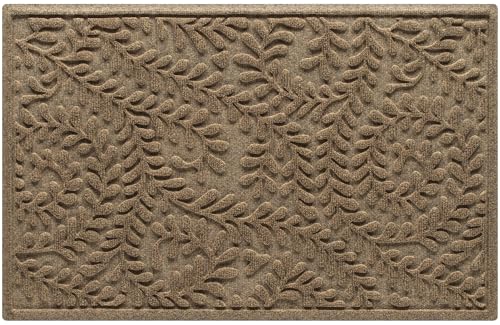 WaterHog Indoor/Outdoor Door Mat (Boxwood) The domestic version of the mat that has been in commercial lobbies for decades: published 3/8-inch construction, 24 oz per square yard PET, and made in the USA. | The commercial-grade option | 8.9/10 | $44.95 - View on Amazon #ad affiliate link · Price as of October 19, 2026 |
| 2 |  Gorilla Grip SoakSTOPPER Indoor Doormat Dense chenille on a thermoplastic rubber backing that the maker says is third-party tested for repeated wash-and-dry cycles | The default indoor mat | 8.8/10 | $29.99 - View on Amazon #ad affiliate link · Price as of October 19, 2026 |
| 3 |  Matace Extra Large Rubber Boot Tray, 55 x 16 in Fifty-five inches of recyclable rubber with a published 1.18-inch raised edge | A whole household's boots in one line | 8.7/10 | $35.99 - View on Amazon #ad affiliate link · Price as of October 19, 2026 |
| 4 |  VASAGLE Hall Tree with Bench and Shoe Cabinet (7 Double Hooks) A published 300-pound bench rating with a closed shoe cabinet underneath and adjustable shelves inside it | The highest published load rating | 8.8/10 | |
| 5 |  Kempf 1-Inch Thick Natural Coco Coir Doormat Stiff coconut fiber at a published one-inch thickness Our skip-this pick | Scraping dried mud | 8.0/10 | $39.95 - View on Amazon #ad affiliate link · Price as of October 19, 2026 |
The commercial-grade option
WaterHog Indoor/Outdoor Door Mat (Boxwood)
The domestic version of the mat that has been in commercial lobbies for decades: published 3/8-inch construction, 24 oz per square yard PET, and made in the USA.
WaterHog is the mat you have already walked on hundreds of times without noticing - it is the standard entrance mat in commercial lobbies, and Bungalow Flooring sells domestic-sized versions of the same construction. Buying it is buying a specification rather than a look.
That specification is the most complete on this page. The Classic construction is published at three-eighths of an inch thick with a gripper backing, or closer to a quarter inch with the smooth backing intended for hard floors, using a 24 ounce per square yard PET fabric. Two numbers - thickness and fabric weight - are two more than most of this category publishes, and together they tell you almost everything: how much it holds, and whether your door will clear it.
The construction detail that matters is bi-level. The raised ridges hold the walking surface up while grit falls into the channels below, so the dirt you scrape off is not the dirt you then walk back over. That is why commercial buildings use it in the second zone of an entry system, and it works the same way at a domestic front door.
The honest downside is cleaning. This is not a mat you put in a washing machine. It hoses down well and it dries reasonably fast, but that is an outdoor job on a dry day rather than a laundry-day job. If the appeal of a mat for you is that it goes in the wash, buy chenille - see best absorbent chenille mats. If the appeal is that it will still be flat and still be working in five years, buy this.
What works
- Published thickness and published fabric weight - the most complete spec sheet here
- Bi-level construction traps grit below the walking surface instead of on it
- Beveled edges reduce the trip hazard and stop the corners curling
What does not
- Not machine washable - cleaning is a hose and a drying rack
- Costs meaningfully more than the chenille mats it sits beside
- Stiffer underfoot than an absorbent mat; it is built for traffic, not comfort
The default indoor mat
Gorilla Grip SoakSTOPPER Indoor Doormat
Dense chenille on a thermoplastic rubber backing that the maker says is third-party tested for repeated wash-and-dry cycles - the failure point that kills most washable mats.
This is the mat most households should start with, and the reason is the part nobody photographs: the backing. Gorilla Grip publishes a specific claim about it - a thermoplastic rubber backing that it says has been third-party tested to survive being washed and dried repeatedly, and it explicitly contrasts that with the PVC and hot-glue backings used elsewhere. That is the correct thing to make a claim about. A chenille mat's absorbency barely changes over its life; what changes is whether the backing is still flat and still gripping after the tenth wash.
The care label is strict and worth obeying literally: machine wash cold, tumble dry low, no bleach, no dry clean, and - the one people ignore - no fabric softener. Softener coats microfiber and is the single fastest way to turn an absorbent mat into a mat that pushes water around. If your household washes everything with a softener sheet in the drum, this mat will underperform and it will not be the mat's fault.
Size is the other reason it leads. Six sizes run from a 24 by 17 inch doormat up to a 70 by 24 inch runner, which means the same product can cover a single back door or the whole first three strides of a hallway. Walk-off distance is the variable that actually determines how much dirt gets stopped - the commercial matting industry sizes entry systems in feet of walk-off, not in mats - so being able to buy length matters more than most spec sheets suggest.
The catch is clearance. Gorilla Grip does not publish a pile height for this mat, and a dense chenille pile is not a low-profile pile. If it is going behind an inward-opening door with a standard half-inch to three-quarter-inch undercut, measure first - see our door clearance guide. The maker also states this is indoor only and specifically not recommended for concrete, which rules out the garage-door and unfinished-basement placements people often want it for.
What works
- Backing is the part the maker actually stakes a claim on - most mats fail there first
- OEKO-TEX Standard 100 tested for harmful substances
- Six sizes including a 70-inch runner, so one product covers a hallway
What does not
- No published pile height, which matters if your door clearance is tight
- Indoor only - the maker specifically warns against concrete
- Fabric softener will destroy the absorbency; the care label is strict
A whole household's boots in one line
Matace Extra Large Rubber Boot Tray, 55 x 16 in
Fifty-five inches of recyclable rubber with a published 1.18-inch raised edge - the tray that stops the overflow problem by simply being longer than the pile of boots.
The failure mode of a boot tray is not the tray. It is that a household has more wet footwear than the tray has room for, so the fifth pair goes on the floor beside it and the whole point is lost. The fix is boring and it is length: a tray long enough to take everything that comes through the door on a wet evening.
Fifty-five by sixteen inches is that tray. It runs along a wall, it takes three or four adult pairs in a line rather than stacked, and each pair sits flat where it can drain. The same line is sold at 40 by 16 and 29.5 by 15.7 inches if the wall is shorter, and in multi-packs if you want one at the back door as well.
The published edge height is 1.18 inches, and that is the number to weigh against the alternatives. It is enough to contain the runoff from a normal wet day and it is less than the two-inch-plus walls on the deeper trays - so if you are dealing with genuine snowmelt from packed boots, a shorter tray with a taller wall may hold more water than this one does, even though it looks smaller.
Material is recyclable rubber rather than the thin polypropylene used on cheaper trays, which matters at this size: a long plastic tray flexes when you pick it up loaded, and cracks at the corners eventually. The trade is weight. A 55-inch rubber tray full of boots is a two-hand job to carry outside, so most people will tip it and wipe it rather than hose it. Pair it with a mat at the door - a tray contains, it does not dry.
What works
- Length is the specification that actually solves a family entry - three or four pairs in a line
- Published edge height, which is the figure that decides whether meltwater stays in the tray
- Rubber rather than thin plastic, so it does not go brittle or crack at the corners
What does not
- Fifty-five inches needs a wall to run along - it will not fit a small entry
- A shallow 1.18-inch edge holds less than a deep-walled tray of the same footprint
- Rubber this size is heavy and awkward to carry out to be hosed
The highest published load rating
VASAGLE Hall Tree with Bench and Shoe Cabinet (7 Double Hooks)
A published 300-pound bench rating with a closed shoe cabinet underneath and adjustable shelves inside it - the most capable hall tree we compiled, and the only one over 275 lb.
A hall tree is three products welded into one purchase - a bench, a coat rack and a shoe store - and the one specification that decides whether it works is the bench rating. Sitting down is what a bench is for; sitting down is also the single behavior that most reliably gets wet boots off at the door instead of in the hallway. This one publishes 300 pounds, which is the highest figure in this set.
The storage underneath is a closed cabinet rather than an open rack, with shelves that adjust to three heights and lift out completely. That last detail is the one to notice: a fixed-shelf cabinet is a cabinet that will not take an ankle boot, and removing a shelf turns two useless short compartments into one usable tall one. The maker states up to 12 pairs.
Seven double hooks is the hanging provision, and it is enough for a household - a double hook takes a coat and a bag rather than a coat or a bag. The frame is steel with particleboard panels, which is the standard construction at this price and is genuinely strong in compression.
Two honest limits. It is 13.8 inches deep, and in a hallway under about 40 inches wide that is a real loss - measure before you buy, and consider the narrow options if the number does not work. And a closed cabinet traps damp: wet boots want a tray in the open air for a night before they go behind a door, or the cabinet becomes the reason your hall smells.
What works
- 300 lb is the highest published bench rating in this set, and the spec a bench lives or dies on
- Shelves adjust to three heights and come out entirely, so tall boots actually fit
- Closed cabinet hides the shoes, which is the whole reason people buy a hall tree over a rack
What does not
- 13.8 inches deep - a genuine loss of hallway width in a narrow entry
- Particleboard: strong in compression, unforgiving if it ever gets soaked
- A closed cabinet holds damp - wet boots need to dry before they go in it
Scraping dried mud
Kempf 1-Inch Thick Natural Coco Coir Doormat
Stiff coconut fiber at a published one-inch thickness - the best mechanical scraper on this list and, at that thickness, an outdoor-only mat by definition.
Skip this one
Skip coir as your winter outdoor mat, which is the one seasonal reversal on this site - it is our usual first recommendation for an exposed position and it is the wrong material for a wet freeze. Coir is an organic fiber that takes up water, and a saturated coir mat in a hard frost becomes a stiff board that scrapes nothing and holds a sheet of ice on its surface. It also rots faster in a position that never gets a dry day. Move it under cover for the winter if you have somewhere, or swap to rubber for the season and put the coir back in April.
Coir is the only material on this site that removes dirt mechanically rather than by absorbing it. Coconut fiber is stiff enough to act as a brush, which is why it takes caked, dried mud off a boot tread when a soft chenille mat just gets muddy. If the problem at your door is solid rather than wet - garden soil, dried clay, gravel dust - this is the material.
Kempf is on this list specifically because it publishes thickness. The standard line is one inch; there is a two-inch line for heavy scraping. Nobody else in the coir category will tell you a number, and thickness is the single most consequential spec a mat has once you consider where it has to sit.
Which brings the hard limit: at one inch, this mat cannot go under a door. Not a tight door, not any door - a standard interior door is hung with half to three-quarters of an inch of clearance and this mat is thicker than the gap. Coir lives outside the door, on the step or the porch, where the door swings away from it. That is not a compromise; that is the correct position for a scraper in a layered system.
Two honest warnings. Coir sheds, heavily, for the first few weeks - you will sweep loose fiber and it does stop. And coir is organic: left in a fully exposed position that stays wet, it will hold water and eventually rot. A covered porch or an overhang roughly doubles its usable life. If your entry has no cover at all, a rubber scraper is the more durable choice - see coir versus chenille versus rubber.
What works
- Kempf publishes an actual thickness figure, which almost no coir brand does
- Stiff coir bristles remove dried and caked mud that fabric mats simply cannot
- Natural fiber, no plastic pile, and it composts at end of life
What does not
- Sheds coir fiber for the first few weeks - this is normal and it is still a mess
- A 1-inch mat cannot go under any standard door
- Coir holds water and rots in a fully exposed position - it wants a porch or overhang
Stage 4 - containment, and the doubling rule
Boot trays are a year-round item that changes size in winter. In summer, a tray holds one or two pairs of muddy shoes. In winter it holds every pair that came through the door, each carrying packed snow, all melting at once - and it holds them for hours rather than minutes, because nobody is putting wet boots away.
Plan on roughly double your summer capacity. In practice that usually means one long tray rather than a small one, sited along a wall out of the walking line, with a ridged or lattice base so the boots drain rather than stand in their own meltwater. Our large tray roundup works through length versus wall depth, which is the real decision here: length for a household with lots of boots, wall depth for packed snow.
The stage nobody plans: drying
Winter adds an entire category of wet objects that has no summer equivalent - coats, hats, gloves, scarves, snow pants - and most entries have nowhere for them to go except a hook, where they hang in a bunched mass that does not dry. By February that is a smell and a pile of gloves that are permanently damp.
Two things fix it, and neither is expensive. A hanging rod rather than hooks, so coats hang on hangers in their own shape with air on both sides. And a warm-ish spot with airflow for the small items - a shelf above a radiator, a rack, or simply a basket that is emptied rather than a heap that is added to. A hall tree with a rod and a top shelf does both jobs on one wall, which is why the storage stage matters more in winter than at any other time of year.
Wet boots are the exception: they should not go into a closed cabinet at all. No airflow means a boot put away wet stays wet and the cabinet takes on the smell. Boots dry on the tray in the open, and get put away later.
If that has already happened - a season of boots put away damp, and now the smell belongs to the boots rather than the weather - drying alone will not undo it. Best shoe deodorizers covers what does, and is clear about which products absorb moisture, which break down odor already in the lining, and which simply add a scent on top.
Build it in October
The practical point of this page is timing. Every part of this arrangement is cheap and available in October, and by the first freeze the useful sizes of tray and mat are the ones that have sold out. More importantly, an arrangement that arrives in December is an arrangement nobody has a habit around - and entryway systems work on habit rather than on equipment.
- Swap the outdoor mat to rubber or a bi-level synthetic, and move the coir under cover.
- Check the threshold mat is one you can hose, so the salt has somewhere to go.
- Size up the indoor absorbent mat, and buy the second one now so rotation is possible.
- Double the tray capacity, sited out of the walking line with a draining base.
- Add hanging and drying for coats and small items - a rod beats hooks, and airflow beats warmth.
One purchase changes the winter arrangement more than any other, and it is not a mat: boots that go out again the next morning have to be dry by then, and in a cold entry they will not be. Best boot dryers compares forced air against silent convection on the makers' own published wattages and turnaround windows.
What this does not fix
Salt on floors still needs mopping, and it needs mopping with plain water rather than left to dry - the chalky bloom is residue rather than damage, but on a wood floor repeated wetting is a genuine problem in its own right. What comes off a mat is also not the same as what came off the boot: no arrangement removes everything, and the target is to intercept most of it in a place that is easy to clean.
And no mat dries a boot. Containment and drying are different jobs, and a tray does the first only. If your household genuinely needs boots dry by morning, that is a job for airflow and time rather than for anything on this page.
For a household building an entry from scratch rather than adapting one for the season, entryway starter kit covers the same equipment in purchase order, with what each item costs you in corridor width.
If the arrangement includes a dryer, the quiet one needs a corner rather than a closet. Our PEET Original review covers its 9.5 by 9.5 inch footprint at 22 inches tall, what 36 watts costs if you genuinely leave it on all winter, and why boots over 11 inches need attachments that are sold separately.
Questions people ask
What do I need for a winter entryway?
Is coir a good winter doormat?
Why is my hallway wet even though I have a doormat?
How big should a winter boot tray be?
Can I keep wet winter boots in a shoe cabinet?
When should I set up a winter entryway?
Sources
- WaterHog Boxwood - Amazon detail page (bi-level construction, indoor/outdoor use, hose-and-air-dry care)
- Gorilla Grip SoakSTOPPER - published sizes, TPR backing and care label
- Matace Extra Large Boot Tray - Amazon detail page (published 55 x 16 x 1.18in, recyclable rubber)
- VASAGLE Hall Tree - Amazon detail page (300 lb bench rating, closed cabinet with adjustable shelves)
Next stage
The mats themselves
Which surfaces cope with deicer and freeze, and what road salt actually does to a mat.
Keep goingAbout the author
Scooter M.
An enthusiast who is genuinely into this. I read the manuals, compile the published specs, and do the math on door clearances. No lab coat, no test bench, and nothing here is a product I have used - which is exactly why every claim carries a source.
Published by Slate Mill Group, with the Mud & Mat team. Published September 6, 2026; last updated September 6, 2026. Editorial policy.
Read next

Winter & Salt
Best door mats for snow and salt
Six picks ranked for slush, freeze and road salt - including the popular mat we would not put at a snowy door.
The System
Layered entryway defense
Scrape, absorb, contain, store - the four stages, and what each one can and cannot do.

Drop-Zone Setup
Entryway drop zone setup
The physical arrangement that makes the sequence take five seconds instead of thirty.
Best Large Tray
Best large boot trays
Length versus wall depth, on published dimensions - the two things a big tray can buy, and the one that suits your mess.

Worth It Or Not
Are boot dryers worth it?
Who a boot dryer genuinely pays for, who should buy a tray and a newspaper instead, and what it costs to run.