By Scooter M. · Last updated August 31, 2026
Mud & Mat earns a commission when you buy through the links on this page, at no extra cost to you. It does not change what we recommend, and we publish a skip-this verdict on products we could otherwise earn from. Full disclosure.
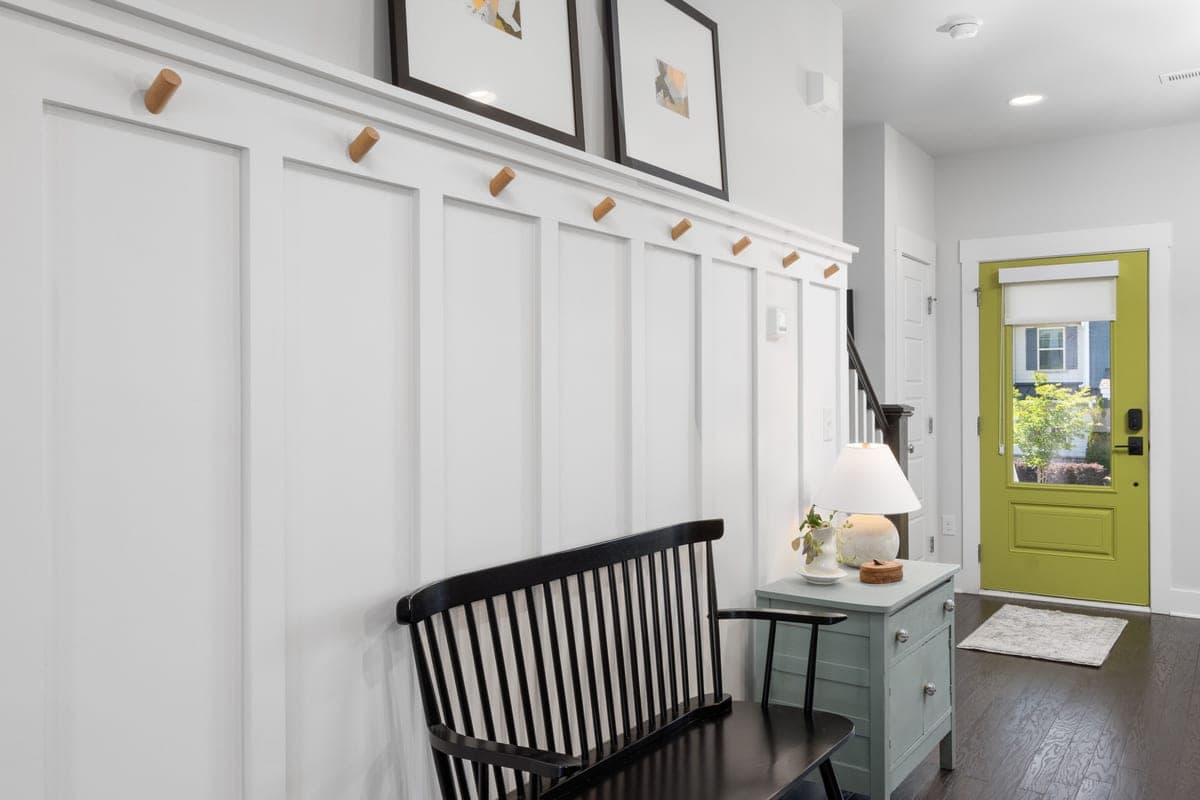
A working entryway drop zone puts a mat in the walking line, a boot tray against the wall beside the door, a seat next to the tray, and storage a step further in - in that order along the wall. The arrangement matters more than the products, because the whole thing only works if arriving, sitting, removing boots and putting them down takes under five seconds. If any step requires walking somewhere else, that step gets skipped and the pile comes back.
Every drop zone that fails, fails for the same reason: the components are all present and they are in the wrong places relative to each other. The bench is across the hall from the tray, so boots come off at the bench and end up on the floor. The storage is around a corner, so nothing gets put away.
The sequence you are designing for
- Door opens. Somebody steps onto the mat and takes two or three strides across it.
- They turn and sit on the seat, which is within arm's reach of where they stopped.
- Boots come off and go straight into the tray, without standing up.
- Coat goes on the hook above the seat, reachable while seated or on standing.
- Later, dry shoes move to storage a step further in.
Read that back and notice there is no walking between steps two and four. That is the design requirement. Every foot of separation between the seat and the tray is a foot of wet floor.
The wall order
Arrange along one wall, in the direction of travel: mat in the walking line, tray against the wall, seat beside the tray, storage past the seat. The mat is the only component that belongs where people step; everything else is off the walking line.
That last point matters for a practical reason. A boot tray with a two-inch lip across a threshold is a genuine trip hazard, especially for anyone carrying something. Against the wall, it is a parking spot.
Quick picks
Ranked against the criteria below. Tap a row to jump to the full write-up; the price button goes straight to Amazon.
| # | Product | Best for | Score | Price |
|---|---|---|---|---|
| 1 |  SONGMICS Cushioned Shoe Storage Bench Rated to 350 lb with a padded seat | The highest load rating | 8.1/10 | $49.99 - View on Amazon #ad affiliate link · Price as of October 18, 2026 |
| 2 |  Kempf Large Rubber Boot Tray, 16 x 32 in Recycled rubber with raised edges and a ridged base, so boots sit above the meltwater instead of in it | Wet boots and snow melt | 8.6/10 | $24.95 - View on Amazon #ad affiliate link · Price as of October 18, 2026 |
| 3 |  VASAGLE HAINS Narrow Shoe Storage Cabinet 9.4 inches deep and rated for 14 to 16 pairs, with a published anti-tip kit in the box | Narrow hallways | 8.3/10 | $85.99 - View on Amazon #ad affiliate link · Price as of October 18, 2026 |
| 4 |  Gorilla Grip SoakSTOPPER Indoor Doormat Dense chenille on a thermoplastic rubber backing that the maker says is third-party tested for repeated wash-and-dry cycles | The default indoor mat | 8.8/10 | $29.99 - View on Amazon #ad affiliate link · Price as of October 18, 2026 |
The highest load rating
SONGMICS Cushioned Shoe Storage Bench
Rated to 350 lb with a padded seat - the version people actually sit on, and the one to buy if the bench is meant to change how your household takes shoes off.
If the bamboo bench is the durable answer, this is the behavioral one. A padded seat gets used. A hard bamboo slat gets stepped past, and a bench nobody sits on does not change anything about how boots come off in your hallway.
The published rating is 350 pounds static, which is the highest here and comfortably enough for an adult dropping onto it rather than lowering carefully. That is the realistic use case - somebody comes in wet, sits down heavily, and levers a boot off. A bench that flexes under that will not be used twice.
The metal frame is the right choice for a damp entry in the same way bamboo is: it does not swell. The upholstery, though, is the honest weak point. Fabric in the direct splash zone of a back door gets wet, stays wet, and eventually smells. Put this bench a step back from the threshold, on the dry side of your door mat, not in the puddle.
It stores shoes on an open shelf rather than hiding them, so it solves the sitting-down problem and the where-do-boots-live problem but not the visual one. If your entry is also your hallway and you want the shoes out of sight, buy a narrow shoe cabinet and a separate seat, or accept the open shelf.
What works
- 350 lb is the highest published rating in this comparison
- A padded seat is used; a hard slat seat is stepped over
- Metal frame does not swell in a damp hallway the way board does
What does not
- Upholstery in a wet entryway will get wet - this wants a spot that stays dry
- Open shelf, so no concealment
- One size, so it either fits your wall or it does not
Wet boots and snow melt
Kempf Large Rubber Boot Tray, 16 x 32 in
Recycled rubber with raised edges and a ridged base, so boots sit above the meltwater instead of in it - the detail that separates a boot tray from a puddle.
The whole argument for a boot tray over a mat is containment: a mat spreads meltwater across its own surface and eventually onto your floor, while a tray holds it inside a raised edge until you tip it out. That is the entire product, and the Kempf tray does the two things that make it work.
First, the raised perimeter. Snow melt from two pairs of winter boots is a genuinely surprising volume of dirty water, and without an edge it goes onto the floor within an hour. Second, and more important, the ridged base. Boots sitting flat in their own meltwater do not dry - they sit in a shallow pool and stay wet until morning. Ridges hold the sole above the water line so the boot dries while the water pools below it.
Recycled rubber matters here for a reason people underrate: weight. Getting a wet boot off involves levering against it, and a light plastic tray slides across the floor and tips its contents out. A heavy rubber tray stays where you put it.
The honest limitation is capacity. Sixteen by thirty-two inches is two adult pairs, or one adult pair and two children's. A four-person household in a snow region needs two trays or a longer one - and this is exactly the point where a tray stops being enough and a bench with shoe storage starts being the better answer, because you also need somewhere to sit while the boots come off.
What works
- Ridged base is the feature that matters - boots dry instead of standing in their own melt
- Recycled rubber is heavy enough to stay put when a boot is levered off
- Genuinely multi-purpose, so it does not become clutter in summer
What does not
- 16 x 32 inches holds two adult pairs, not a family's worth
- Contained water has to be tipped out - it does not evaporate quickly in a cold hallway
- Rubber can mark a light-colored floor if grit gets underneath; sweep beneath it
Narrow hallways
VASAGLE HAINS Narrow Shoe Storage Cabinet
9.4 inches deep and rated for 14 to 16 pairs, with a published anti-tip kit in the box - the cabinet for a hallway that cannot spare a foot of floor.
Depth is the specification that decides whether entryway furniture is possible at all. A hallway you can still walk down with a cabinet in it is usually a hallway with under twelve inches to spare, and most shoe furniture is fifteen or more. At 9.4 inches, this cabinet fits where the alternatives simply do not.
The flip-drawer mechanism is how it gets there: shoes sit at an angle inside a shallow panel that tips forward, rather than sitting flat on a deep shelf. That geometry is also the limitation, and VASAGLE is upfront about it - fourteen to sixteen pairs up to about a US 11. Boots do not fit. Winter boots really do not fit. If boots are the problem you are solving, this is the wrong product and an open bench or a boot tray is the right one.
Two published numbers deserve attention because most makers omit them: a 15 pound maximum top load and 11 pounds per interior shelf. That top figure rules out the obvious use - dumping a bag of shopping or a heavy plant on it - and it is worth knowing before rather than after. The included anti-tip wall-mount kit is a genuine plus on a forty-inch-tall, nine-inch-deep cabinet; that footprint is tippy by geometry, and having the hardware in the box makes it likely you will actually fit it.
The real trade with any closed cabinet is moisture. Sealing a wet shoe into a cupboard is how a hallway starts smelling. Closed storage is for dry shoes; wet ones need a tray or an open shelf first. That sequence - contain, dry, then store - is the whole logic of our layered defense guide.
What works
- 9.4 inches deep is genuinely narrow - it fits hallways that reject normal furniture
- Publishes both capacity and load limits, including per-shelf
- Anti-tip kit is included rather than sold separately, which for a 40-inch-tall cabinet matters
What does not
- Flip drawers are shallow - boots and high-tops do not fit, only shoes up to about US 11
- 15 lb top load means it is not a place to put a heavy plant or a bag of shopping
- Closed storage traps damp - wet shoes should dry before they go in
The default indoor mat
Gorilla Grip SoakSTOPPER Indoor Doormat
Dense chenille on a thermoplastic rubber backing that the maker says is third-party tested for repeated wash-and-dry cycles - the failure point that kills most washable mats.
This is the mat most households should start with, and the reason is the part nobody photographs: the backing. Gorilla Grip publishes a specific claim about it - a thermoplastic rubber backing that it says has been third-party tested to survive being washed and dried repeatedly, and it explicitly contrasts that with the PVC and hot-glue backings used elsewhere. That is the correct thing to make a claim about. A chenille mat's absorbency barely changes over its life; what changes is whether the backing is still flat and still gripping after the tenth wash.
The care label is strict and worth obeying literally: machine wash cold, tumble dry low, no bleach, no dry clean, and - the one people ignore - no fabric softener. Softener coats microfiber and is the single fastest way to turn an absorbent mat into a mat that pushes water around. If your household washes everything with a softener sheet in the drum, this mat will underperform and it will not be the mat's fault.
Size is the other reason it leads. Six sizes run from a 24 by 17 inch doormat up to a 70 by 24 inch runner, which means the same product can cover a single back door or the whole first three strides of a hallway. Walk-off distance is the variable that actually determines how much dirt gets stopped - the commercial matting industry sizes entry systems in feet of walk-off, not in mats - so being able to buy length matters more than most spec sheets suggest.
The catch is clearance. Gorilla Grip does not publish a pile height for this mat, and a dense chenille pile is not a low-profile pile. If it is going behind an inward-opening door with a standard half-inch to three-quarter-inch undercut, measure first - see our door clearance guide. The maker also states this is indoor only and specifically not recommended for concrete, which rules out the garage-door and unfinished-basement placements people often want it for.
What works
- Backing is the part the maker actually stakes a claim on - most mats fail there first
- OEKO-TEX Standard 100 tested for harmful substances
- Six sizes including a 70-inch runner, so one product covers a hallway
What does not
- No published pile height, which matters if your door clearance is tight
- Indoor only - the maker specifically warns against concrete
- Fabric softener will destroy the absorbency; the care label is strict
The pieces, and what each has to be
The mat
Long rather than wide, because walk-off distance is what stops dirt and width mostly adds wash weight. Thin enough for the door gap if it sits in the swing - see door clearance - or as deep as you like if it sits past it.
The tray
Wall depth for containment, and a ridged base so the boots dry rather than standing in their own meltwater. Sized for the number of pairs that actually come off at that door on a wet day, not on an average day.
The seat
The highest-leverage item and the one people cut. Boots come off standing up when there is nowhere to sit, and a boot removed while hopping lands wherever. Insist on a published static load rating - it is the specification that separates a bench from a shoe rack with a flat top.
The storage
Open if shoes arrive damp, because only open shelving dries them. Closed if the shoes are dry and the visible pile is what bothers you. Depth is the constraint in a hallway, and under twelve inches is what keeps it walkable.
The small things that decide whether it gets used
- Hooks at the right height, including a low one for children. A coat hook a child cannot reach is a coat on the floor.
- A surface for keys and mail within reach of the seat. Otherwise those land on the stairs. Note the load limit if it is the top of a narrow cabinet - 15 lb is typical and it is less than a bag of shopping.
- Light you can turn on before you are all the way in. People do not perform a four-step sequence in the dark.
- A basket for the things that do not have a home. Every entry has these, and a designated container is what stops them colonizing the bench.
- Nothing that has to be opened one-handed while holding shopping. If a lid or a door is in the sequence, the sequence breaks.
If the drop zone is a dedicated mudroom rather than a corner of a hall, the mat choice changes with it - best mudroom mats covers what a room-sized position needs. And the whole arrangement has a seasonal version worth building before the first freeze: winter entryway setup.
One object is missing from most drop zones and it is the one carrying the most concentrated water in the house: the umbrella. A stand without a removable tray collects that water at floor level and keeps it, which is a ring on a wood floor by February - best umbrella stands covers which ones publish a tray and which do not.
One more object belongs in a working drop zone and it costs almost nothing: something to get the boots off with. Where the household wears work boots or waders, a boot jack by the door removes the reason people walk through to a chair - which is the single most common way a drop zone gets bypassed.
If your entry is a hallway
Most are, and the constraint becomes depth rather than layout. Under twelve inches keeps a hall walkable, which rules out most conventional shoe furniture and points at narrow flip-drawer cabinets and short racks that fit under a window sill or a coat rail.
In a genuinely tight hall, prioritize ruthlessly: mat, tray, hooks. Skip the seat if there is no room for one and accept that boots will come off standing - or put a small stool that lives elsewhere and comes out in winter. A workable three-piece arrangement beats an aspirational four-piece one that does not fit.
Hooks are the item of the three that is easiest to get wrong in a way that matters for wet coats: the hook count on a listing is not how many coats hang properly, because each hook usually gets less wall than a winter coat is wide. Best entryway coat racks works out the width per hook from published figures, and covers the two-rail approach that puts a second row where a child can reach it.
The one-slot-per-person principle works for shoes as well as hooks. Best shoe cubby benches applies it to the seat itself, and ranks the benches on published load, cubby size and whether a shelf adjusts for boots.
Questions people ask
What is an entryway drop zone?
What order should entryway pieces go in?
What is the most important part of a drop zone?
How do you set up a drop zone in a narrow hallway?
Should the storage be open or closed?
Sources
About the author
Scooter M.
An enthusiast who is genuinely into this. I read the manuals, compile the published specs, and do the math on door clearances. No lab coat, no test bench, and nothing here is a product I have used - which is exactly why every claim carries a source.
Published by Slate Mill Group, with the Mud & Mat team. Published August 31, 2026; last updated August 31, 2026. Editorial policy.
Read next
The System
Layered entryway defense
Scrape, absorb, contain, store - the four stages, and what each one can and cannot do.
Best Storage Bench
Best shoe storage benches
Published load ratings, wet tolerance and depth - and the bench that publishes no load rating at all.
Best Boot Tray
Best boot trays for entryways
Wall depth, a ridged base and enough weight to stay put - the three things that separate a tray from a puddle.
Storage Decision
Bench vs cabinet vs rack
Behavior, concealment or capacity - pick the one your entry actually lacks.