By Scooter M. · Last updated September 13, 2026
Mud & Mat earns a commission when you buy through the links on this page, at no extra cost to you. It does not change what we recommend, and we publish a skip-this verdict on products we could otherwise earn from. Full disclosure.
Buy a stand with a removable drip tray, and treat every other feature as secondary. A wet umbrella carries several tablespoons of water; a stand without a tray collects that in a sealed base you would have to lift and upend to empty, which nobody does. Two of the four stands here publish a detachable or removable tray. The other two publish a footprint, a finish and nothing about the water.
This is a small purchase and an easy one to get wrong, because the category is sold on appearance. Umbrella stands are photographed in bright hallways next to a dry umbrella, and the product being sold is a tidy corner. The product you actually need is a container that catches water and lets you throw it away.
It belongs on this site for the same reason boot trays do. Water arriving at a door and finding its way onto a floor is the entire problem this site exists to solve - and an umbrella is a device engineered to deliver water to your threshold in the most concentrated form possible.
How we picked
How we picked
- A published removable or detachable tray, first and by a wide margin. It is the difference between emptying a stand and mopping around it. A molded-in base means the water stays until it evaporates, and a cool hallway evaporates slowly.
- Published footprint, read against a corridor. These are small objects in the tightest part of a house. Square stands sit flush to a wall and into corners; round ones leave two crescents of dead floor. Both matter more than the styling.
- Height against the umbrellas you own. A full-length umbrella in a 16-inch tube leans, and a leaning umbrella drips down the outside of the stand rather than into it.
- Provision for folding umbrellas. Half of modern umbrellas fold. Dropped into a tube they lie in the bottom, in whatever water the long ones have shed. Hooks solve this and most stands do not have them.
- Mass, because a stand that tips empties onto the floor. A light stand catches a coat sleeve or a dog and goes over, taking the collected water with it. Published weight is a genuine specification here.
We have not physically tested these products. We do not own them, we have no lab, and we do not accept free product. Everything above is compiled from published manufacturer specifications, published care guidance and live retailer data - and we tell you which is which on every claim. How we pick.
How much water is actually involved
More than people expect, and that is why this matters. A full-size umbrella shaken once at the door and stood in a corner will keep releasing water for an hour - the canopy holds it in the folds, and it runs down the ribs to the tip. Two or three umbrellas after a school run is a small puddle, reliably, in the same spot.
In the same spot is the important part. Repeated wetting of one patch is what damages a floor: a wood board cups and the finish clouds, laminate swells at the joint, and an unsealed tile grout line darkens permanently. It is the same mechanism we describe in mats for hardwood floors, delivered by a different object.
A stand with a tray turns that from a floor problem into a weekly task. A stand without one just holds the water at floor level in a metal tube, which is marginally better than the umbrella standing in the corner on its own.
Published figures only. Not published means the listing states nothing of that kind.
Quick picks
Ranked against the criteria below. Tap a row to jump to the full write-up; the price button goes straight to Amazon.
| # | Product | Best for | Score | Price |
|---|---|---|---|---|
| 1 |  SONGMICS Round Umbrella Stand with Drip Tray A detachable plastic drip tray and four hooks on a 6.7-inch steel footprint | The tray that actually comes out | 9.0/10 | $31.99 - View on Amazon #ad affiliate link · Price as of October 18, 2026 |
| 2 | 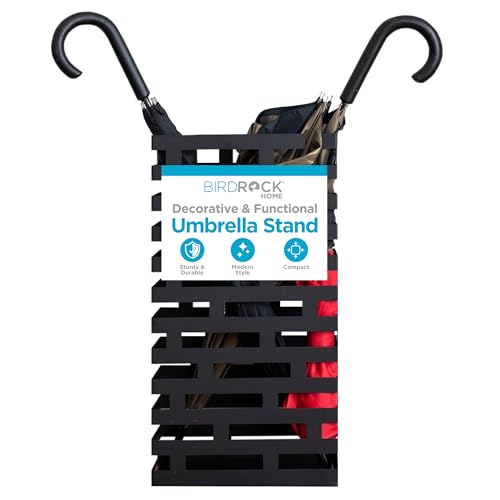 BIRDROCK HOME Umbrella Stand with Removable Water Tray Eight pounds of iron, 22.9 inches tall, with a removable water tray | Long umbrellas and walking sticks | 8.6/10 | $57.67 - View on Amazon #ad affiliate link · Price as of October 18, 2026 |
| 3 |  Hiceeden Square Metal Umbrella Stand The same 6.3-inch square footprint as the budget tube, with the maker stating it is heavy enough not to tip | Weight in a small square | 6.6/10 | $23.99 - View on Amazon #ad affiliate link · Price as of October 18, 2026 |
| 4 |  Okllen Square Metal Umbrella Holder A 6.3-inch square metal tube that sits flush to a wall and costs the least here Our skip-this pick | A corner, cheaply | 6.4/10 | $21.59 - View on Amazon #ad affiliate link · Price as of October 18, 2026 |
The tray that actually comes out
SONGMICS Round Umbrella Stand with Drip Tray
A detachable plastic drip tray and four hooks on a 6.7-inch steel footprint - the only stand here that solves both halves of the problem, holding the umbrella and then getting rid of the water.
An umbrella stand is a water-containment product that happens to look like decor, and most of the market sells the decor half. A wet umbrella carries a surprising amount of water - enough to leave a ring on a wood floor overnight - and the only question that matters is where that water goes.
This one answers it properly: the drip tray is detachable. That sounds minor and it is the whole difference in ownership. A stand with a molded-in base collects water you then have to tip the entire unit to empty, which nobody does, so it sits there and eventually smells. A tray that lifts out gets carried to a sink.
The four hooks solve the second problem, which is that half of modern umbrellas are folding ones. A folding umbrella dropped into a tube lies in the bottom of it, soaking, in the water everything else has shed. Hung on a hook it drips into the tray and dries.
The limits are height and material. At 16.1 inches this is sized for standard umbrellas rather than full-length golf ones, which will lean rather than stand. And the tray is plastic in a steel body, so it is the component that will eventually crack - though a cracked tray is a cheaper failure than a rusted base.
What works
- The tray detaches, which is the difference between emptying it and mopping around it
- Four hooks take folding umbrellas that would otherwise lie in the bottom
- A 6.7-inch square of floor is about as little as an entryway object can ask for
What does not
- 16.1 inches tall is short for a full-length golf umbrella
- A plastic tray in a steel body is the part that will crack first
- Round means it does not sit flush to a wall the way a square stand does
Long umbrellas and walking sticks
BIRDROCK HOME Umbrella Stand with Removable Water Tray
Eight pounds of iron, 22.9 inches tall, with a removable water tray - the stand for full-length umbrellas and the households where things get knocked.
The tall stand solves a problem the compact ones cannot: a full-length umbrella in a 16-inch tube leans, and a leaning umbrella either falls out or drips down the outside of the stand onto the floor. At 22.9 inches this one holds a standard long umbrella upright with the tip in the tray where it belongs.
Mass is the second argument. Eight pounds of iron stays where it is put. Light stands get knocked by a coat sleeve, a bag or a dog, and an umbrella stand that tips is a stand that empties its contents - including the water - across the hall. If the entry is busy, weight is a feature.
The removable water tray is the specification we would not buy without, and BIRDROCK publishes it. Same logic as every other stand here: water that cannot be poured away is water that stays.
Two honest costs. Nearly twelve inches of depth is real floor for a product whose entire job is holding sticks, which in a narrow hall is hard to justify - the corridor arithmetic applies here as much as it does to shoe storage. And iron in a permanently damp spot depends on its coating; chip it and you have a rust source sitting in a tray of water.
What works
- Nearly 23 inches tall, so a full-length umbrella stands rather than leans
- Eight pounds of iron does not get knocked over by a coat or a dog
- Explicitly sold for canes and walking sticks, which a narrow tube will not hold upright
What does not
- 11.9 inches of depth is a lot for an object that holds umbrellas
- Eight pounds is deliberate mass - it is not a thing you move to vacuum
- Iron in a wet position wants its finish intact; a chip is where rust starts
Weight in a small square
Hiceeden Square Metal Umbrella Stand
The same 6.3-inch square footprint as the budget tube, with the maker stating it is heavy enough not to tip - and, like it, no published drip tray.
This is the budget square tube with one specification the other one lacks: the maker states it is heavy enough not to tip. In an entry where people move fast with bags, that is not a trivial difference - a light stand full of umbrellas goes over the first time somebody catches it with a coat.
It is sold for offices, hotels and shops as well as houses, which is a reasonable proxy for build quality in a category where almost nothing is published. Commercial-facing listings tend to mean thicker gauge metal, because the alternative is replacing them.
The problem is identical to its rival's, though. There is no drip tray in the published specification, which means a wet umbrella drains into the bottom of a sealed metal tube and waits there. Heavier construction makes that worse rather than better - now the object you have to lift and tip over a sink weighs more.
Our position across this page is consistent: the tray is the product. If the umbrellas are dry when they go in, both square tubes are decent, cheap and space-efficient. If they are wet, buy a stand that publishes a removable tray, and put a mat under whatever you end up with.
What works
- Stated heavy enough to resist tipping, which the lighter tubes are not
- Same wall-flush square footprint as the cheapest option
- Sold for offices and shops as well as homes, so it is built for traffic
What does not
- No drip tray published - the same water problem as the other budget tube
- No hooks for folding umbrellas
- Weight without a tray just means a heavier thing to tip out over a sink
A corner, cheaply
Okllen Square Metal Umbrella Holder
A 6.3-inch square metal tube that sits flush to a wall and costs the least here - and publishes nothing at all about what happens to the water.
Skip this one
Skip this one if the umbrellas going into it are actually wet, which is the only reason to own an umbrella stand. It is well-shaped for a corner and it is the cheapest thing here, but the listing publishes no drip tray at all - and a stand with no removable tray does not contain water, it relocates it to the bottom of a metal tube standing on your floor. That is a ring on a wood floor and a smell by February. Buy it as a dry-storage tube for a porch or a garage. For an entry where dripping umbrellas arrive, buy one of the two stands that publish a tray.
The square format is genuinely better than round for a small entry. A round stand touches a wall at one point and leaves two useless crescents of floor either side of it; a square one sits flush, or tucks into a corner and disappears. At 6.3 inches a side this is the smallest object on the page.
It is also the cheapest, and in this category cheap usually means one specific omission. Here it is the tray. The listing describes the construction, the size and the finish color, and says nothing about where water goes - which in a hollow metal tube means it pools in the bottom and stays there.
That matters more than it sounds. A wet umbrella is not damp, it is carrying tablespoons of water, and a tube with no drain and no removable tray collects that until it evaporates - slowly, in a cool hallway, which is how an entryway acquires a smell nobody can locate.
Bought for the right job it is fine. A porch, a garage, a hallway where the umbrellas arrive folded and dry in a bag - it is a tidy, cheap, wall-flush tube. Bought as rain management, it is the wrong product, and the two stands here that publish a removable tray cost very little more.
What works
- Square sides sit flush against a wall or into a corner, unlike a round stand
- A 6.3-inch square is the smallest footprint on this page
- Cheapest way to stop umbrellas living on the floor
What does not
- No drip tray is published, so the water has nowhere to go but the base and then the floor
- No hooks, so folding umbrellas lie in whatever has collected at the bottom
- Nothing published about the finish, which is the spec that decides whether it rusts
Round or square
Square wins in a small entry and it is not close. A square stand sits flush against a wall along its whole side, or tucks into a corner and effectively disappears. A round stand of the same capacity touches the wall at one point and leaves two crescents of floor that are too small to use and large enough to trip over.
Round has one genuine advantage: nothing to line up. In a wide hallway where the stand sits out in the open rather than against something, a round profile reads better and has no corner to catch a shin.
In practice the decision is usually made for you by where the stand has to go. If it is going into a corner, buy square. If it is going beside a console table in a hall you would describe as spacious, the shape is a preference rather than a constraint.
The folding umbrella problem
Umbrella stands were designed for full-length umbrellas: a tube, a tip in the bottom, a handle at the top. Folding umbrellas break that completely. Dropped into the same tube, a folded umbrella disappears to the bottom and sits in whatever water the long ones have shed - which means it never dries, and the next time it is opened it smells.
Hooks fix it, and almost nothing in this category has them. A folding umbrella hung by its strap drips into the tray and dries in open air. One stand here publishes four hooks; the rest publish none, which for a household that mostly carries compact umbrellas makes them close to useless.
Closed in the stand, or open to dry?
The received wisdom is to open an umbrella and stand it to dry, and for a canopy that is correct - air reaches the folds and the whole thing dries in an hour rather than a day. The problem is that an open umbrella occupies about four square feet of the one room in the house with no spare floor, and it drips over all of it rather than into a tray.
The workable compromise in a normal hallway is to shake the umbrella hard outside the door before it comes in, stand it closed but unstrapped in a stand with a tray, and open it properly only after a genuine soaking - over a bath or outside under cover, not in the hall. An unstrapped umbrella in a stand dries considerably faster than a strapped one, because the folds are not clamped shut against themselves.
That is also the argument for hooks over a tube for folding umbrellas. Hung by the strap, a compact umbrella hangs open-ended and drains; dropped into a tube it is compressed into its own wet folds at the bottom of the stand, which is where the smell comes from.
Where it goes, and what else it holds
Beside the door, on the handle side, out of the swing arc. A stand inside the arc gets shunted every time somebody comes in, which grinds grit into the floor under it and eventually tips it. The same door-arc check that decides tray placement applies here.
Worth knowing: the taller, heavier stands are also the ones that hold walking sticks and canes upright, which a short narrow tube will not - it lets them lean and slide. If anyone in the household uses a stick, that quietly becomes the deciding specification, and the 22.9-inch iron stand here is the one sold for it.
Buy it this way
- Insist on a published removable tray. Without it you are buying a tube that holds water at floor level.
- Square for a corner, round for open floor - and check the footprint against the pinch point of the hall.
- Full-length umbrellas need 20 inches or more of height or they lean and drip down the outside.
- Folding umbrellas need hooks. In a tube they sit in the water and stay wet.
- Weight is a feature in a busy entry - a light stand that tips empties its water across the floor.
Questions people ask
Do umbrella stands need a drip tray?
What size umbrella stand do I need?
Where should an umbrella stand go?
How do you store folding umbrellas?
Will an umbrella stand damage my floor?
Are metal umbrella stands prone to rust?
Sources
- SONGMICS Round Umbrella Stand - Amazon detail page (6.7 x 6.7 x 16.1in, alloy steel, rust-resistant painted finish, detachable plastic drip tray, 4 hooks)
- BIRDROCK HOME Umbrella Stand - Amazon detail page (11.9 x 5.9 x 22.9in, iron, 8 lb, removable water tray, stated for umbrellas, canes and walking sticks)
- Hiceeden Square Umbrella Stand - Amazon detail page (6.3 x 6.3 x 16.5in, metal, stated heavy enough not to tip; no drip tray published)
- Okllen Square Umbrella Holder - Amazon detail page (6.3 x 6.3 x 16.5in, metal hollow design; no drip tray published)
Next stage
And a mat under it
Whatever the stand misses lands on the floor. That floor wants covering.
Keep goingAbout the author
Scooter M.
An enthusiast who is genuinely into this. I read the manuals, compile the published specs, and do the math on door clearances. No lab coat, no test bench, and nothing here is a product I have used - which is exactly why every claim carries a source.
Published by Slate Mill Group, with the Mud & Mat team. Published September 13, 2026; last updated September 13, 2026. Editorial policy.
Read next
Drop-Zone Setup
Entryway drop zone setup
The physical arrangement that makes the sequence take five seconds instead of thirty.

Best for Small Spaces
Best small-space shoe storage
Published depths from 9.4 inches, pairs per square foot of floor, and why vertical beats clever in a tight entry.
Best Indoor Mat
Best indoor entryway mats for mud and water
Six indoor mats ranked on absorbency, wash durability and whether your door will actually clear them.
Hardwood Guide
Mats for hardwood floors
Standing water and trapped grit - the two ways a mat damages the floor it was bought to protect.