By Scooter M. · Last updated September 6, 2026
Mud & Mat earns a commission when you buy through the links on this page, at no extra cost to you. It does not change what we recommend, and we publish a skip-this verdict on products we could otherwise earn from. Full disclosure.
In a small entry, buy on published depth and then on vertical capacity. Depth is what you are short of - a 9.4-inch cabinet and a 16-inch one hold similar numbers of shoes and cost you completely different amounts of corridor. Height is nearly free, because nobody walks through the air above your shoes. The best small-space storage is therefore the shallowest unit that goes highest, not the smallest object you can find.
The way small-space storage is usually shopped is by looking for small furniture. That is the wrong axis. A small entry is not short of volume; it is short of one specific dimension - the distance from the wall into the room - and everything else is available in quantities you are not using.
Once you see it that way the shortlist changes completely. A 73-inch-tall rack that projects 12.6 inches is small-space storage. A neat 20-inch-tall bench that projects 16 inches is not, however compact it looks in the photograph.
How we picked
How we picked
- Published depth, treated as the primary spec. Every unit here is ranked first on how far it projects from the wall, because that is the number that decides whether the room still works. Where two units cost the same corridor width, the one that stores more in the height above it wins - and a unit that publishes no footprint at all is marked unbuyable for this position rather than merely unranked.
- Pairs per square foot of floor, not pairs. A cabinet holding 24 pairs is not better than one holding 15 if it takes twice the floor. We work in what the unit costs you in floor area against what it gives back.
- Vertical capability. Height is the free dimension in a small entry. We weight units that go up over units that spread out, and we say where a wall fixing or an anti-tip kit becomes mandatory as a result.
- Whether wet footwear can live in it. Small entries are usually the whole entry, so the same unit has to cope with today's wet boots. Closed cabinets trap damp; open racks dry. We flag which is which rather than treating concealment as a pure win.
- Assembly and reversibility. In a rented flat, a unit that can be moved, split or wall-fixed without damage is worth more than one that cannot. We note where a maker publishes a modular or detachable design.
We have not physically tested these products. We do not own them, we have no lab, and we do not accept free product. Everything above is compiled from published manufacturer specifications, published care guidance and live retailer data - and we tell you which is which on every claim. How we pick.
Published depths, and what each costs you
Published footprints. Remaining corridor is arithmetic against a 36in hallway.
The spread here is only about three inches between the shallowest and the deepest unit that publishes a figure, which does not sound like much until you put it against a corridor. Three inches is the difference between two people passing and one person turning sideways, and in a flat entrance hall it is often the difference between a unit that gets used and one that gets resented.
Quick picks
Ranked against the criteria below. Tap a row to jump to the full write-up; the price button goes straight to Amazon.
| # | Product | Best for | Score | Price |
|---|---|---|---|---|
| 1 |  VASAGLE HAINS Narrow Shoe Storage Cabinet 9.4 inches deep and rated for 14 to 16 pairs, with a published anti-tip kit in the box | Narrow hallways | 8.3/10 | $85.99 - View on Amazon #ad affiliate link · Price as of October 18, 2026 |
| 2 | 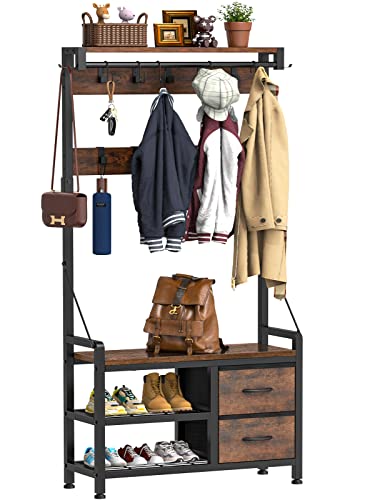 Lulive 5-in-1 Hall Tree with Bench and Drawers Published at 11.8 inches deep with a 275-pound bench and 17 hooks, and it splits into a bench plus a separate wall rack | The shallowest footprint | 8.5/10 | |
| 3 |  Simple Houseware 3-Tier Shoe Rack 11.2 x 26.8 x 20.9 inches, nine to sixteen pairs, a metal frame and nothing else | The cheapest thing that works | 7.6/10 | $21.87 - View on Amazon #ad affiliate link · Price as of October 18, 2026 |
| 4 |  VASAGLE 10-Tier Shoe Rack Organizer Thirty pairs from a 24.8-inch wall run at 12.6 inches deep | Sheer volume | 7.9/10 | $119.99 - View on Amazon #ad affiliate link · Price as of October 18, 2026 |
| 5 |  SONGMICS Cushioned Shoe Storage Bench Rated to 350 lb with a padded seat Our skip-this pick | The highest load rating | 8.1/10 | $49.99 - View on Amazon #ad affiliate link · Price as of October 18, 2026 |
Narrow hallways
VASAGLE HAINS Narrow Shoe Storage Cabinet
9.4 inches deep and rated for 14 to 16 pairs, with a published anti-tip kit in the box - the cabinet for a hallway that cannot spare a foot of floor.
Depth is the specification that decides whether entryway furniture is possible at all. A hallway you can still walk down with a cabinet in it is usually a hallway with under twelve inches to spare, and most shoe furniture is fifteen or more. At 9.4 inches, this cabinet fits where the alternatives simply do not.
The flip-drawer mechanism is how it gets there: shoes sit at an angle inside a shallow panel that tips forward, rather than sitting flat on a deep shelf. That geometry is also the limitation, and VASAGLE is upfront about it - fourteen to sixteen pairs up to about a US 11. Boots do not fit. Winter boots really do not fit. If boots are the problem you are solving, this is the wrong product and an open bench or a boot tray is the right one.
Two published numbers deserve attention because most makers omit them: a 15 pound maximum top load and 11 pounds per interior shelf. That top figure rules out the obvious use - dumping a bag of shopping or a heavy plant on it - and it is worth knowing before rather than after. The included anti-tip wall-mount kit is a genuine plus on a forty-inch-tall, nine-inch-deep cabinet; that footprint is tippy by geometry, and having the hardware in the box makes it likely you will actually fit it.
The real trade with any closed cabinet is moisture. Sealing a wet shoe into a cupboard is how a hallway starts smelling. Closed storage is for dry shoes; wet ones need a tray or an open shelf first. That sequence - contain, dry, then store - is the whole logic of our layered defense guide.
What works
- 9.4 inches deep is genuinely narrow - it fits hallways that reject normal furniture
- Publishes both capacity and load limits, including per-shelf
- Anti-tip kit is included rather than sold separately, which for a 40-inch-tall cabinet matters
What does not
- Flip drawers are shallow - boots and high-tops do not fit, only shoes up to about US 11
- 15 lb top load means it is not a place to put a heavy plant or a bag of shopping
- Closed storage traps damp - wet shoes should dry before they go in
The shallowest footprint
Lulive 5-in-1 Hall Tree with Bench and Drawers
Published at 11.8 inches deep with a 275-pound bench and 17 hooks, and it splits into a bench plus a separate wall rack - the one that fits a hallway the others do not.
Depth is the constraint that rules hall trees out of most real hallways, and this is the one that answers it. Published at 11.8 inches deep, it is two full inches shallower than the rest of this set - which does not sound like much until you are trying to get a pushchair past it. In a 36-inch hall, two inches is the difference between a squeeze and a corridor.
It does not pay for that with strength. The published bench rating is 275 pounds, second only to the 300-pound model and well above the cheaper open-shelf units. The frame is metal with engineered wood panels and the whole thing weighs 24.2 pounds, which is light enough for one person to position and heavy enough not to walk around.
The unusual feature is that it comes apart. The two-tier structure detaches into a bench and a wall rack, so if the entry arrangement changes - or you move - the same purchase becomes two separate pieces rather than one awkward one. Two anti-tipping straps and four adjustable foot pads are supplied, and on a 70-inch unit you should use them.
The honest trade is capacity. Two shoe shelves at 11.8 inches deep will take flat shoes comfortably and let a large boot overhang, and there is no concealment at all - this is open storage. Seventeen hooks is also more of a suggestion than a load rating: hanging seventeen wet coats on a light frame is not what the number 275 refers to. For a household that needs to hide the shoes, the closed-door options are the other direction.
What works
- 11.8 inches deep - two full inches shallower than the rest, which is the difference in a tight hall
- 275 lb published bench rating despite the shallow footprint
- Splits into a bench and a wall-mounted rack, so it can adapt to a different room later
What does not
- Seventeen hooks on a 31.5-inch frame is more hanging points than the structure invites you to load
- Open shoe shelves - no concealment at all
- Shallow depth means a large boot overhangs the shelf front
The cheapest thing that works
Simple Houseware 3-Tier Shoe Rack
11.2 x 26.8 x 20.9 inches, nine to sixteen pairs, a metal frame and nothing else - the honest minimum, and often all a small entry actually needs.
There is a version of this problem that does not need furniture, and this is the product for it. A metal frame, three tiers, nine to sixteen pairs depending on what you own, and a published footprint of 11.2 by 26.8 by 20.9 inches. It costs a fraction of the cabinets above and in a small entry it is frequently sufficient.
The height is quietly its best feature. At under twenty-one inches it slides beneath a window sill, beneath a wall-mounted coat rail, or under a console table - the places in an entryway that are otherwise dead space. Tall storage buys capacity; short storage buys the ability to put it somewhere.
Metal and open means it tolerates a wet hallway indefinitely. Nothing swells, nothing traps damp, and a hose or a wipe is the whole maintenance routine. That is a real advantage over anything made of engineered wood in the splash zone of a back door.
Two honest limits. Wire shelves let narrow children's shoes tip and fall through, which is irritating daily rather than occasionally - the grid variant handles that better. And the top is not a seat: it is not rated, it is not padded, and it will bend. If you want somewhere to sit while boots come off, that is a bench, and it is a genuinely different product.
What works
- Cheap enough to be a non-decision, and it does the basic job properly
- Under 21 inches tall, so it fits under a window or a coat rail
- Metal and open, so damp shoes dry and nothing swells
What does not
- Wire shelves let small shoes tip through - not ideal for children's shoes
- The flat top is not a seat and is not rated as one
- No concealment at all
Sheer volume
VASAGLE 10-Tier Shoe Rack Organizer
Thirty pairs from a 24.8-inch wall run at 12.6 inches deep - open shelving that goes up instead of out, with everything on display as the price.
If the constraint is simply that there are too many shoes and not enough floor, this is the arithmetic answer. Thirty pairs, 24.8 inches of wall, 12.6 inches of depth. Per pair stored it is comfortably the cheapest thing in this comparison and nothing else is close.
Open shelving has one genuine functional advantage over every cabinet here, and it is the one this site cares about: air. A damp shoe on an open shelf dries. The same shoe in a closed flip-drawer cabinet stays damp, and a hallway full of damp shoes in a closed cupboard is where entryway smells come from. If your household comes home wet regularly, open shelving is not a compromise - it is the correct choice.
The height is the thing to think about honestly before buying. At 73.6 inches the top two tiers are above eye level for most people and above reach for some. In practice those tiers become long-term storage - the shoes you wear twice a year - rather than daily slots. That is fine if you plan for it and annoying if you do not.
And it hides nothing. Thirty pairs of shoes on ten open shelves is thirty pairs of shoes you can see from the front door. If the reason you are shopping is that the hallway looks chaotic, this will organize the chaos without concealing it, and a flip-drawer cabinet is the product that actually addresses what is bothering you.
What works
- Thirty pairs from under 25 inches of wall is the highest raw capacity here
- Open shelves let damp shoes dry, unlike any closed cabinet
- Cheapest per pair stored of anything in this comparison
What does not
- Over six feet tall - top tiers are out of reach for many people
- Everything is visible; this is a storage solution, not a tidiness solution
- Tall and light means wall anchoring is mandatory, not advisory
The highest load rating
SONGMICS Cushioned Shoe Storage Bench
Rated to 350 lb with a padded seat - the version people actually sit on, and the one to buy if the bench is meant to change how your household takes shoes off.
Skip this one
Skip this one for a small entry, and it is a trade-off rather than a fault. It publishes the highest static load rating on this site at 350 pounds, and a genuinely modest footprint - 12.6 inches deep by 23.6 inches wide - so it is not the depth that rules it out. It is what you get back for that floor. At 16.9 inches tall it is a seat with one open shelf under it, which is three or four pairs; the tall units on this page take the same corridor width and hold twenty-four to thirty. In a small entry, height is the free dimension and floor area is the one you are short of, so a bench is the most expensive square footage in the room. Buy it when sitting down at the door matters more than capacity, which in a wide hall it often does.
If the bamboo bench is the durable answer, this is the behavioral one. A padded seat gets used. A hard bamboo slat gets stepped past, and a bench nobody sits on does not change anything about how boots come off in your hallway.
The published rating is 350 pounds static, which is the highest here and comfortably enough for an adult dropping onto it rather than lowering carefully. That is the realistic use case - somebody comes in wet, sits down heavily, and levers a boot off. A bench that flexes under that will not be used twice.
The metal frame is the right choice for a damp entry in the same way bamboo is: it does not swell. The upholstery, though, is the honest weak point. Fabric in the direct splash zone of a back door gets wet, stays wet, and eventually smells. Put this bench a step back from the threshold, on the dry side of your door mat, not in the puddle.
It stores shoes on an open shelf rather than hiding them, so it solves the sitting-down problem and the where-do-boots-live problem but not the visual one. If your entry is also your hallway and you want the shoes out of sight, buy a narrow shoe cabinet and a separate seat, or accept the open shelf.
What works
- 350 lb is the highest published rating in this comparison
- A padded seat is used; a hard slat seat is stepped over
- Metal frame does not swell in a damp hallway the way board does
What does not
- Upholstery in a wet entryway will get wet - this wants a spot that stays dry
- Open shelf, so no concealment
- One size, so it either fits your wall or it does not
Go up, not out
The single highest-value move in a small entry is to stop thinking about the floor and start thinking about the wall. A 73-inch tower at 12.6 inches deep holds roughly twice what a 40-inch cabinet at 9.4 inches deep holds, and costs you about three extra inches of corridor to do it. Measured in pairs per square foot of floor, tall units win by a wide margin and it is not close.
There are two real caveats. Tall units must be fixed or anti-tipped - a 73-inch tower loaded at the top with nothing at the bottom is exactly the geometry that goes over, and in a household with children that is a safety issue rather than a tidiness one. And the top shelf of a tall rack is genuinely inconvenient, so it should hold the shoes nobody wears in February rather than the school shoes.
The same logic applies to coats. A wall rack about four and a half inches deep takes a household's outerwear off the floor, the banister and the backs of chairs for almost no corridor, which in a small entry is a better use of the wall than another piece of furniture. Best entryway coat racks sets the published depths against each other and explains why the hook count in a listing title overstates how many coats a rack really hangs.
Closed storage and wet shoes do not mix
In a big house you can have a closed cabinet for the shoes and a tray for the wet boots. In a small entry the same unit has to do both, and that changes the calculation. A closed cabinet is better looking and worse for anything damp: no airflow, so a wet shoe put away in the evening is a wet shoe in the morning and eventually a smell that belongs to the cabinet rather than the shoe.
The honest compromise in a small entry is an open rack for the shoes in rotation and a closed unit - if you have one - for the ones you are not wearing this season. Or a single open unit and the discipline of not putting anything away wet. Our open versus closed comparison sets out both sides properly.
The thing that actually fails in small entries
It is not capacity. It is that the storage is not where people stop. In a small hall there is usually exactly one place a person naturally pauses to take shoes off - just inside the door, with a hand on the wall or the door frame - and if the storage is anywhere else the shoes are left at that spot regardless of what you bought.
So work out where that spot is before you choose the unit, then buy something that fits there rather than something that fits the nicest empty wall. If the natural stopping point cannot take storage, the next best move is a shallow tray at that spot and the storage a step further in, which is the arrangement we describe in entryway drop zone setup.
Renting? Buy for reversibility
Two things matter in a rental that do not matter elsewhere. Whether the unit can be secured without permanent damage - most anti-tip kits use a single small screw into a stud, which is a defensible hole, but check before you commit to a 73-inch tower. And whether the unit can be split or repurposed, because the next flat will have a different hall.
A modular rack or a hall tree that detaches into a bench and a wall rack survives a move in a way a fitted-looking cabinet does not. That is a genuine specification, not a nice-to-have, and one of the units here publishes it.
Buy it this way
- Measure the pinch point and the door arc first. Everything else is secondary.
- Under about 10 inches of affordable depth - a narrow flip-drawer cabinet is the only format that fits.
- 10 to 13 inches available and height to spare - go tall, and use the anti-tip hardware.
- Wet boots in the same space - keep the everyday shoes on open shelves, not behind a door.
- Any unit that publishes no depth - do not buy it for a small entry, however good the rest of the spec sheet is.
There is one storage surface in a small entry that costs no floor at all, and it is the back of a door. Best over-door shoe organizers ranks them on published depth off the door - which runs from half an inch to seven and a half - and on the pocket size that decides whether an adult shoe actually fits.
Every unit on this page still stands on the floor it is trying to save. The one format that uses none of it is on the wall: best wall-mounted shoe racks ranks those on published weight capacity - only two of six listings state one - and on how far each projects into the hall, which runs from 5.98 to 8 inches.
Questions people ask
What is the best shoe storage for a small entryway?
How deep can entryway storage be in a narrow hall?
Are tall shoe racks safe?
Can I keep wet shoes in a closed cabinet?
What if there is no wall free in my entry?
Is a bench worth the space in a small entry?
Sources
- VASAGLE HAINS narrow shoe cabinet - published 9.4in D x 32.7in W x 40in H
- VASAGLE 10-tier shoe rack - published 12.6 x 24.8 x 73.6in
- Lulive hall tree - Amazon detail page (published 11.8 x 31.5 x 70.9in, 275 lb bench rating, detachable two-tier structure)
- Simple Houseware 3-tier shoe rack - published 11.2in D x 26.8in W x 20.9in H
Next stage
The arrangement
Storage only works if it sits where people already stop. That is a layout problem, not a product one.
Keep goingAbout the author
Scooter M.
An enthusiast who is genuinely into this. I read the manuals, compile the published specs, and do the math on door clearances. No lab coat, no test bench, and nothing here is a product I have used - which is exactly why every claim carries a source.
Published by Slate Mill Group, with the Mud & Mat team. Published September 6, 2026; last updated September 6, 2026. Editorial policy.
Read next
Best Narrow Cabinet
Best narrow shoe cabinets
Published depth, pairs stored and load limits - plus the boots that flip drawers cannot take.
Best Shoe Rack
Best entryway shoe racks
Depth in inches, pairs per foot of wall, and whether shoes can dry - ranked for a hallway you still need to walk down.
Storage Decision
Bench vs cabinet vs rack
Behavior, concealment or capacity - pick the one your entry actually lacks.
Drop-Zone Setup
Entryway drop zone setup
The physical arrangement that makes the sequence take five seconds instead of thirty.