By Scooter M. · Last updated September 14, 2026
Mud & Mat earns a commission when you buy through the links on this page, at no extra cost to you. It does not change what we recommend, and we publish a skip-this verdict on products we could otherwise earn from. Full disclosure.
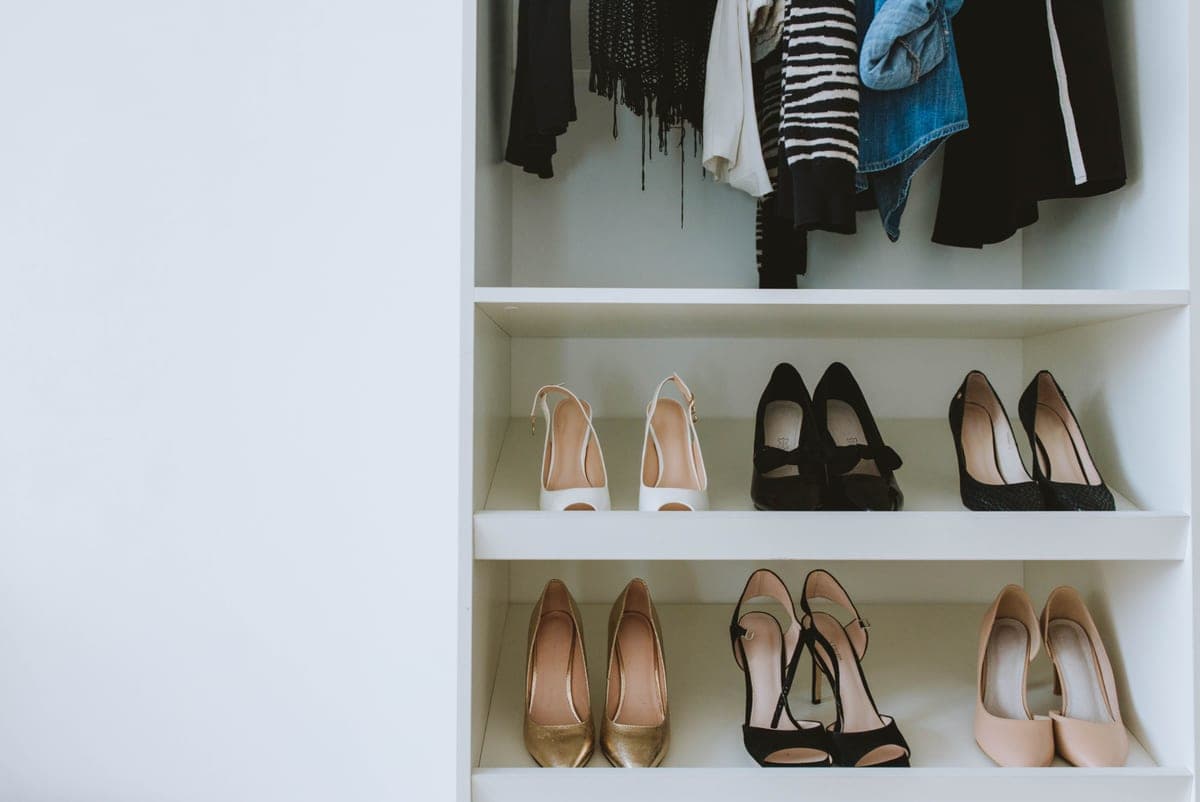
Closed storage conceals shoes and seals moisture in with them; open storage dries shoes and conceals nothing. These are direct opposites and no product resolves them. The working answer is a sequence rather than a purchase: contain wet footwear in a tray, let it dry there or on an open shelf, and put only dry shoes into a closed cabinet. A household that comes home wet and owns only closed storage will end up with a hallway that smells.
Furniture listings do not mention this because it is not a selling point, and it is the single most consequential thing about the category. Ventilation and concealment are the same axis pointing in opposite directions.
Why closed storage traps damp
A shoe that comes in damp carries water in the lining, the insole and the material itself. On an open shelf, air moves over all of it and the water leaves. In a closed cabinet, the same water evaporates into a small sealed volume, saturates it, and then has nowhere to go.
The result is a cabinet interior that stays humid, and humid enclosed spaces with organic material in them develop odor. This is not a quality problem with any particular cabinet - it is what a box does.
No deodorizer fixes that, because the cupboard keeps re-wetting what is inside it. An absorber earns its place once the shoes going in are already dry - see best shoe deodorizers for which ones name an active ingredient and how long each is stated to last.
Why open storage still loses on the thing people care about
Because the reason most people shop for entryway storage is that the hallway looks bad, and a rack of thirty visible pairs is organized chaos rather than order. Open shelving genuinely solves the functional problem and genuinely does not solve the visual one.
It is worth being honest with yourself about which problem you have. If the shoes are dry and it is purely a visual issue, a cabinet is the correct purchase and the moisture caveat barely applies. If shoes arrive wet several times a week, the visual fix will cost you the functional one.
Side by side
The same shoes, two storage strategies.
Quick picks
Ranked against the criteria below. Tap a row to jump to the full write-up; the price button goes straight to Amazon.
| # | Product | Best for | Score | Price |
|---|---|---|---|---|
| 1 |  VASAGLE HAINS Narrow Shoe Storage Cabinet 9.4 inches deep and rated for 14 to 16 pairs, with a published anti-tip kit in the box | Narrow hallways | 8.3/10 | $85.99 - View on Amazon #ad affiliate link · Price as of October 18, 2026 |
| 2 |  VASAGLE 10-Tier Shoe Rack Organizer Thirty pairs from a 24.8-inch wall run at 12.6 inches deep | Sheer volume | 7.9/10 | $119.99 - View on Amazon #ad affiliate link · Price as of October 18, 2026 |
| 3 | 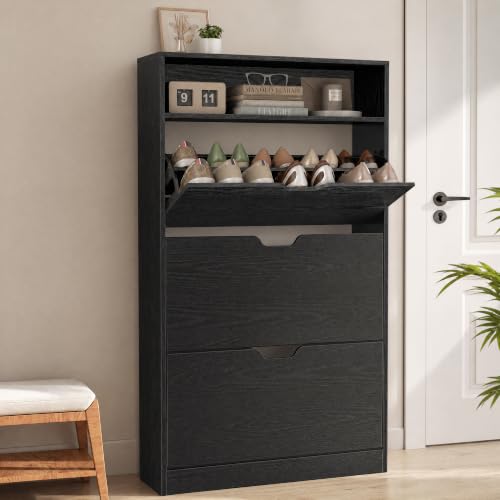 VASAGLE CUSTOS 3-Flip-Drawer Shoe Cabinet Published at 9.4 x 31.5 x 54.5 inches for 21 to 24 pairs with detachable two-level dividers | Most pairs behind a closed drawer | 8.5/10 | $119.99 - View on Amazon #ad affiliate link · Price as of October 18, 2026 |
| 4 |  SONGMICS 3-Tier Bamboo Shoe Rack Bench Published at 11.3 x 27.6 x 17.8 inches and rated to 286 lb | Sitting down to take boots off | 8.4/10 |
Narrow hallways
VASAGLE HAINS Narrow Shoe Storage Cabinet
9.4 inches deep and rated for 14 to 16 pairs, with a published anti-tip kit in the box - the cabinet for a hallway that cannot spare a foot of floor.
Depth is the specification that decides whether entryway furniture is possible at all. A hallway you can still walk down with a cabinet in it is usually a hallway with under twelve inches to spare, and most shoe furniture is fifteen or more. At 9.4 inches, this cabinet fits where the alternatives simply do not.
The flip-drawer mechanism is how it gets there: shoes sit at an angle inside a shallow panel that tips forward, rather than sitting flat on a deep shelf. That geometry is also the limitation, and VASAGLE is upfront about it - fourteen to sixteen pairs up to about a US 11. Boots do not fit. Winter boots really do not fit. If boots are the problem you are solving, this is the wrong product and an open bench or a boot tray is the right one.
Two published numbers deserve attention because most makers omit them: a 15 pound maximum top load and 11 pounds per interior shelf. That top figure rules out the obvious use - dumping a bag of shopping or a heavy plant on it - and it is worth knowing before rather than after. The included anti-tip wall-mount kit is a genuine plus on a forty-inch-tall, nine-inch-deep cabinet; that footprint is tippy by geometry, and having the hardware in the box makes it likely you will actually fit it.
The real trade with any closed cabinet is moisture. Sealing a wet shoe into a cupboard is how a hallway starts smelling. Closed storage is for dry shoes; wet ones need a tray or an open shelf first. That sequence - contain, dry, then store - is the whole logic of our layered defense guide.
What works
- 9.4 inches deep is genuinely narrow - it fits hallways that reject normal furniture
- Publishes both capacity and load limits, including per-shelf
- Anti-tip kit is included rather than sold separately, which for a 40-inch-tall cabinet matters
What does not
- Flip drawers are shallow - boots and high-tops do not fit, only shoes up to about US 11
- 15 lb top load means it is not a place to put a heavy plant or a bag of shopping
- Closed storage traps damp - wet shoes should dry before they go in
Sheer volume
VASAGLE 10-Tier Shoe Rack Organizer
Thirty pairs from a 24.8-inch wall run at 12.6 inches deep - open shelving that goes up instead of out, with everything on display as the price.
If the constraint is simply that there are too many shoes and not enough floor, this is the arithmetic answer. Thirty pairs, 24.8 inches of wall, 12.6 inches of depth. Per pair stored it is comfortably the cheapest thing in this comparison and nothing else is close.
Open shelving has one genuine functional advantage over every cabinet here, and it is the one this site cares about: air. A damp shoe on an open shelf dries. The same shoe in a closed flip-drawer cabinet stays damp, and a hallway full of damp shoes in a closed cupboard is where entryway smells come from. If your household comes home wet regularly, open shelving is not a compromise - it is the correct choice.
The height is the thing to think about honestly before buying. At 73.6 inches the top two tiers are above eye level for most people and above reach for some. In practice those tiers become long-term storage - the shoes you wear twice a year - rather than daily slots. That is fine if you plan for it and annoying if you do not.
And it hides nothing. Thirty pairs of shoes on ten open shelves is thirty pairs of shoes you can see from the front door. If the reason you are shopping is that the hallway looks chaotic, this will organize the chaos without concealing it, and a flip-drawer cabinet is the product that actually addresses what is bothering you.
What works
- Thirty pairs from under 25 inches of wall is the highest raw capacity here
- Open shelves let damp shoes dry, unlike any closed cabinet
- Cheapest per pair stored of anything in this comparison
What does not
- Over six feet tall - top tiers are out of reach for many people
- Everything is visible; this is a storage solution, not a tidiness solution
- Tall and light means wall anchoring is mandatory, not advisory
Most pairs behind a closed drawer
VASAGLE CUSTOS 3-Flip-Drawer Shoe Cabinet
Published at 9.4 x 31.5 x 54.5 inches for 21 to 24 pairs with detachable two-level dividers - the most shoes you can put out of sight without giving up hallway depth.
This is the density answer among cabinets. Thirty-one and a half inches of wall, 9.4 inches of depth, and twenty-one to twenty-four pairs inside it. An open ten-tier rack stores more shoes per square foot, but it stores them where everyone can see them; if the point of the purchase is that the hall stops looking like a shoe shop, this holds the most.
The detachable dividers are what make the range real rather than optimistic. Each divider drops into two levels, so one drawer takes three layers of flats or two of high-tops, and a household with mixed footwear is not stuck with a single fixed number. VASAGLE rates it up to about a US 11, which is the ceiling a flip drawer has by geometry rather than a cost-cutting decision.
The cost is presence. At 54.5 inches this is taller than a kitchen counter, and in a narrow hall it reads as a wardrobe rather than a shoe cupboard - that is a decision about the room, not about the product. VASAGLE publishes a 97-pound maximum static load and a 57.9-pound unit weight, puts an anti-tip kit in the box, and its own notes say to secure the cabinet to the wall. Do it. Fifty-four inches tall at nine inches deep with a drawer swinging out at the top is the geometry that goes over, and it matters most in a house with small children.
Same moisture caveat as every closed cabinet: dry shoes only. Wet boots go in a tray and dry there, and boots will not fit in this cabinet anyway at 9.4 inches deep. The open shelf spaces help with the odd damp pair, but they are not ventilation for twenty-four of them. If you want one thing that handles both, you want an open bench and you should read bench versus cabinet versus rack before you buy.
What works
- Twenty-one to twenty-four pairs is the most any closed cabinet here holds, and it does it at 9.4 inches of depth
- Detachable dividers with two levels each adapt to mixed shoe heights instead of fixing one number
- The anti-tip kit is in the box and VASAGLE's own notes tell you to fit it
What does not
- At 54.5 inches tall it is a piece of furniture, not a discreet addition
- 9.4 inches deep is shoe-sized - boots do not go in a flip drawer
- 97 lb is a whole-unit static figure; VASAGLE publishes no top-surface or per-shelf limit for this one
Sitting down to take boots off
SONGMICS 3-Tier Bamboo Shoe Rack Bench
Published at 11.3 x 27.6 x 17.8 inches and rated to 286 lb - a bench you can genuinely sit on, which is the entire point and the thing most shoe benches quietly are not.
Most furniture sold as a shoe bench is a shoe rack with a flat top. The distinction is not pedantic: a rack with a flat top will hold a bag, and it will fail the first time an adult sits down hard on it to pull a wet boot off. SONGMICS publishes a static load rating of 286 pounds for this bench, which is the specification that tells you which of the two you are buying.
That matters because sitting down is the behavior change that actually keeps mud out of a house. People take boots off standing in the hall, hopping, holding a wall, and the boot ends up somewhere other than where you wanted it. Give them somewhere to sit within reach of the door and the boots come off at the door.
Bamboo is the right material for this position for an unglamorous reason: hallways get damp, and particle board swells irreversibly the first time it gets properly wet. Bamboo tolerates humidity, and the open-tier construction lets wet shoes dry instead of sealing moisture into a closed cabinet - which is the trade you make when you choose a bench over a closed shoe cabinet.
Two limits worth knowing before you measure. The standard bench is 11.3 inches deep, and large men's boots will overhang that; the wider 42.9-inch version in the same line gives you more length but not more depth. And this is open storage - the shoes are on display. If a visible row of shoes is the thing you are trying to fix, this is the wrong category and a cabinet is the right one.
What works
- A published load rating - most shoe benches publish none, and most are not seats
- Bamboo tolerates a damp hallway better than particle board, which swells and never recovers
- Open tiers let wet shoes dry instead of sealing damp in
What does not
- Open shelving means the shoes are visible - this is storage, not concealment
- 11.3 inches deep is tight for large men's boots, which will overhang
- Bamboo marks if water is left standing on it
The sequence that gets you both
- Contain. Wet boots go straight into a tray with a ridged base, which holds the runoff and lets the sole sit above it.
- Dry. They stay in the tray or move to an open shelf until they are genuinely dry. This is the step that gets skipped and it is the one that matters.
- Store. Dry shoes go into the closed cabinet, where they are concealed and where the absence of moisture makes the seal harmless.
That sequence is the entire logic of this site scaled to the last stage, and it is why our layered defense guide treats storage as stage four rather than as a separate furniture decision.
The one genuine hybrid
A closed cabinet with a ventilated back panel or deliberate gaps is meaningfully better than a sealed box, and some designs do include them. It is a partial fix rather than a solution - it slows the humidity build-up without giving you the airflow of an open shelf - and it is worth looking for if a cabinet is the only option your hallway allows.
Questions people ask
Is open or closed shoe storage better?
Why does my shoe cabinet smell?
Can I ventilate a closed shoe cabinet?
Do I need both open and closed storage?
Sources
About the author
Scooter M.
An enthusiast who is genuinely into this. I read the manuals, compile the published specs, and do the math on door clearances. No lab coat, no test bench, and nothing here is a product I have used - which is exactly why every claim carries a source.
Published by Slate Mill Group, with the Mud & Mat team. Published August 31, 2026; last updated September 14, 2026. Editorial policy.
Read next
Best Narrow Cabinet
Best narrow shoe cabinets
Published depth, pairs stored and load limits - plus the boots that flip drawers cannot take.
Best Shoe Rack
Best entryway shoe racks
Depth in inches, pairs per foot of wall, and whether shoes can dry - ranked for a hallway you still need to walk down.
Storage Decision
Bench vs cabinet vs rack
Behavior, concealment or capacity - pick the one your entry actually lacks.
Drop-Zone Setup
Entryway drop zone setup
The physical arrangement that makes the sequence take five seconds instead of thirty.