By Scooter M. · Last updated September 21, 2026
Mud & Mat earns a commission when you buy through the links on this page, at no extra cost to you. It does not change what we recommend, and we publish a skip-this verdict on products we could otherwise earn from. Full disclosure.
Buy an over-door organizer on three published numbers: how far it projects from the door, how big one pocket actually is, and the stated weight it holds. Published depths here run from 0.5 to 7.5 inches, which is the difference between a door that still swings and one that does not. Pocket widths run from 4.3 to 4.5 inches, so a men's sneaker needs two. And mesh breathes where clear PVC does not.
The back of a door is the only storage surface in a small entry that costs no floor at all, which is why this format exists and why it sells at a fraction of the price of furniture. Our small-space guide makes the general case: depth is the dimension you are short of, and height is free. An over-door organizer is that argument taken to its conclusion.
It also comes with a constraint no other shoe storage has. Everything you hang here gets added to the thickness of a door that has to keep opening, closing and clearing whatever is behind it. That makes the published depth the first spec to read rather than the last, and it is the one the listings bury below the pocket count.
How we picked
How we picked
- Published depth off the door. This decides whether the door still works. Figures here run from half an inch to seven and a half, and a loaded pocket adds more on top. A door that opens back against a wall, a radiator or a towel rail has a hard limit, and it is easy to exceed without noticing until the door stops.
- Published pocket size, not pocket count. Twenty-four pockets is not twenty-four pairs. Two makers publish the actual pocket dimensions and one publishes the honest conversion - twelve pairs of shoes, or twenty-four pairs of sandals. Where a listing states neither, you are buying on a number that overstates what you get.
- Whether the pocket breathes. This is the site's standing objection to closed storage, and a sealed vinyl pocket is closed storage at its smallest scale. Mesh lets a barely-dry shoe finish drying; clear PVC holds the moisture against it. We rank mesh above clear for anything that comes in off a wet path.
- Published weight capacity and how it is hung. Three of these state a maximum - 40, 40 and 50 pounds - and one states nothing. Hook count matters too, because three hooks on a hollow-core door concentrate more load than four.
- Whether it holds the footwear you actually own. A 4.3-inch pocket takes a flat, not a work boot. One format here is open metal shelving and its maker names short boots specifically, which for this site's reader is the difference between a useful product and a closet accessory.
We have not physically tested these products. We do not own them, we have no lab, and we do not accept free product. Everything above is compiled from published manufacturer specifications, published care guidance and live retailer data - and we tell you which is which on every claim. How we pick.
Depth is the number nobody reads first
Open the door fully and look at what is behind it. In most entries it is a wall, and the gap between the door face and that wall is the whole budget for this purchase. A half-inch organizer spends almost none of it. A 7.5-inch metal rack spends all of it and then some, and the shoes on the shelves add their own width again.
The failure is not subtle when it happens. The door stops short, the organizer takes the impact, and the hooks work the paint off the top edge of the door every time somebody pushes. On an interior closet door the same depth can stop the door latching at all, because the organizer sits in the rebate.
This is the same measurement discipline our door clearance guide applies underneath a door, and it is more forgiving there - a mat is a quarter of an inch out and you notice nothing. Here you are working in whole inches and the published figures span a factor of fifteen.
Maker-published figures from each product's own retailer listing. 'Not published' means the listing states nothing, not that the product lacks the property.
Read the first and last columns together. The shallowest organizer is the one made of the material we would least like a damp shoe to sit in, and the one that holds real footwear is the one that eats the most door. There is no product here that wins both, which is why the pick depends on what is behind your door and what you are putting in it.
Quick picks
Ranked against the criteria below. Tap a row to jump to the full write-up; the price button goes straight to Amazon.
| # | Product | Best for | Score | Price |
|---|---|---|---|---|
| 1 |  Amazon Basics 24-Pocket Door Organizer A published 50 lb capacity | The most weight for the least door depth | 8.2/10 | |
| 2 |  Gorilla Grip Over-Door Organizer, 24 Pockets Deep mesh pockets rated to a published 40 lb, hanging 4.5 inches off the door | Shoes that are not quite dry | 8.0/10 | |
| 3 |  Whitmor 12-Tier Over-Door Shoe Rack Twelve metal-and-mesh shelves rated by the maker at 36 pairs, with a mesh back stated to keep the frame off the door | Shoes a fabric pocket will not hold | 7.6/10 | |
| 4 | 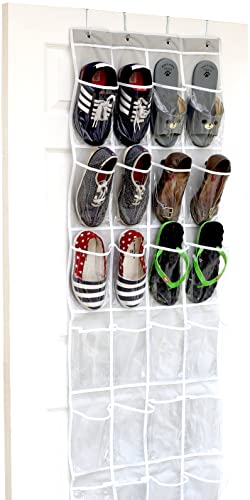 Simple Houseware 24-Pocket Organizer The shallowest organizer here at a published half an inch, with clear pockets and a 40 lb rating Our skip-this pick | Seeing what is in the pockets | 6.8/10 |
The most weight for the least door depth
Amazon Basics 24-Pocket Door Organizer
A published 50 lb capacity - the highest here - on a mesh organizer that projects only 2.76 inches, and the one listing honest enough to say 24 pockets is 12 pairs of shoes.
One sentence on this listing does more for a buyer than anything else on the page: it stores 12 pairs of shoes, or 24 pairs of sandals. Every organizer in this category is sold on a pocket count, and every pocket count overstates what it holds, because a real shoe needs two pockets or spills out of one. Amazon states the honest number without being asked.
The rest of the specification backs that up. Pockets are published at 8.8 inches tall by 4.5 wide, so you can hold a tape measure against your own shoe rather than guessing. The mesh breathes. The stated maximum is 50 pounds, the highest figure here. And it projects 2.76 inches from the door, which is a third less than the deepest option.
The trade-offs are structural rather than hidden. Three hooks instead of four means each hook carries more, and on a hollow-core door that is where the wear shows. There is no frame at all, so the organizer hangs slack empty and sags loaded - the same property that makes it fold away in summer makes it droop in use.
And 4.5 inches of pocket width is simply narrow. A women's flat or a child's shoe sits in one pocket happily; a men's size 11 sneaker does not, which is exactly why the maker quotes twelve pairs. For a household of adult footwear, the metal-shelf format on this page holds more of what you actually own.
What works
- 50 lb is the highest published capacity on this page, on the second-shallowest organizer
- Publishes the pocket size - 8.8 by 4.5 inches - so you can measure a shoe against it before ordering
- Says out loud that 24 pockets means 12 pairs of shoes, which is the honest reading every other listing avoids
What does not
- Three hooks rather than four puts more load on each one
- A 4.5 inch pocket width is narrow for a men's sneaker, which is why the maker quotes 12 pairs
- No assembly and no structure means it hangs slack until it is loaded, and then it sags
Shoes that are not quite dry
Gorilla Grip Over-Door Organizer, 24 Pockets
Deep mesh pockets rated to a published 40 lb, hanging 4.5 inches off the door - the only organizer here whose maker states the pockets breathe, which is what a barely-dry shoe needs.
Everything this site says about closed storage applies double to a fabric pocket. A shoe that goes into a sealed vinyl sleeve while it is still faintly damp has nowhere to dry, and the pocket holds the moisture against it all night. That is why the mesh version is the one to buy, and Gorilla Grip is the only maker here that puts the reasoning on its own listing: the pockets are described as breathable, allowing airflow and reducing dust and odor buildup.
The published numbers are good for the category. Forty pounds of stated capacity across 24 pockets, from an organizer that weighs under ten ounces itself, with four hooks over the door top rather than three. Reinforced stitching is called out, and the fabric is non-woven rather than the thin vinyl sheet a budget organizer uses.
The catch is depth. At a published 4.5 inches this is the thickest organizer here by a wide margin, and that number is not a detail - it is the whole question of whether the door still works. A door that opens back against a wall, a radiator or a towel rail loses 4.5 inches of swing, and a loaded pocket adds more.
The other honest limit is that no pocket dimension is published. Two competitors state theirs, so you can check a large sneaker before buying; here you cannot. Fabric pockets also sag under load in a way a metal shelf does not, which is a property of the format rather than of this product. If what you need to store is boots rather than shoes, the boot rack roundup is the right page.
What works
- Mesh pockets are the only ones here the maker explicitly ties to airflow and odor, which matters for footwear that is merely damp
- 40 lb published capacity with reinforced stitching, at under ten ounces of organizer
- Four hooks rather than three spreads the load across the door top
What does not
- 4.5 inches deep is the thickest fabric organizer here - it fouls a door that opens against a wall or a radiator
- Gorilla Grip publishes no pocket dimensions, so you cannot check a size 12 against it before buying
- Pockets sag once loaded, which is the failure every fabric organizer shares
Shoes a fabric pocket will not hold
Whitmor 12-Tier Over-Door Shoe Rack
Twelve metal-and-mesh shelves rated by the maker at 36 pairs, with a mesh back stated to keep the frame off the door - the only format here that takes a short boot.
The fabric organizers on this page all fail at the same point: a real adult shoe does not fit a pocket. This is the format that answers it. Twelve open metal shelves take whatever you put on them, and Whitmor's own listing names short boots alongside sneakers and heels - the only maker here that does.
Two design details are worth the money. The back is mesh-lined, which Whitmor states is to keep the metal frame from scuffing the door, and that is a real problem with bare metal racks on a painted door. And it can be wall mounted rather than hung, with the tools in the box, so a door that has to swing fully is not a reason to rule it out.
The cost is depth, and it is severe. At a published 7.5 inches this projects nearly three times as far as the shallowest organizer here, before a shoe goes on the shelf. On an inward-opening entry door that is a large bite out of the swing arc, and on a closet door it may stop the door closing at all. Measure the gap behind the door before buying, the same way our door clearance guide has you measure the gap underneath one.
The listing also has two gaps. There is no published weight capacity, which the three fabric organizers all state - odd, given this is the sturdiest construction here. And the height appears as 69 inches in the specification table and 74 inches including hooks in the description. Neither is wrong, but they are not the same number, and on a door the height is what decides whether the bottom tier clears the floor.
What works
- Open shelves hold what a 4.5-inch pocket cannot - the listing names sneakers, heels and short boots
- Mesh-lined back is stated to protect the door from scuffs, which the fabric organizers do not address
- Can be wall mounted instead of hung, so it is not tied to a door that needs to swing freely
What does not
- 7.5 inches deep is by far the most door swing surrendered on this page
- Whitmor publishes no weight capacity at all, while all three fabric organizers do
- The listing gives 69 inches in its specification table and 74 inches including hooks in the description, so measure your own door before you trust either
Seeing what is in the pockets
Simple Houseware 24-Pocket Organizer
The shallowest organizer here at a published half an inch, with clear pockets and a 40 lb rating - and clear vinyl is exactly the wrong surface for a shoe that is not fully dry.
Skip this one
Skip the clear-pocket version if anything going into it has been outside in the last few hours, and that is the only reason we rank it last. On its own terms it is well specified: half an inch deep, 24 pockets at a published 4.3 by 9.5 inches, a 40 pound rating, four hooks and a stated door-thickness limit of 1-3/8 inches. Nothing else here is that shallow or that transparent about what it fits. The problem is the material. Clear PVC is a sealed sleeve, and this site's whole argument about closed storage is that sealing a damp shoe in an unventilated space is how an entryway starts to smell. Two mesh organizers on this page cost about the same, state the same or higher capacity, and let the air through. Buy the clear one for slippers, sandals and craft supplies in a dry closet - not for the shoes that come in off a wet path.
Judged on its published numbers this is the best-documented organizer on the page. Simple Houseware states the overall size, the pocket size, the capacity, the number of hooks and - uniquely here - the door thickness it fits, which is 1-3/8 inches. At half an inch deep it is also the only one that leaves a door behaving like a door.
The clear pockets are a genuine convenience. Twenty-four identical fabric pouches means feeling through them for the shoe you want; twenty-four windows means seeing it. For anything stored long term - off-season sandals, craft supplies, small tools - that is worth more than it sounds.
Then there is the material problem, and for this site it is decisive. Clear PVC is a sealed sleeve with no airflow. Our shoe cabinet and deodorizer pages make the same point over and over: a damp shoe put into an unventilated space stays damp, and the smell that follows belongs to the container. Two mesh organizers here cost about the same and let air through.
The pockets are also the narrowest on the page at a published 4.3 inches, and the listing says plainly what that means - slim shoes, small sneakers, flats, sandals and heels. That is an honest description rather than a flaw, but it rules out the muddy-boot household this site is written for. Keep this one for a dry closet and put a mesh organizer on the door that shoes actually arrive at.
What works
- Half an inch deep on the published figure - it barely changes what the door can do
- Publishes its pocket size and its door-thickness limit, which is more than most of this category states
- Clear pockets mean you find the pair you want without patting down twenty-four of them
What does not
- Clear PVC does not breathe, so a shoe that is even slightly damp stays damp in it
- 4.3 inches is the narrowest pocket width here, and the listing is upfront that it suits slim shoes, flats and sandals
- The 40 lb rating comes with a half-inch-deep pocket, so the limit you hit first is volume, not weight
A pocket is not a pair
Every listing in this category leads with a pocket count, and every pocket count flatters the product. A pocket published at 4.5 inches wide takes one adult shoe, not a pair - so a 24-pocket organizer holds twelve pairs of ordinary shoes, and fewer if the shoes are wide. Amazon Basics says exactly that on its own listing. The others let the number speak for itself.
Height matters as much as width. Published pocket heights here are 8.8 and 9.5 inches, which is fine for a flat, a sandal or a low sneaker and useless for anything with a shaft. A short boot goes in a pocket sideways or not at all, which is the reason the open-shelf format exists.
The practical test before you buy is to measure the widest shoe in the house across the sole and compare it with the published pocket width. If it is close, assume one shoe per pocket and halve the advertised capacity. That number - the honest one - is what you should compare against a three-tier floor rack, which costs about the same and does not touch the door.
Mesh or clear, and why it matters here
This site argues in several places that closed storage seals moisture in with the shoes, and that a hallway of damp footwear in a sealed cupboard is where entryway smell comes from. A clear vinyl pocket is the same trap in miniature: no airflow, a shoe that arrived slightly damp, and a whole night for the two to sit together.
Mesh solves it without costing anything. Both mesh organizers here are within a couple of dollars of the clear one, both state the same or a higher weight capacity, and one maker explicitly ties the mesh to airflow and to reducing odor buildup. If the shoes going on the door have been outside, buy mesh.
None of this makes an over-door organizer a drying solution. It is storage for dry shoes with a margin for error, not a place to put a wet boot - that still belongs in a tray until it is dry. The sequence is the same one the whole site runs on: contain, dry, then store.
What hangs it up, and what that does to the door
Two of these use four hooks and one uses three. On a solid door that is a detail; on a hollow-core interior door, which most closet doors are, the hooks bear on a thin edge and the load is worth spreading. One listing publishes the door thickness it fits, which is 1-3/8 inches - the common interior size - and nobody else states a limit at all.
Hooks also mark the door. Bare metal on paint wears through where the hook rocks each time the door moves, and the only product here that addresses the problem is the metal rack, whose mesh-lined back is stated to protect the door from scuffs. On the fabric organizers a strip of felt tape under each hook costs nothing and saves the paint.
The door is not the only surface that costs no floor. If you have a clear wall and are willing to drill, best wall-mounted shoe racks covers the harder-wearing version of the same idea, judged on the published weight capacity that most of that category declines to print.
Questions people ask
How much space does an over-door shoe organizer take from the door?
How many pairs does a 24-pocket organizer really hold?
Are mesh or clear pockets better?
Will an over-door organizer fit my door?
Can I put wet boots in one?
Is an over-door organizer better than a shoe rack?
Sources
- Amazon Basics 24 Medium Mesh Pocket Over-the-Door Hanging Shoe Organizer - Amazon detail page (2.76 x 18.9 x 67.2in, 50 lb maximum, pockets 8.8 x 4.5in, 3 metal hooks, 12 pairs of shoes stated)
- Gorilla Grip Over the Door Shoe Organizer, 24 Large Pockets - Amazon detail page (4.5 x 19 x 64in, 40 lb, deep breathable mesh pockets, 4 hooks)
- Whitmor 36 Pair Over the Door Shoe Organizer, 12 Tier - Amazon detail page (7.5 x 21.62 x 69in, 74in including hooks, 4.8 lb, metal frame with mesh shelves and mesh-lined back, wall mountable; no weight capacity published)
- Simple Houseware 24 Pockets Clear Over the Door Shoe Organizer - Amazon detail page (0.5 x 19 x 64in, pockets 4.3 x 9.5in, 40 lb, 4 hooks, fits doors up to 1-3/8in thick)
Next stage
Stage 4 - store
A pocket is closed storage by another name. The same dry-shoes-only rule applies to it.
Keep goingAbout the author
Scooter M.
An enthusiast who is genuinely into this. I read the manuals, compile the published specs, and do the math on door clearances. No lab coat, no test bench, and nothing here is a product I have used - which is exactly why every claim carries a source.
Published by Slate Mill Group, with the Mud & Mat team. Published September 21, 2026; last updated September 21, 2026. Editorial policy.
Read next
Best for Small Spaces
Best small-space shoe storage
Published depths from 9.4 inches, pairs per square foot of floor, and why vertical beats clever in a tight entry.
Open or Closed
Open vs closed shoe storage
Concealment and ventilation are opposites. The fix is a sequence, not a product.
Door Clearance Data
Low-profile mats and door clearance
Published mat thicknesses against the real door undercut - the arithmetic nobody else prints.
Best Shoe Rack
Best entryway shoe racks
Depth in inches, pairs per foot of wall, and whether shoes can dry - ranked for a hallway you still need to walk down.