By Scooter M. · Last updated September 13, 2026
Mud & Mat earns a commission when you buy through the links on this page, at no extra cost to you. It does not change what we recommend, and we publish a skip-this verdict on products we could otherwise earn from. Full disclosure.
Store tall boots inverted on poles, and buy on published pole length and published depth. A knee-high boot stood on the floor folds at the ankle and the crease is permanent; a boot inverted over a pole is supported from the inside along the whole shaft, and it drains and breathes while it is up there. Pole lengths here run to a published 19.5 inches, and depths from 9.9 to 19.5 - which is the number that decides whether the rack fits your hallway.
Shoe storage is a capacity problem. Boot storage is a shape problem, and that is why a shoe rack full of boots is not the same as a boot rack. Lay a pair of riding boots on a shelf and they slump; stand them up and they fold. Either way the shaft takes a line across the ankle that does not come out.
The fix the category converged on is simple and it works: turn the boot upside down over a vertical pole, so the pole holds the shaft open from the inside. Everything else on this page - capacity, footprint, finish - is secondary to whether the pole is long enough to do that.
How we picked
How we picked
- Published pole length, because it decides whether the shaft is supported. A short pole holds the top four inches of a knee-high boot and lets the rest slump, which is barely better than the floor. 19.5 inches supports essentially the whole shaft. Where a maker publishes no pole length we say so.
- Published depth against a real corridor. These racks project further into a room than almost any other entryway furniture - from 9.9 inches to 19.5. We put every published depth against a 36-inch hallway, as we do across this hub, so the number means something before it arrives.
- What the rack does to the boot it is holding. A bare rod end presses a dimple into a soft shaft over months, and a rough weld scores a lining. Makers who publish rounded tips or a smooth coating are addressing the two real ways a boot rack damages boots.
- Airflow, because these live in wet entryways. An inverted boot drains toward its opening and air can move through it. That is a genuine secondary benefit of the format and it is why we rank pole racks above flat shelving for boots specifically.
- Capacity per inch of depth, not capacity alone. Ten pairs on a ten-inch-deep frame is a better use of an entryway than six pairs on a nineteen-inch one, and the ranking reflects that rather than raw pair counts.
We have not physically tested these products. We do not own them, we have no lab, and we do not accept free product. Everything above is compiled from published manufacturer specifications, published care guidance and live retailer data - and we tell you which is which on every claim. How we pick.
Why a stored boot creases
A boot shaft is a tube of leather or rubber with no internal structure. Stood on its sole with nothing inside it, the shaft has to hold its own weight, and the material does what any unsupported tube does - it buckles at the narrowest point, which is the ankle.
Once buckled, it creases. Leather takes a permanent line along the fold and the finish cracks along it over time; rubber takes a hinge that eventually splits. Neither is reversible, and both happen in storage rather than in use, which is what makes it such an irritating way to lose a pair of boots.
Inverting the boot over a pole removes the problem entirely, because the pole is the internal structure the shaft lacks. Boot shapers do the same job in the same way; a rack is simply shapers and storage in one object.
Published figures. Remaining corridor is arithmetic against a 36in hallway.
Quick picks
Ranked against the criteria below. Tap a row to jump to the full write-up; the price button goes straight to Amazon.
| # | Product | Best for | Score | Price |
|---|---|---|---|---|
| 1 | 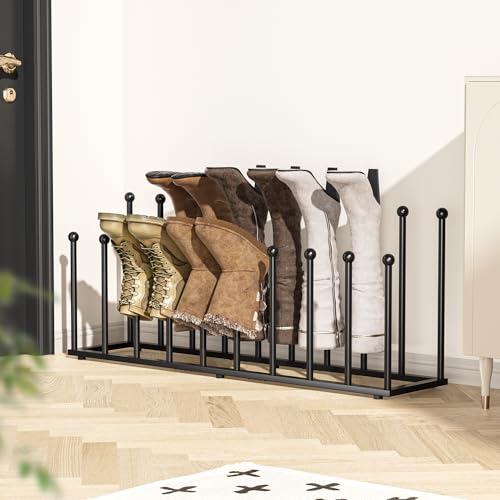 pickpiff Freestanding Boot Rack, 10 Pairs Twenty rods on a rectangular base for ten pairs, across a published 35-inch span only 9.84 inches deep | A whole household's boots | 8.6/10 | $45.99 - View on Amazon #ad affiliate link · Price as of October 18, 2026 |
| 2 |  HzTinT Boot Rack for Tall Boots, 6 Pairs Twelve 19.5-inch powder-coated poles that hold six pairs upside down by the shaft, which is the only storage method that keeps a tall boot from folding at the ankle. | Tall boots that must not crease | 8.5/10 | $29.99 - View on Amazon #ad affiliate link · Price as of October 18, 2026 |
| 3 |  Urban Deco Free Standing Boot Rack, 4 Pairs Four pairs in a published 9.9 by 16 inch footprint, with the maker stating the inverted design is there to accelerate air circulation inside the boot. | The smallest boot footprint | 8.0/10 | $19.99 - View on Amazon #ad affiliate link · Price as of October 18, 2026 |
| 4 |  DIMJ 4-Tier Boot Rack, 8 Pairs The only tiered unit here Our skip-this pick | Going up instead of out | 7.5/10 | $36.99 - View on Amazon #ad affiliate link · Price as of October 18, 2026 |
A whole household's boots
pickpiff Freestanding Boot Rack, 10 Pairs
Twenty rods on a rectangular base for ten pairs, across a published 35-inch span only 9.84 inches deep - the best capacity per inch of depth here, on the listing that publishes the least about itself.
This is the household version. Ten pairs, in a strip 35 inches wide and only 9.84 inches deep, which is the right geometry for a mudroom or a garage wall: long and shallow rather than square and deep. Twenty rods rise from a rectangular base, and pickpiff names the boots it expects on them - knee-high, hiking, cycling, rain and work.
The format is doing the work here rather than any single component. The rods are inverted with a rounded top, and pickpiff states that this keeps the shaft straight, stops debris dropping into the boot and helps prevent wrinkles and creases. It also states that the elevated design moves air through each boot to keep moisture and odour down. Both claims describe what an inverted rack is for, and both are the right things to make a claim about.
Ten inches of depth for ten pairs is the best ratio on this page. Compare it with the pole rack that takes 19.5 inches of floor for six pairs: same job, twice the room, fewer boots. Depth is the dimension entries are short of, and this is the unit that respects it.
Two honest limits, and the first is a documentation one. This listing publishes no pole length - and on a page that treats pole length as the number deciding whether a knee-high shaft is supported or merely held at the top, that is a real gap, which is why it scores below where its capacity alone would put it. There is no weight capacity and nothing about the finish either. The second limit is physical: 35 inches of wall is a commitment in a house, and ten pairs stored damp in one place is a smell in waiting - which is the case for drying them on a tray or a boot dryer before they are put away rather than after.
What works
- Ten pairs on a 9.84-inch frame is the best capacity per inch of depth on this page
- Inverted storage over a rounded top, stated to keep boot shafts straight and help prevent wrinkles and creases
- The elevated design is stated to promote airflow inside each boot, which is the whole point of the format
What does not
- Publishes no pole length, which is the number this page treats as decisive for a knee-high shaft
- Publishes no weight capacity, and nothing about the metal's finish or rust resistance
- Thirty-five inches of wall and ten pairs in one place - a lot of damp rubber if the boots go on wet
Tall boots that must not crease
HzTinT Boot Rack for Tall Boots, 6 Pairs
Twelve 19.5-inch powder-coated poles that hold six pairs upside down by the shaft, which is the only storage method that keeps a tall boot from folding at the ankle.
A tall boot stored standing up folds at the ankle, and the crease it takes is permanent. That is the entire problem a boot rack exists to solve, and the solution every decent one uses is the same: invert the boot over a pole so the shaft is supported from the inside along its whole length.
The published pole length is what separates these racks from each other, and 19.5 inches is at the long end. A short pole holds the top of a shaft and lets the rest slump, which is barely better than standing it on the floor. This one supports a knee-high boot essentially to the ankle.
The secondary benefit matters in an entryway specifically: an inverted boot drains and breathes. Whatever moisture is in the lining runs toward the opening rather than pooling in the toe, and air can move through. That is the same reasoning behind a ridged boot tray, applied to storage rather than containment.
The cost is floor area. At 19.5 inches deep this projects further into a room than most shoe furniture and returns six pairs for it, with no vertical stacking at all. In a closet or a mudroom corner that is a fine trade. In a corridor it is the wrong product, and the narrow storage options are the place to look instead.
What works
- A 19.5-inch pole supports the full shaft of a knee-high boot rather than the top four inches
- Inverted storage lets the inside of a damp boot drain and breathe
- Powder coat over metal is the right finish for a surface wet boots touch
What does not
- 19.5 inches DEEP is a lot of floor for six pairs - this wants a closet, not a hallway
- Only 9.8 inches tall, so it does nothing for vertical space
- Pole storage suits boots and nothing else; sneakers fall off it
The smallest boot footprint
Urban Deco Free Standing Boot Rack, 4 Pairs
Four pairs in a published 9.9 by 16 inch footprint, with the maker stating the inverted design is there to accelerate air circulation inside the boot.
The useful thing about this one is the published depth: 9.9 inches. Every other boot rack we compiled projects between ten and twenty inches into the room, and in a hallway that difference decides whether the unit gets used or resented.
Capacity is the price. Four pairs is a single person's boot collection - a pair of work boots, a pair of wellingtons, a pair of winter boots and something smart. For a household of four it is not enough, and doubling up means buying two.
Urban Deco makes two claims worth repeating because they are specific rather than decorative. The inverted design is stated to accelerate air circulation inside the shoe, which is the real reason to store boots upside down in a damp entryway. And the powder coating is stated to be smooth so it will not scratch the inside of the shoe - a genuine failure mode on cheaper racks, where a rough weld or a bare cut edge scores the lining of an expensive boot.
Treat it as a personal rack rather than a family one, and keep it for boots that are already dry. Soaking boots belong on a tray overnight first; a rack is where they live afterwards.
What works
- Under ten inches deep - the only boot rack here that fits a corridor
- The maker states the smooth coating will not scratch the inside of a boot, which pole racks can
- Small enough to live in a closet base without claiming the whole floor
What does not
- Four pairs is one person's boots, not a household's
- 16.7 inches tall means it is still a floor-level unit with dead air above it
- Metal-on-leather still wants the boot dry before it goes on, or you get a mark line
Going up instead of out
DIMJ 4-Tier Boot Rack, 8 Pairs
The only tiered unit here - eight pairs stacked vertically rather than laid in a strip, which is the right answer when the floor is spoken for and the wall is not.
Skip this one
Skip this one if the space is tight enough that you need to measure, and that is most of the entries this rack is sold for. The tiered format is genuinely the smartest use of a small footprint in this category - but the listing publishes its product dimensions as 6 by 6 by 6 inches, which cannot be true of a unit holding eight pairs of boots, and no corrected figure appears anywhere on the page. On a site that ranks furniture on published depth against a real corridor, a dimension you cannot trust is the same as no dimension at all. Buy it where the space is generous and the format is what you want; buy a rack that states its size where it is not.
Every other boot rack on this page is a strip: one layer of boots, laid out along a wall, eating floor. This one stacks them four tiers high, which is the format that actually respects a small entry - height is the dimension nobody is using, and eight pairs occupying one rack's worth of floor is twice the density of the alternatives.
It is also the most versatile shape here. Pole racks hold boots and reject everything else; tiers take knee-highs, hiking boots, rain boots and heels on the same frame, which matters in a household where the footwear is not uniform.
Then there is the dimension problem, and it is worth being blunt about. The listing's product-dimensions field reads 6 inches by 6 inches by 6 inches. That is not a slightly optimistic figure, it is impossible - a cube the size of a tissue box does not hold eight pairs of boots - and nothing else on the page corrects it. So the one number a buyer needs in order to know whether this fits is unusable.
That is why it ranks last rather than first despite having the best idea on the page. If your space is generous, the format is excellent and the footprint does not matter. If you are working to inches, buy something that tells you its size - the small-space storage picks are all ranked on published depth for exactly this reason.
What works
- Tiered storage uses the vertical space every other boot rack here wastes
- Handles tall boots, hiking boots, rain boots and heels on the same frame
- Stated for indoor and outdoor use, which suits a covered porch or a garage
What does not
- The listing's published dimensions are 6 x 6 x 6 inches, which is impossible for an 8-pair rack
- Without a trustworthy footprint you cannot check it against your space before it arrives
- Stacked tiers mean the boots on top drip onto the boots below
Depth is the number that decides it
Run the arithmetic before anything else. In a 36-inch hallway a ten-inch rack leaves 26 inches of corridor, which is comfortable. A 19.5-inch rack leaves 16.5 inches, which is narrower than an adult carrying a bag and is the width at which households quietly stop using the thing and start putting boots on the floor beside it.
That is the same test we apply to narrow boot trays and to small-space shoe storage, and it produces the same answer here: measure the pinch point of the wall you intend to use - usually at an architrave or a radiator - and subtract.
The shallow racks pay for that depth in capacity, and that trade is real. Four pairs at 9.9 inches deep is one person's boots. Ten pairs at 9.84 inches deep, on a 35-inch span, is the best ratio here - it just needs a wall long enough to take it.
What a bad rack does to good boots
Two failure modes, both avoidable, both rarely mentioned. The first is the rod tip. A bare cut end of tube pressing into the inside of a soft leather shaft for a season leaves a visible dimple, and it is exactly where the boot is under tension. pickpiff publishes a rounded top on its rods and states that it keeps the shaft straight and helps prevent wrinkles and creases, and it is the kind of detail that separates a considered product from a bent-tube one.
The second is surface finish. A rough weld or a bare edge scores the lining every time a boot goes on or comes off. Urban Deco states its powder coating is smooth so it will not scratch the inside of the shoe - again, specific rather than decorative.
Poles or tiers?
Pole racks do one thing perfectly and nothing else. They will not take sneakers, sandals or anything without a shaft - those simply fall off. In a household whose entryway footwear is genuinely mixed, that is a rack doing half a job while the other half sits on the floor.
Tiered racks take everything and use vertical space, which in a small entry is the free dimension. The cost is that a tier is a flat shelf: a knee-high boot on it still has to be laid down or stood up, so the crease problem returns for exactly the boots this page exists to protect.
The honest answer for most households is a pole rack for the tall boots that would otherwise crease, and a general shoe rack for everything else - rather than one unit trying to be both.
Buy it this way
- Measure the wall's pinch point first, then subtract the published depth. Under about 20 inches of remaining corridor, go shallower.
- Buy on pole length if you own knee-high boots - a short pole supports the top of the shaft and lets the rest fold anyway.
- Ten pairs at ten inches beats six pairs at nineteen. Judge capacity per inch of depth, not capacity.
- Look for rounded tips and a smooth coating - those are the two details that stop a rack marking the boots.
- Never put wet boots away. Drain or dry them first; a rack is where dry boots live.
Questions people ask
Why do tall boots need a special rack?
How long should a boot rack pole be?
How much floor does a boot rack take?
Can I store wet boots on a rack?
Will a boot rack hold shoes too?
Do boot racks damage boots?
Sources
- pickpiff Freestanding Boot Rack, 10 Pairs - Amazon detail page (20 metal rods on a rectangular base, 9.84 x 35 x 17.1in, 3 lb, inverted storage with a round top stated to keep shafts straight and help prevent wrinkles and creases, elevated design stated to promote airflow; no pole length and no weight capacity published)
- HzTinT Boot Rack - Amazon detail page (19.5in poles, 6 pairs on 12 poles, 19.5 x 28.7 x 9.8in, powder-coated antirust metal)
- Urban Deco Boot Rack - Amazon detail page (4 pairs, 9.9 x 16 x 16.7in, smooth powder coat, inverted design stated to accelerate air circulation)
- DIMJ 4-Tier Boot Rack - Amazon detail page (8 pairs across 4 tiers, powder-coated metal; product dimensions field reads 6 x 6 x 6in)
Next stage
Dry before you store
A rack keeps a boot's shape. It does nothing about the water still inside it.
Keep goingAbout the author
Scooter M.
An enthusiast who is genuinely into this. I read the manuals, compile the published specs, and do the math on door clearances. No lab coat, no test bench, and nothing here is a product I have used - which is exactly why every claim carries a source.
Published by Slate Mill Group, with the Mud & Mat team. Published September 13, 2026; last updated September 13, 2026. Editorial policy.
Read next

Best Shoe Rack
Best entryway shoe racks
Depth in inches, pairs per foot of wall, and whether shoes can dry - ranked for a hallway you still need to walk down.
Best for Small Spaces
Best small-space shoe storage
Published depths from 9.4 inches, pairs per square foot of floor, and why vertical beats clever in a tight entry.

Best Boot Dryer
Best boot dryers
Forced air against silent convection, ranked on published wattage, dry time and capacity - and the classic that publishes none of them.
Best Large Tray
Best large boot trays
Length versus wall depth, on published dimensions - the two things a big tray can buy, and the one that suits your mess.
Best for Big Feet
Best shoe storage for large shoes
Published shelf depth against published foot length - the comparison that explains why your size 14s hang off the front.