By Scooter M. · Last updated September 21, 2026
Mud & Mat earns a commission when you buy through the links on this page, at no extra cost to you. It does not change what we recommend, and we publish a skip-this verdict on products we could otherwise earn from. Full disclosure.
Buy in this order: an absorbent mat inside, a boot tray beside the door, a scraper mat outside, hooks, then a shoe rack. The first two solve most of the problem for the least money and the least floor. The scraper only earns its place if the dirt arriving is solid rather than wet. Hooks and a rack are storage rather than defense, and they are the two people buy first and regret.
Two other pages on this site cover the theory and the layout. Layered entryway defense explains why four stages in sequence beat one heroic product, and entryway drop zone setup sets out where each item goes along the wall. This page answers the question those two leave open, which is what to actually buy, in what order, when the budget arrives in pieces.
The ordering matters because the items are not equally valuable and they are frequently bought backwards. A shoe rack does nothing about mud. A beautiful coir mat outside a covered door that only ever sees rain is money spent on the wrong mechanism. The sequence below is ranked by how much dirt each purchase actually stops per dollar and per inch of floor.
How this list is ordered
How we picked
- Dirt stopped per dollar. The first two items on this list stop most of what a household tracks in. Everything after them is refinement. If the budget runs out after two purchases, the entry still works.
- Floor space consumed. In a tight hall, floor is scarcer than money. A mat costs nothing in corridor width; a tray costs a strip against the wall; a rack costs real depth. Items that cost no floor come first.
- Whether it fails safely. A mat that is too thick stops a door. A tray that is too shallow overflows. We flag the specification that causes each item's characteristic failure so the first purchase is not a returned one.
- Whether the household will actually use it. A tray nobody steps to, or hooks a child cannot reach, are purchases that quietly stop being used. Behavior decides more of this than product quality does.
- Every pick is already ranked elsewhere on this site. Nothing here is chosen for the starter kit alone - each item is the product we rank on its own category page, so you can read the full comparison behind it.
We have not physically tested these products. We do not own them, we have no lab, and we do not accept free product. Everything above is compiled from published manufacturer specifications, published care guidance and live retailer data - and we tell you which is which on every claim. How we pick.
Item one: an absorbent mat inside the door
If you buy one thing, buy this. Most of what damages a floor is water carrying grit, and an absorbent mat immediately inside the door takes up both at the point where they arrive. It costs no corridor width at all, because it lies in a space you were already walking through.
The specification that decides it is thickness against your door gap - a mat that stops the door is a mat that goes back. Our door clearance guide puts published pile heights against the standard undercut, and it is the first measurement to take before ordering anything.
The second specification is length rather than width. Dirt comes off in proportion to how many steps land on the mat, so a longer mat in the walking line beats a wider one across the doorway - the arithmetic is in our mat sizing guide.
Item two: a boot tray beside the door
The second purchase is the one that surprises people, because a tray is not a mat and it solves a different failure. A mat spreads meltwater until it runs off the edge. A tray holds it behind a raised wall until you tip it out, which is the only thing on this list that contains salt rather than distributing it.
It is also the item that most changes behavior, because it gives wet boots a named place. A tray against the wall beside the door, not across the threshold, is the arrangement that gets used - our drop-zone guide sets out the whole line along the wall.
Buy on published wall depth rather than footprint. An inch of wall is plenty for rain; snow and road salt want closer to two. The full comparison is in best boot trays for entryways.
Item three: a scraper outside, but only for the right dirt
This is the first conditional purchase on the list. A stiff coir mat outside scrapes solid material - dried mud, grit, gravel dust - mechanically off the tread. It is superb at that and it does essentially nothing about water, which it neither absorbs nor drains.
So it earns its place if your problem is solid, and wastes your money if your problem is wet. Coir is also organic: in a fully exposed position that never dries it takes up water, goes rigid in a freeze and eventually breaks down. Under a porch roof it lasts years. The trade is set out in coir vs chenille vs rubber.
Item four: hooks, at two heights
Hooks are the cheapest item here and the one most often bought last. Their value is not storage, it is interception - a wet coat that has nowhere to land at the door travels to a chair, a banister or a bed, and the water goes with it.
Buy on published load and on how much wall each hook gets rather than on hook count, and mount a second low rail if there are children in the house. A coat hook a child cannot reach is a coat on the floor. The published-figure comparison is in best entryway coat racks.
Item five: a shoe rack, once the first four are in
A rack is storage, not defense. It does not stop a single particle of dirt entering the house - it stops the shoes that have already come off from forming a pile. That is a real problem and it is the last one to solve, not the first.
Buy the shallowest unit that goes highest, because depth is the dimension a hall is short of and height is free. Open shelving also lets damp shoes dry, which closed storage does not - the reasoning is in open vs closed shoe storage, and the full rack comparison is in best entryway shoe racks.
Quick picks
Ranked against the criteria below. Tap a row to jump to the full write-up; the price button goes straight to Amazon.
| # | Product | Best for | Score | Price |
|---|---|---|---|---|
| 1 |  Gorilla Grip SoakSTOPPER Indoor Doormat Dense chenille on a thermoplastic rubber backing that the maker says is third-party tested for repeated wash-and-dry cycles | The default indoor mat | 8.8/10 | $29.99 - View on Amazon #ad affiliate link · Price as of October 18, 2026 |
| 2 |  Kempf Large Rubber Boot Tray, 16 x 32 in Recycled rubber with raised edges and a ridged base, so boots sit above the meltwater instead of in it | Wet boots and snow melt | 8.6/10 | $24.95 - View on Amazon #ad affiliate link · Price as of October 18, 2026 |
| 3 |  Kempf 1-Inch Thick Natural Coco Coir Doormat Stiff coconut fiber at a published one-inch thickness | Scraping dried mud | 8.0/10 | $39.95 - View on Amazon #ad affiliate link · Price as of October 18, 2026 |
| 4 | 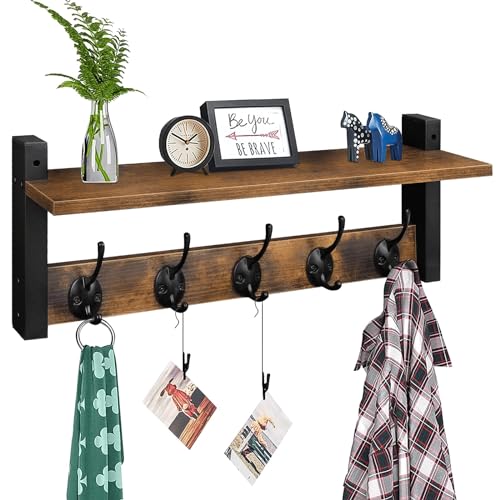 Homode Coat Rack with Shelf, 5 Hooks A published 50 lb rating, all three dimensions and wall anchors in the box | Most narrow halls | 8.1/10 | |
| 5 |  Simple Houseware 3-Tier Shoe Rack 11.2 x 26.8 x 20.9 inches, nine to sixteen pairs, a metal frame and nothing else | The cheapest thing that works | 7.6/10 | $21.87 - View on Amazon #ad affiliate link · Price as of October 18, 2026 |
The default indoor mat
Gorilla Grip SoakSTOPPER Indoor Doormat
Dense chenille on a thermoplastic rubber backing that the maker says is third-party tested for repeated wash-and-dry cycles - the failure point that kills most washable mats.
This is the mat most households should start with, and the reason is the part nobody photographs: the backing. Gorilla Grip publishes a specific claim about it - a thermoplastic rubber backing that it says has been third-party tested to survive being washed and dried repeatedly, and it explicitly contrasts that with the PVC and hot-glue backings used elsewhere. That is the correct thing to make a claim about. A chenille mat's absorbency barely changes over its life; what changes is whether the backing is still flat and still gripping after the tenth wash.
The care label is strict and worth obeying literally: machine wash cold, tumble dry low, no bleach, no dry clean, and - the one people ignore - no fabric softener. Softener coats microfiber and is the single fastest way to turn an absorbent mat into a mat that pushes water around. If your household washes everything with a softener sheet in the drum, this mat will underperform and it will not be the mat's fault.
Size is the other reason it leads. Six sizes run from a 24 by 17 inch doormat up to a 70 by 24 inch runner, which means the same product can cover a single back door or the whole first three strides of a hallway. Walk-off distance is the variable that actually determines how much dirt gets stopped - the commercial matting industry sizes entry systems in feet of walk-off, not in mats - so being able to buy length matters more than most spec sheets suggest.
The catch is clearance. Gorilla Grip does not publish a pile height for this mat, and a dense chenille pile is not a low-profile pile. If it is going behind an inward-opening door with a standard half-inch to three-quarter-inch undercut, measure first - see our door clearance guide. The maker also states this is indoor only and specifically not recommended for concrete, which rules out the garage-door and unfinished-basement placements people often want it for.
What works
- Backing is the part the maker actually stakes a claim on - most mats fail there first
- OEKO-TEX Standard 100 tested for harmful substances
- Six sizes including a 70-inch runner, so one product covers a hallway
What does not
- No published pile height, which matters if your door clearance is tight
- Indoor only - the maker specifically warns against concrete
- Fabric softener will destroy the absorbency; the care label is strict
Wet boots and snow melt
Kempf Large Rubber Boot Tray, 16 x 32 in
Recycled rubber with raised edges and a ridged base, so boots sit above the meltwater instead of in it - the detail that separates a boot tray from a puddle.
The whole argument for a boot tray over a mat is containment: a mat spreads meltwater across its own surface and eventually onto your floor, while a tray holds it inside a raised edge until you tip it out. That is the entire product, and the Kempf tray does the two things that make it work.
First, the raised perimeter. Snow melt from two pairs of winter boots is a genuinely surprising volume of dirty water, and without an edge it goes onto the floor within an hour. Second, and more important, the ridged base. Boots sitting flat in their own meltwater do not dry - they sit in a shallow pool and stay wet until morning. Ridges hold the sole above the water line so the boot dries while the water pools below it.
Recycled rubber matters here for a reason people underrate: weight. Getting a wet boot off involves levering against it, and a light plastic tray slides across the floor and tips its contents out. A heavy rubber tray stays where you put it.
The honest limitation is capacity. Sixteen by thirty-two inches is two adult pairs, or one adult pair and two children's. A four-person household in a snow region needs two trays or a longer one - and this is exactly the point where a tray stops being enough and a bench with shoe storage starts being the better answer, because you also need somewhere to sit while the boots come off.
What works
- Ridged base is the feature that matters - boots dry instead of standing in their own melt
- Recycled rubber is heavy enough to stay put when a boot is levered off
- Genuinely multi-purpose, so it does not become clutter in summer
What does not
- 16 x 32 inches holds two adult pairs, not a family's worth
- Contained water has to be tipped out - it does not evaporate quickly in a cold hallway
- Rubber can mark a light-colored floor if grit gets underneath; sweep beneath it
Scraping dried mud
Kempf 1-Inch Thick Natural Coco Coir Doormat
Stiff coconut fiber at a published one-inch thickness - the best mechanical scraper on this list and, at that thickness, an outdoor-only mat by definition.
Coir is the only material on this site that removes dirt mechanically rather than by absorbing it. Coconut fiber is stiff enough to act as a brush, which is why it takes caked, dried mud off a boot tread when a soft chenille mat just gets muddy. If the problem at your door is solid rather than wet - garden soil, dried clay, gravel dust - this is the material.
Kempf is on this list specifically because it publishes thickness. The standard line is one inch; there is a two-inch line for heavy scraping. Nobody else in the coir category will tell you a number, and thickness is the single most consequential spec a mat has once you consider where it has to sit.
Which brings the hard limit: at one inch, this mat cannot go under a door. Not a tight door, not any door - a standard interior door is hung with half to three-quarters of an inch of clearance and this mat is thicker than the gap. Coir lives outside the door, on the step or the porch, where the door swings away from it. That is not a compromise; that is the correct position for a scraper in a layered system.
Two honest warnings. Coir sheds, heavily, for the first few weeks - you will sweep loose fiber and it does stop. And coir is organic: left in a fully exposed position that stays wet, it will hold water and eventually rot. A covered porch or an overhang roughly doubles its usable life. If your entry has no cover at all, a rubber scraper is the more durable choice - see coir versus chenille versus rubber.
What works
- Kempf publishes an actual thickness figure, which almost no coir brand does
- Stiff coir bristles remove dried and caked mud that fabric mats simply cannot
- Natural fiber, no plastic pile, and it composts at end of life
What does not
- Sheds coir fiber for the first few weeks - this is normal and it is still a mess
- A 1-inch mat cannot go under any standard door
- Coir holds water and rots in a fully exposed position - it wants a porch or overhang
Most narrow halls
Homode Coat Rack with Shelf, 5 Hooks
A published 50 lb rating, all three dimensions and wall anchors in the box - the most complete spec sheet here, on a shelf that sits under five inches off the wall.
This is the rack to buy if you do not want to think about it, and the reason is the listing rather than the looks. Homode publishes a 50 pound maximum, a full set of dimensions at 17.1 by 4.52 by 7.48 inches, and states that screws and anchors are in the box. Those figures agree with each other, which on this page is less common than it should be.
The depth is what makes it the default for a narrow hall. A shelf 4.52 inches deep, with hooks under it, adds very little to what a coat already takes out of a corridor. Our drop-zone guide argues for keeping everything in a tight entry under twelve inches deep; this rack is a third of that.
The honest limit is spacing. Five hooks on a 17.1 inch rail puts them about 3.4 inches apart, and a padded winter coat on a hook is much wider than that. In practice fewer heavy coats hang properly than the hook count suggests, and a full rail becomes a single mass of fabric that stays damp in the middle. The double hooks help a little: the lower point takes a bag or a scarf without stealing a coat position.
Two small cautions. The shelf is chipboard, and chipboard swells if water sits on it, so it is a place for keys and dry hats rather than wet gloves. And the 50 pound figure is not labeled per hook or per rack; the conservative reading is the whole rack, which is still generous for a household's outerwear as long as it is mounted into something solid.
What works
- Publishes a load figure, all three dimensions and the hardware in the box - and the figures agree with each other
- 4.52 inches off the wall is shallow enough for a corridor you still have to walk down
- Double hooks give every position a second, lower point for a bag or a scarf
What does not
- Five hooks along 17.1 inches is about 3.4 inches per hook, so bulky winter coats will overlap
- The shelf is chipboard, which does not tolerate standing water - keep wet gloves off it
- The 50 lb figure does not say whether it is per hook or for the rack; read it as the whole rack
The cheapest thing that works
Simple Houseware 3-Tier Shoe Rack
11.2 x 26.8 x 20.9 inches, nine to sixteen pairs, a metal frame and nothing else - the honest minimum, and often all a small entry actually needs.
There is a version of this problem that does not need furniture, and this is the product for it. A metal frame, three tiers, nine to sixteen pairs depending on what you own, and a published footprint of 11.2 by 26.8 by 20.9 inches. It costs a fraction of the cabinets above and in a small entry it is frequently sufficient.
The height is quietly its best feature. At under twenty-one inches it slides beneath a window sill, beneath a wall-mounted coat rail, or under a console table - the places in an entryway that are otherwise dead space. Tall storage buys capacity; short storage buys the ability to put it somewhere.
Metal and open means it tolerates a wet hallway indefinitely. Nothing swells, nothing traps damp, and a hose or a wipe is the whole maintenance routine. That is a real advantage over anything made of engineered wood in the splash zone of a back door.
Two honest limits. Wire shelves let narrow children's shoes tip and fall through, which is irritating daily rather than occasionally - the grid variant handles that better. And the top is not a seat: it is not rated, it is not padded, and it will bend. If you want somewhere to sit while boots come off, that is a bench, and it is a genuinely different product.
What works
- Cheap enough to be a non-decision, and it does the basic job properly
- Under 21 inches tall, so it fits under a window or a coat rail
- Metal and open, so damp shoes dry and nothing swells
What does not
- Wire shelves let small shoes tip through - not ideal for children's shoes
- The flat top is not a seat and is not rated as one
- No concealment at all
What to skip at the start
- A hall tree, until you know the layout works. It is the most expensive item in the category and it commits a wall. Get the mat, tray and hooks working first, then buy the furniture that replaces two of them.
- A boot dryer, unless boots are needed again the same day. A dryer is the right answer to a specific problem - wet boots needed tomorrow morning - and an expensive answer to boots that have all week to dry on a tray.
- A second mat outside, if the position is fully exposed and always wet. Coir rots there. Either buy a synthetic scraper for that spot or spend the money on length inside instead.
- Anything decorative before anything functional. The half-round monogrammed mat is not a mat, it is a sign. Buy the working layer first and the nice one when it needs replacing.
- A deodorizer, before the drying works. Deodorizers are step two. A damp boot in a closed space will out-smell any insert you put in it.
Doing it in a smaller space, or with a dog
In a genuinely tight hall the order compresses rather than changes: mat, tray, hooks, and skip the rest until something moves out. Everything in a corridor wants to stay under about twelve inches deep, which rules out most conventional shoe furniture and points at narrow cabinets and low racks when the time comes.
With a dog, the order changes at one point: the absorbent mat gets bigger and moves to where the dog lands, and a paw-specific layer joins the list early rather than late. A mat sized for feet is the wrong size for a dog that shakes. Our dog door mat roundup covers the sizing, and no mat reaches the mud packed between the pads - that needs a paw cleaning mat or water.
Questions people ask
What do I actually need for an entryway?
What should I buy first for a muddy entryway?
Do I need both an indoor and an outdoor mat?
Is a boot tray worth it if I already have a mat?
What is the cheapest way to keep an entryway clean?
What should I not buy for an entryway at first?
Sources
Next stage
The whole system
This page is the shopping order. The defense guide is the reasoning underneath it.
Keep goingAbout the author
Scooter M.
An enthusiast who is genuinely into this. I read the manuals, compile the published specs, and do the math on door clearances. No lab coat, no test bench, and nothing here is a product I have used - which is exactly why every claim carries a source.
Published by Slate Mill Group, with the Mud & Mat team. Published September 21, 2026; last updated September 21, 2026. Editorial policy.
Read next
The System
Layered entryway defense
Scrape, absorb, contain, store - the four stages, and what each one can and cannot do.

Drop-Zone Setup
Entryway drop zone setup
The physical arrangement that makes the sequence take five seconds instead of thirty.

Sizing Guide
Entryway mat sizing
Length beats width - what size mat actually intercepts a stride, and which standard sizes are worth buying.
Best Boot Tray
Best boot trays for entryways
Wall depth, a ridged base and enough weight to stay put - the three things that separate a tray from a puddle.