By Scooter M. · Last updated September 13, 2026
Mud & Mat earns a commission when you buy through the links on this page, at no extra cost to you. It does not change what we recommend, and we publish a skip-this verdict on products we could otherwise earn from. Full disclosure.
Buy a bi-level or deeply grooved mat that lets sand fall below the walking surface, and hose or shake it rather than washing it. Sand is dry, fine and non-adhesive, so absorbency does nothing for it and a deep pile actively works against you - the grains go in and will not shake out. What removes sand is geometry: ridges that scrape it off a sole and channels deep enough that it drops out of the traffic path instead of being walked back over.
Everything else on this site is written about mud and water, and almost none of it transfers. Mud is wet and adhesive - it sticks to a sole and has to be scraped or absorbed off. Sand does neither. It is dry, it is loose, and it comes off a foot with almost no persuasion at all; the problem is entirely about where it goes next.
That is why the mats that win on this page are not the mats that win elsewhere, and why the site's usual first recommendation - deep absorbent chenille - is the explicit skip here. The property that makes chenille brilliant against water makes it a permanent sand reservoir.
How we picked
How we picked
- Fall-through geometry before anything else. The question is whether removed sand ends up below the walking surface or on it. Bi-level construction and deep grooves put it underneath; a flat surface of any material keeps it where the next foot lands.
- Whether it empties. A mat that traps sand and cannot be emptied is full after one weekend. Shake-out and hose-down both count; a machine wash does not, because sand in a drum is hard on the machine and does not fully release from a dense pile anyway.
- Abrasion tolerance. Sand is abrasive in a way mud is not - it is literally rock. Surfaces that survive it are stiff fiber, rubber and heavy PET; soft microfiber wears against it over a season.
- Exposure, because these mats live outside. Beach and lakeside entries are sunny, salty and wet. UV degradation and rot matter more here than in a suburban porch, and we flag which materials survive which.
- Not absorbency. Deliberately. This is the one page on this site where holding water is close to irrelevant, and ranking on it would produce exactly the wrong answer.
We have not physically tested these products. We do not own them, we have no lab, and we do not accept free product. Everything above is compiled from published manufacturer specifications, published care guidance and live retailer data - and we tell you which is which on every claim. How we pick.
Why sand defeats a normal doormat
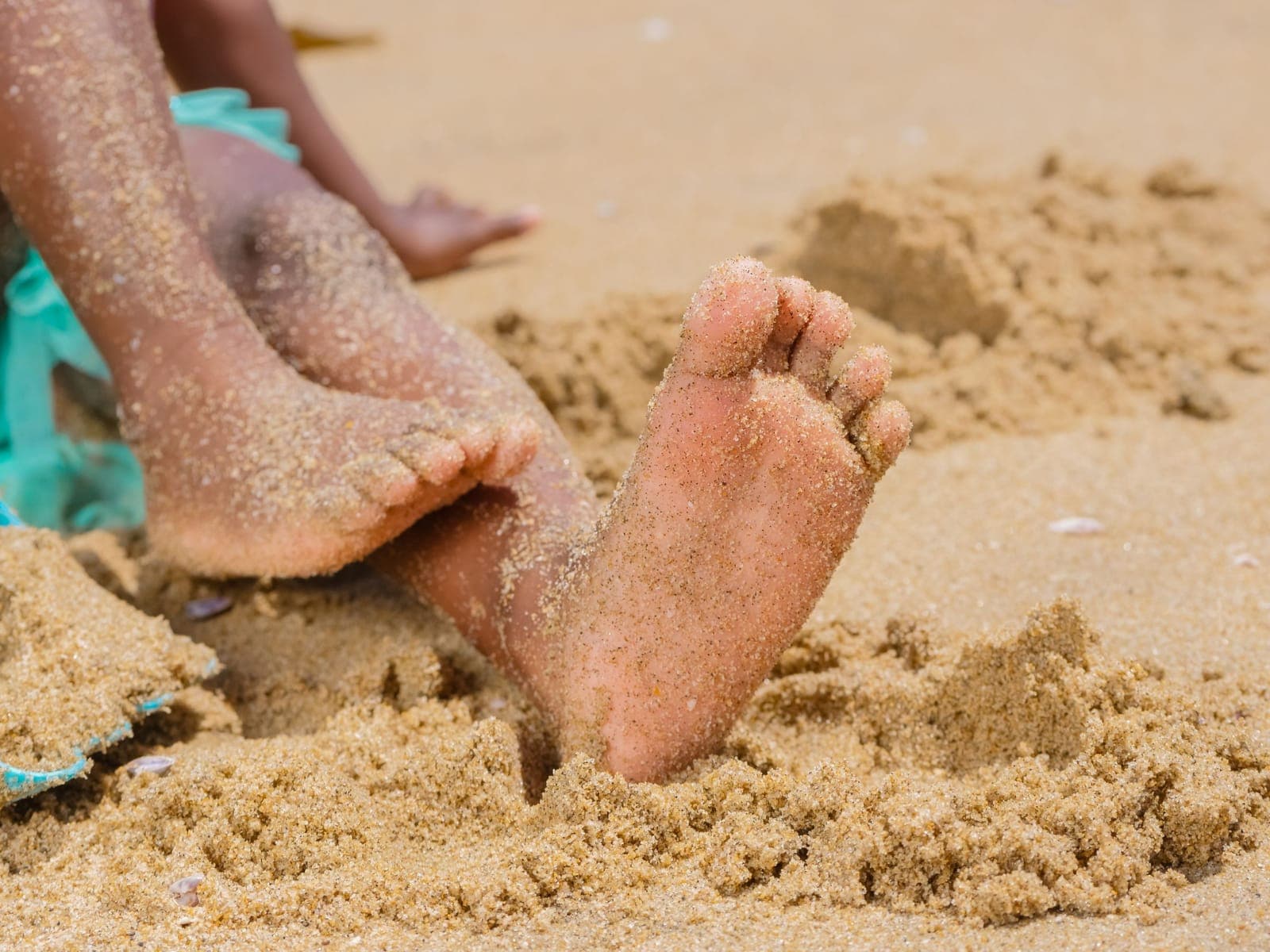
Beach sand grains are typically a fraction of a millimeter across - fine enough to behave almost like a liquid when dry. Pour it onto any textured surface and it finds every gap, and unlike mud it never binds to itself or to the fiber. It just sits there, loose, waiting to be picked up again.
On a flat mat that means the sand you scraped off is now on the surface you are standing on, and the next person through picks up a share of it. The mat has relocated the problem by about six inches. On a deep-pile mat it means the grains migrate down into the pile, out of reach of shaking, and the mat becomes a reservoir that releases sand slowly for months.
Bi-level construction is the answer, and it is the same mechanism our dirt-trapper roundup describes for grit: raised ribs carry the foot while the removed material falls into channels below the walking surface. With sand it works better than with anything else, because dry sand flows into those channels rather than clinging to the ribs.
How each surface handles dry sand specifically. Construction details are maker-published.
Quick picks
Ranked against the criteria below. Tap a row to jump to the full write-up; the price button goes straight to Amazon.
| # | Product | Best for | Score | Price |
|---|---|---|---|---|
| 1 | 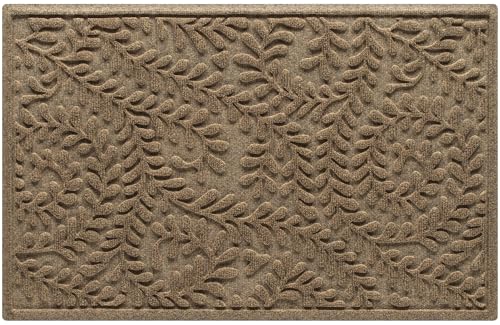 WaterHog Indoor/Outdoor Door Mat (Boxwood) The domestic version of the mat that has been in commercial lobbies for decades: published 3/8-inch construction, 24 oz per square yard PET, and made in the USA. | The commercial-grade option | 8.9/10 | $44.95 - View on Amazon #ad affiliate link · Price as of October 18, 2026 |
| 2 |  Gorilla Grip WeatherMAX Outdoor Doormat Natural rubber that is genuinely waterproof rather than water-resistant, which is the difference between a mat that drains and a mat that becomes a sponge in November. | Rain and outdoor use | 8.4/10 | |
| 3 |  Kempf 1-Inch Thick Natural Coco Coir Doormat Stiff coconut fiber at a published one-inch thickness | Scraping dried mud | 8.0/10 | $39.95 - View on Amazon #ad affiliate link · Price as of October 18, 2026 |
| 4 |  Smiry Natural Rubber Front Door Mat A competent low-profile rubber scraper at a lower price than the name brands, with the specification transparency to match the price Our skip-this pick | Budget outdoor scraper | 6.4/10 | |
| 5 |  Gorilla Grip SoakSTOPPER Indoor Doormat Dense chenille on a thermoplastic rubber backing that the maker says is third-party tested for repeated wash-and-dry cycles Our skip-this pick | The default indoor mat | 8.8/10 | $29.99 - View on Amazon #ad affiliate link · Price as of October 18, 2026 |
The commercial-grade option
WaterHog Indoor/Outdoor Door Mat (Boxwood)
The domestic version of the mat that has been in commercial lobbies for decades: published 3/8-inch construction, 24 oz per square yard PET, and made in the USA.
WaterHog is the mat you have already walked on hundreds of times without noticing - it is the standard entrance mat in commercial lobbies, and Bungalow Flooring sells domestic-sized versions of the same construction. Buying it is buying a specification rather than a look.
That specification is the most complete on this page. The Classic construction is published at three-eighths of an inch thick with a gripper backing, or closer to a quarter inch with the smooth backing intended for hard floors, using a 24 ounce per square yard PET fabric. Two numbers - thickness and fabric weight - are two more than most of this category publishes, and together they tell you almost everything: how much it holds, and whether your door will clear it.
The construction detail that matters is bi-level. The raised ridges hold the walking surface up while grit falls into the channels below, so the dirt you scrape off is not the dirt you then walk back over. That is why commercial buildings use it in the second zone of an entry system, and it works the same way at a domestic front door.
The honest downside is cleaning. This is not a mat you put in a washing machine. It hoses down well and it dries reasonably fast, but that is an outdoor job on a dry day rather than a laundry-day job. If the appeal of a mat for you is that it goes in the wash, buy chenille - see best absorbent chenille mats. If the appeal is that it will still be flat and still be working in five years, buy this.
What works
- Published thickness and published fabric weight - the most complete spec sheet here
- Bi-level construction traps grit below the walking surface instead of on it
- Beveled edges reduce the trip hazard and stop the corners curling
What does not
- Not machine washable - cleaning is a hose and a drying rack
- Costs meaningfully more than the chenille mats it sits beside
- Stiffer underfoot than an absorbent mat; it is built for traffic, not comfort
Rain and outdoor use
Gorilla Grip WeatherMAX Outdoor Doormat
Natural rubber that is genuinely waterproof rather than water-resistant, which is the difference between a mat that drains and a mat that becomes a sponge in November.
This mat has one job and it is not absorbency. It is a woven top bonded to a natural rubber backing, and the assembly sheds water rather than holding it. That sounds like a weakness until you have owned an absorbent outdoor mat through a wet November and discovered that what you actually own is a permanently saturated sponge that keeps the water at your threshold instead of away from it.
Outside the door, waterproof beats absorbent every time. Water needs to run off the mat and away; grit needs somewhere to fall out of the tread. Gorilla Grip builds this one with deep grooves, a beveled rubber border and what it calls a retention dam, then it cleans with a hose in thirty seconds - the cleaning method people will genuinely perform, unlike hauling a soaked outdoor mat into a washing machine.
Gorilla Grip also specifies stain and fade resistance, which matters more outdoors than most buyers expect. UV is what turns a black rubber mat chalky gray in a single summer, and a mat that has gone gray and stiff has usually also gone brittle around the edges.
The thing this mat cannot do is finish the job. It is stage one of a layered system - scrape outside, absorb inside. Pair it with a chenille mat immediately in from the door and you have the household version of what commercial buildings have used for decades. Buy it as the only mat and you will have clean boot treads and wet floors. Our coir versus chenille versus rubber comparison sets out which material belongs at which position.
What works
- Waterproof rather than absorbent - it never gets waterlogged and never needs drying
- Hoseable, which is the cleaning method most people will actually do
- Stain and fade resistant, so it does not go gray in a season of sun
What does not
- The woven top catches moisture but holds no useful volume - it still needs an absorbent mat inside
- One size per listing, so the 72x24in runner has to be bought separately
- Rubber goes stiff in hard frost
Scraping dried mud
Kempf 1-Inch Thick Natural Coco Coir Doormat
Stiff coconut fiber at a published one-inch thickness - the best mechanical scraper on this list and, at that thickness, an outdoor-only mat by definition.
Coir is the only material on this site that removes dirt mechanically rather than by absorbing it. Coconut fiber is stiff enough to act as a brush, which is why it takes caked, dried mud off a boot tread when a soft chenille mat just gets muddy. If the problem at your door is solid rather than wet - garden soil, dried clay, gravel dust - this is the material.
Kempf is on this list specifically because it publishes thickness. The standard line is one inch; there is a two-inch line for heavy scraping. Nobody else in the coir category will tell you a number, and thickness is the single most consequential spec a mat has once you consider where it has to sit.
Which brings the hard limit: at one inch, this mat cannot go under a door. Not a tight door, not any door - a standard interior door is hung with half to three-quarters of an inch of clearance and this mat is thicker than the gap. Coir lives outside the door, on the step or the porch, where the door swings away from it. That is not a compromise; that is the correct position for a scraper in a layered system.
Two honest warnings. Coir sheds, heavily, for the first few weeks - you will sweep loose fiber and it does stop. And coir is organic: left in a fully exposed position that stays wet, it will hold water and eventually rot. A covered porch or an overhang roughly doubles its usable life. If your entry has no cover at all, a rubber scraper is the more durable choice - see coir versus chenille versus rubber.
What works
- Kempf publishes an actual thickness figure, which almost no coir brand does
- Stiff coir bristles remove dried and caked mud that fabric mats simply cannot
- Natural fiber, no plastic pile, and it composts at end of life
What does not
- Sheds coir fiber for the first few weeks - this is normal and it is still a mess
- A 1-inch mat cannot go under any standard door
- Coir holds water and rots in a fully exposed position - it wants a porch or overhang
Budget outdoor scraper
Smiry Natural Rubber Front Door Mat
A competent low-profile rubber scraper at a lower price than the name brands, with the specification transparency to match the price - which is to say, not much.
Skip this one
Skip this one unless price is the deciding factor. It is not a bad mat - it is an unspecified one. Smiry publishes no thickness, no rubber grade and no durability testing, which means the only thing you can actually compare it on is price. Gorilla Grip's WeatherMAX costs a little more and at least tells you it is stain and fade resistant natural rubber; WaterHog costs more again and publishes both its thickness and its fabric weight. In a category where the failure mode is a mat going stiff and chalky after one summer of UV, buying the option that makes no durability claim at all is a gamble you are taking on purpose.
This is the mat we would not buy, and it is on the list because a roundup where everything wins is an advertisement rather than a comparison.
There is nothing wrong with it. It is natural rubber, it is low profile, it traps dirt and moisture in the way rubber mats do, and it hoses clean. If you bought it you would probably be fine.
The problem is that Smiry publishes nothing you can check. No thickness, so you cannot answer the door-clearance question before it arrives. No rubber grade or UV treatment, so you cannot predict whether it survives a summer. No durability claim of any kind, which in a category whose characteristic failure is exactly durability - rubber going chalky, stiff and brittle - is the specification that matters most.
Compare that with the alternatives at close to the same money. Gorilla Grip states stain and fade resistance on the WeatherMAX. WaterHog publishes thickness, fabric weight and construction. Kempf publishes coir thickness to the inch. Buying the unspecified option saves a few dollars and costs you the ability to tell whether you bought the right thing until a year has passed. That is the trade, stated plainly; if you take it knowingly, that is a legitimate choice.
What works
- Genuinely cheap for a natural rubber mat
- Hoseable, like every rubber mat, which is the easiest cleaning routine there is
- Low profile enough for most door swings
What does not
- No published thickness, no published rubber grade, no published durability claim
- One size only
- Nothing here that the better-specified rubber mats do not do better
The default indoor mat
Gorilla Grip SoakSTOPPER Indoor Doormat
Dense chenille on a thermoplastic rubber backing that the maker says is third-party tested for repeated wash-and-dry cycles - the failure point that kills most washable mats.
Skip this one
Skip deep chenille anywhere sand is the problem, which is the exact reversal of what this site recommends for mud and water. A dense pile is a trap, and against sand it traps beautifully and then will not let go - fine dry grains work down between the fibers where shaking does nothing, and you end up putting a mat full of abrasive grit through a washing machine, which is hard on the machine and only partly effective. It remains our default indoor mat everywhere else. At a beach house it is the wrong surface at the front door and a perfectly good one two rooms in.
This is the mat most households should start with, and the reason is the part nobody photographs: the backing. Gorilla Grip publishes a specific claim about it - a thermoplastic rubber backing that it says has been third-party tested to survive being washed and dried repeatedly, and it explicitly contrasts that with the PVC and hot-glue backings used elsewhere. That is the correct thing to make a claim about. A chenille mat's absorbency barely changes over its life; what changes is whether the backing is still flat and still gripping after the tenth wash.
The care label is strict and worth obeying literally: machine wash cold, tumble dry low, no bleach, no dry clean, and - the one people ignore - no fabric softener. Softener coats microfiber and is the single fastest way to turn an absorbent mat into a mat that pushes water around. If your household washes everything with a softener sheet in the drum, this mat will underperform and it will not be the mat's fault.
Size is the other reason it leads. Six sizes run from a 24 by 17 inch doormat up to a 70 by 24 inch runner, which means the same product can cover a single back door or the whole first three strides of a hallway. Walk-off distance is the variable that actually determines how much dirt gets stopped - the commercial matting industry sizes entry systems in feet of walk-off, not in mats - so being able to buy length matters more than most spec sheets suggest.
The catch is clearance. Gorilla Grip does not publish a pile height for this mat, and a dense chenille pile is not a low-profile pile. If it is going behind an inward-opening door with a standard half-inch to three-quarter-inch undercut, measure first - see our door clearance guide. The maker also states this is indoor only and specifically not recommended for concrete, which rules out the garage-door and unfinished-basement placements people often want it for.
What works
- Backing is the part the maker actually stakes a claim on - most mats fail there first
- OEKO-TEX Standard 100 tested for harmful substances
- Six sizes including a 70-inch runner, so one product covers a hallway
What does not
- No published pile height, which matters if your door clearance is tight
- Indoor only - the maker specifically warns against concrete
- Fabric softener will destroy the absorbency; the care label is strict
Two mats, and the second one is the trick
The arrangement that actually works at a beach house is not one clever mat. It is a scraping mat outside that takes the bulk, and a second mat immediately inside that takes what the first one missed - the same two-position logic as indoor vs outdoor mats with a different surface at the second station.
Inside, the second mat should still not be deep chenille. A low-profile woven or ridged rubber mat gives the remaining grains somewhere to fall and can be picked up and shaken over a step. That is a ten-second job; emptying a chenille pile of sand is not a job at all, it is a wash.
If the household genuinely wants something soft underfoot inside the door, put it one room further in, past both sand stations. It will last far longer and it will not be the thing collecting grit.
Salt, sun and what survives a coastal position
A beach-house entry is a harsher place than a suburban porch. Salt air is corrosive to metal fixings and accelerates the breakdown of some polymers, the UV load is higher near reflective sand and water, and the mat is frequently wet with salt water rather than fresh.
That has one clear implication: coir is the material to be careful with. It is superb at scraping dry sand - stiff, cheap and effective - and it is an organic fiber that rots when it stays wet, and a coastal position is often wet. Under a covered porch it will last seasons; fully exposed to spray and rain, it will not.
Rubber and recycled PET both tolerate the position far better, and the mats with a stated stain and fade resistance are the ones to prefer where the sun is direct. Whatever you buy, hose the salt off it occasionally - salt left to dry in a mat is abrasive on the fiber and hard on any metal underneath.
Buy it this way
- Buy geometry, not absorbency. Bi-level or deeply grooved, so sand drops below the surface you walk on.
- Two positions. A scraper outside and a shakeable low-profile mat immediately inside.
- Keep deep chenille away from the sand door - it traps beautifully and never gives it back.
- Shake and hose; do not machine wash. Sand in a drum is bad for the machine and only partly comes out anyway.
- Covered porch, coir is excellent. Fully exposed, buy rubber or PET - coir rots in a position that never dries.
Questions people ask
What is the best doormat for sand?
Why is a plush doormat bad for sand?
Can you wash a sandy doormat in a washing machine?
Is coir good for a beach house?
How many mats do I need at a beach house door?
Does salt damage door mats?
Sources
- WaterHog Boxwood - Amazon detail page (bi-level ridged design stated to resist crushing, 3/8in height, shake / vacuum / hose care)
- Gorilla Grip WeatherMAX - Amazon detail page (deep grooves, beveled rubber border and retention dam, natural rubber backing, stain and fade resistant)
- Kempf coco coir doormat - Amazon detail page (1in stiff coir, open woven backing, shake or tap clean, no washing; best placed in covered positions)
- Smiry natural rubber front door mat - Amazon detail page (molded natural rubber, hoseable)
- Gorilla Grip SoakSTOPPER - maker product page (dense chenille pile, machine wash care label)
Next stage
Stage 3 - contain
Sandy flip-flops and wet swim shoes still need somewhere to sit that is not your floor.
Keep goingAbout the author
Scooter M.
An enthusiast who is genuinely into this. I read the manuals, compile the published specs, and do the math on door clearances. No lab coat, no test bench, and nothing here is a product I have used - which is exactly why every claim carries a source.
Published by Slate Mill Group, with the Mud & Mat team. Published September 13, 2026; last updated September 13, 2026. Editorial policy.
Read next

Best Outdoor Mat
Best outdoor coir doormats
Stiff coir scrapes what fabric cannot - but it is organic, so where you put it decides how long it lasts.

Material Decision
Coir vs chenille vs rubber door mats
The material table this category never publishes - scraping, absorbency, weather and cleaning, side by side.
Best Dirt Trapper
Best dirt trapper door mats
Trapping is a construction property, not a marketing word - here is which mats actually get grit below the walking surface.
Cleaning Procedure
How to clean a doormat
Three materials, three procedures - and the one laundry habit that destroys an absorbent mat.