By Scooter M. · Last updated September 9, 2026
Mud & Mat earns a commission when you buy through the links on this page, at no extra cost to you. It does not change what we recommend, and we publish a skip-this verdict on products we could otherwise earn from. Full disclosure.
Buy a mat whose maker names the backing polymer and says which floors it is safe on - not one that only says non-slip. Nearly every absorbent mat in this category now publishes a polymer: TPR, TPE, or a rubber compound. Almost none publishes a friction figure, and only one mat we compiled carries a third-party slip-resistance marker. What separates a good backing from a bad one in practice is whether it is named, whether the maker states floor compatibility, and whether it survives being washed - because a backing that has curled or gone hard is a mat that slides.
Non-slip is the most common claim in this category and one of the least informative. It appears on almost every listing, it is not defined anywhere, and no retailer requires anything to be measured before it can be printed. Two mats can both say non-slip and behave completely differently on the same tile floor.
What is actually underneath a mat is a thin layer of polymer, and there are only a handful of them in use. Once you know which one you are buying, the claim stops being a slogan and starts being checkable - and the differences between them are real, particularly on the floor types where a backing can do damage rather than just slide.
How we compared backings
How we picked
- Whether the maker names the polymer. TPR, TPE, natural rubber, SBR - a named material can be reasoned about. The word non-slip on its own cannot, and we treat an unnamed backing the same way we treat an unpublished thickness: as a gap rather than as a pass.
- Whether the maker states floor compatibility. This is the claim that matters most and the one most often missing. A backing safe on ceramic tile is not automatically safe on luxury vinyl, and a maker who names the floors it has considered is telling you something the friction word never does.
- Third-party marking, where any exists. Exactly one product in this set carries a slip-resistance marker from a named organization. That is not a certification of the whole category and we do not treat it as one - but a named third party is worth more than an adjective.
- Survivability through the wash. A washable mat's backing is the part that fails: it delaminates, curls at the corners, or goes hard and stops gripping. A maker who makes a specific durability claim about the backing is making a claim about the actual failure mode.
- No friction figures, because nobody publishes any. No maker in this set states a coefficient of friction, wet or dry, and we will not estimate one. Where we rank on grip we are ranking on published construction and stated floor compatibility, and we say so.
We have not physically tested these products. We do not own them, we have no lab, and we do not accept free product. Everything above is compiled from published manufacturer specifications, published care guidance and live retailer data - and we tell you which is which on every claim. How we pick.
The backings actually in use
TPR - thermoplastic rubber. The default on washable chenille mats. It is a rubber-like polymer that can be melted and re-formed, which is why it can be bonded to a fabric mat in one piece rather than glued on. Gorilla Grip and Soggy Doggy both name it, and Soggy Doggy specifies that its TPR is non-latex, which matters if anybody in the house has a latex sensitivity.
TPE - thermoplastic elastomer. A closely related family; TPR is usually described as a subset of it. Muddy Mat names TPE specifically and states grip on both tile and hardwood. In practice a buyer will not be able to tell TPR and TPE apart by feel, and both behave the same way in the two situations that matter: they harden if they are tumble-dried hot, and they can mark soft flooring over time.
Natural rubber and SBR. The outdoor and commercial answer. WaterHog uses a rubber backing containing 20 percent recycled SBR, and the Gorilla Grip WeatherMAX uses natural rubber. Rubber is heavier, grips harder, tolerates weather and UV, and is the compound most associated with discoloring vinyl - which is why it is worth reading the floor list rather than assuming.
PVC and hot glue. The cheap constructions, and the ones Gorilla Grip explicitly names as what it is not using - its listing contrasts its TP rubber backing with other brands that use PVC or hot glue that break down over time. Nobody advertises a hot-glue backing, so you will only identify it by absence: a mat that names no polymer at all.
No backing. Coir is the honest outlier. Kempf states plainly that its mat has an open woven backing with no PVC, no rubber and no synthetics, and it frames that as a feature - air circulates and the fibers dry faster than a rubber-backed mat. It is also exactly why a coir mat slides on a smooth floor: there is nothing under it that is trying to grip.
What each maker actually publishes
Manufacturer- or retailer-published statements only. Nobody in this set publishes a coefficient of friction.
Read down the third column rather than the second. Naming the polymer is now close to standard; naming the floors is not, and it is the column that answers the question a buyer actually has. One mat in this set lists five floor types and flags a sixth as needing a check. Two name a floor type in passing. Two name none at all.
Quick picks
Ranked against the criteria below. Tap a row to jump to the full write-up; the price button goes straight to Amazon.
| # | Product | Best for | Score | Price |
|---|---|---|---|---|
| 1 | 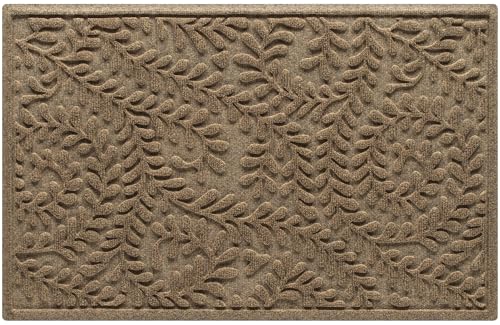 WaterHog Indoor/Outdoor Door Mat (Boxwood) The domestic version of the mat that has been in commercial lobbies for decades: published 3/8-inch construction, 24 oz per square yard PET, and made in the USA. Our skip-this pick | The commercial-grade option | 8.9/10 | $44.95 - View on Amazon #ad affiliate link · Price as of October 18, 2026 |
| 2 |  Soggy Doggy Microfiber Chenille Doormat Published fiber blend, published noodle length and an extra-large 36x60 size | Big dogs and big spaces | 8.6/10 | $43.99 - View on Amazon #ad affiliate link · Price as of October 18, 2026 |
| 3 | 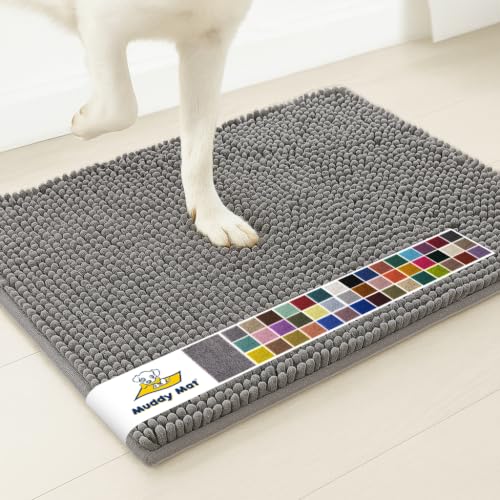 Muddy Mat Original Absorbent Door Mat A one-inch chenille pile the maker says absorbs five times its own weight | Wet dog paws | 8.5/10 | $22.70 - View on Amazon #ad affiliate link · Price as of October 18, 2026 |
| 4 |  Gorilla Grip SoakSTOPPER Indoor Doormat Dense chenille on a thermoplastic rubber backing that the maker says is third-party tested for repeated wash-and-dry cycles | The default indoor mat | 8.8/10 | $29.99 - View on Amazon #ad affiliate link · Price as of October 18, 2026 |
| 5 |  Kempf 1-Inch Thick Natural Coco Coir Doormat Stiff coconut fiber at a published one-inch thickness | Scraping dried mud | 8.0/10 | $39.95 - View on Amazon #ad affiliate link · Price as of October 18, 2026 |
The commercial-grade option
WaterHog Indoor/Outdoor Door Mat (Boxwood)
The domestic version of the mat that has been in commercial lobbies for decades: published 3/8-inch construction, 24 oz per square yard PET, and made in the USA.
Skip this one
Skip this one on vinyl or luxury vinyl plank until you have checked with your flooring manufacturer, and that is the maker's own instruction rather than ours. WaterHog lists the floors its rubber backing is suitable for - hardwood, ceramic and porcelain tile, natural stone, concrete - and then singles vinyl out with a caveat telling you to refer to the flooring manufacturer's care guidelines. Rubber-backed mats on vinyl are a known discoloration risk, and a mat that stains a floor has cost you more than it saved. On every other floor type in that list this is the best-documented backing on this site, and the mat we would buy.
WaterHog is the mat you have already walked on hundreds of times without noticing - it is the standard entrance mat in commercial lobbies, and Bungalow Flooring sells domestic-sized versions of the same construction. Buying it is buying a specification rather than a look.
That specification is the most complete on this page. The Classic construction is published at three-eighths of an inch thick with a gripper backing, or closer to a quarter inch with the smooth backing intended for hard floors, using a 24 ounce per square yard PET fabric. Two numbers - thickness and fabric weight - are two more than most of this category publishes, and together they tell you almost everything: how much it holds, and whether your door will clear it.
The construction detail that matters is bi-level. The raised ridges hold the walking surface up while grit falls into the channels below, so the dirt you scrape off is not the dirt you then walk back over. That is why commercial buildings use it in the second zone of an entry system, and it works the same way at a domestic front door.
The honest downside is cleaning. This is not a mat you put in a washing machine. It hoses down well and it dries reasonably fast, but that is an outdoor job on a dry day rather than a laundry-day job. If the appeal of a mat for you is that it goes in the wash, buy chenille - see best absorbent chenille mats. If the appeal is that it will still be flat and still be working in five years, buy this.
What works
- Published thickness and published fabric weight - the most complete spec sheet here
- Bi-level construction traps grit below the walking surface instead of on it
- Beveled edges reduce the trip hazard and stop the corners curling
What does not
- Not machine washable - cleaning is a hose and a drying rack
- Costs meaningfully more than the chenille mats it sits beside
- Stiffer underfoot than an absorbent mat; it is built for traffic, not comfort
Big dogs and big spaces
Soggy Doggy Microfiber Chenille Doormat
Published fiber blend, published noodle length and an extra-large 36x60 size - the most transparent spec sheet of any paw mat here, and the maker admits the pile compresses under a door.
Soggy Doggy publishes the thing everyone else hides: an 80 percent polyester, 20 percent polyamide microfiber chenille blend, with one-inch noodles. That blend matters. Polyamide is the component that actually pulls water rather than pushing it around, and a mat that tells you the ratio is a mat whose maker expects to be checked. In a category where seven of eight competing publishers state no specification of any kind, that is worth a lot.
The maker also says something most brands would leave out - that the noodles compress if the mat is placed a few inches from the door frame. That is an honest way of describing a door-clearance problem, and it is the correct read. A one-inch pile against a half-inch to three-quarter-inch door undercut does not clear; it compresses, drags, and eventually the door wins.
The size range is where this earns its place over cheaper chenille. The extra-large is 36 by 60 inches. That is five feet of walk-off, which is the length at which a mat stops being a doormat and starts being an entry system. The commercial matting trade sizes entry zones at ten to fifteen feet of total walk-off to stop the large majority of tracked-in soil; a domestic entryway is never going to get there, but five feet gets you two to three full strides instead of one.
Practical warning on the XL: 36 by 60 inches of saturated chenille is a heavy, bulky wash load, and a standard domestic top-loader will struggle to agitate it properly. If you buy the XL, plan on a front-loader, a laundromat trip, or hosing it down outside and drying it flat. The mat is machine dryable, which helps - but a mat you cannot realistically wash is a mat that stops absorbing.
What works
- Publishes the actual fiber blend - almost unheard of in this category
- 36x60 inch XL is genuinely large enough to be a walk-off zone, not a doormat
- Machine dryable, which shortens the turnaround in a wet week
What does not
- The 1-inch noodle pile has the same door-clearance problem as every deep mat
- The XL size is a serious load in a domestic washing machine
- Priced above the generic chenille mats it competes with on absorbency
Wet dog paws
Muddy Mat Original Absorbent Door Mat
A one-inch chenille pile the maker says absorbs five times its own weight - the deepest-pile mainstream option, and the one that most often will not clear a door.
Muddy Mat is the brand most people in this category have already heard of, and the demand data agrees - it is the single highest-volume product query in the entryway-mat space. The reason it earns that position is the pile. The maker states roughly a one-inch chenille layer that soaks up to five times its own weight, and depth is genuinely what separates a mat that holds a wet dog from a mat that smears one down the hall.
That same inch is the reason this mat needs a placement decision rather than a purchase decision. A standard interior door is hung with roughly half an inch to three-quarters of an inch of clearance above the finished floor. A one-inch pile does not fit under that. It will compress a little, and it will still catch. If the mat is going behind an inward-opening door, this is the wrong mat and no amount of liking it changes the arithmetic - put a low-profile mat at the swing and put this one just past it.
Where it belongs is the strip immediately inside the door, past the swing, or in a mudroom where the door opens outward. That is also where a wet dog actually shakes. The 60 by 24 inch runner is the size worth considering for a dog household: paw prints are not a doorway problem, they are a first-four-strides problem, and a 28-inch mat gets you one stride.
Cleaning is straightforward but has one rule people skip: shake or hose the mat before it goes in the machine. Chenille holds grit as effectively as it holds water, and washing a mat still full of dry mud puts that mud into your drum and back into the pile. Drying is the other honest limitation - a one-inch pile takes meaningfully longer to dry than a quarter-inch one, so a single mat in a two-dog household will spend part of its week damp. Two mats in rotation is the practical answer, and it is cheaper than a replacement floor. See our dog and paw mat picks for the full comparison.
What works
- The deepest published pile in this comparison - it holds a genuinely wet dog
- Runner size covers the first strides after the door, where paw prints actually land
- Machine washable, so the mud leaves rather than accumulating
What does not
- A 1-inch pile will not clear a standard interior door undercut - a placement decision, not a preference
- Deep pile takes noticeably longer to dry than a low-profile mat
- Needs shaking out before washing or the mud goes into your machine
The default indoor mat
Gorilla Grip SoakSTOPPER Indoor Doormat
Dense chenille on a thermoplastic rubber backing that the maker says is third-party tested for repeated wash-and-dry cycles - the failure point that kills most washable mats.
This is the mat most households should start with, and the reason is the part nobody photographs: the backing. Gorilla Grip publishes a specific claim about it - a thermoplastic rubber backing that it says has been third-party tested to survive being washed and dried repeatedly, and it explicitly contrasts that with the PVC and hot-glue backings used elsewhere. That is the correct thing to make a claim about. A chenille mat's absorbency barely changes over its life; what changes is whether the backing is still flat and still gripping after the tenth wash.
The care label is strict and worth obeying literally: machine wash cold, tumble dry low, no bleach, no dry clean, and - the one people ignore - no fabric softener. Softener coats microfiber and is the single fastest way to turn an absorbent mat into a mat that pushes water around. If your household washes everything with a softener sheet in the drum, this mat will underperform and it will not be the mat's fault.
Size is the other reason it leads. Six sizes run from a 24 by 17 inch doormat up to a 70 by 24 inch runner, which means the same product can cover a single back door or the whole first three strides of a hallway. Walk-off distance is the variable that actually determines how much dirt gets stopped - the commercial matting industry sizes entry systems in feet of walk-off, not in mats - so being able to buy length matters more than most spec sheets suggest.
The catch is clearance. Gorilla Grip does not publish a pile height for this mat, and a dense chenille pile is not a low-profile pile. If it is going behind an inward-opening door with a standard half-inch to three-quarter-inch undercut, measure first - see our door clearance guide. The maker also states this is indoor only and specifically not recommended for concrete, which rules out the garage-door and unfinished-basement placements people often want it for.
What works
- Backing is the part the maker actually stakes a claim on - most mats fail there first
- OEKO-TEX Standard 100 tested for harmful substances
- Six sizes including a 70-inch runner, so one product covers a hallway
What does not
- No published pile height, which matters if your door clearance is tight
- Indoor only - the maker specifically warns against concrete
- Fabric softener will destroy the absorbency; the care label is strict
Scraping dried mud
Kempf 1-Inch Thick Natural Coco Coir Doormat
Stiff coconut fiber at a published one-inch thickness - the best mechanical scraper on this list and, at that thickness, an outdoor-only mat by definition.
Coir is the only material on this site that removes dirt mechanically rather than by absorbing it. Coconut fiber is stiff enough to act as a brush, which is why it takes caked, dried mud off a boot tread when a soft chenille mat just gets muddy. If the problem at your door is solid rather than wet - garden soil, dried clay, gravel dust - this is the material.
Kempf is on this list specifically because it publishes thickness. The standard line is one inch; there is a two-inch line for heavy scraping. Nobody else in the coir category will tell you a number, and thickness is the single most consequential spec a mat has once you consider where it has to sit.
Which brings the hard limit: at one inch, this mat cannot go under a door. Not a tight door, not any door - a standard interior door is hung with half to three-quarters of an inch of clearance and this mat is thicker than the gap. Coir lives outside the door, on the step or the porch, where the door swings away from it. That is not a compromise; that is the correct position for a scraper in a layered system.
Two honest warnings. Coir sheds, heavily, for the first few weeks - you will sweep loose fiber and it does stop. And coir is organic: left in a fully exposed position that stays wet, it will hold water and eventually rot. A covered porch or an overhang roughly doubles its usable life. If your entry has no cover at all, a rubber scraper is the more durable choice - see coir versus chenille versus rubber.
What works
- Kempf publishes an actual thickness figure, which almost no coir brand does
- Stiff coir bristles remove dried and caked mud that fabric mats simply cannot
- Natural fiber, no plastic pile, and it composts at end of life
What does not
- Sheds coir fiber for the first few weeks - this is normal and it is still a mess
- A 1-inch mat cannot go under any standard door
- Coir holds water and rots in a fully exposed position - it wants a porch or overhang
The figure none of them publish
There is a real number behind all of this - coefficient of friction, measured dry and wet - and no maker in this category publishes it for a domestic door mat. The National Floor Safety Institute runs a certification program around traction, and exactly one product here references it: WaterHog states its skid resistance is supported by the NFSI, and the commercial WaterHog Classic line is described by matting distributors as certified by that body.
We are being deliberately careful with that sentence. Supported by is the wording on the domestic listing, and it is not the same as a published test result with a number attached. It is still the only third-party reference point in the set, which tells you how thin the ground is here. Everything else on the market is an unqualified adjective.
What a backing can do to a floor
Slipping is the risk everybody thinks about. Staining is the one that actually costs money, and it is specific: rubber and some rubber-like compounds can discolor vinyl and luxury vinyl plank over months of contact, typically as a yellow or amber shadow in the shape of the mat. It is a chemical interaction between plasticizers rather than dirt, and it does not come out.
This is why the WaterHog listing is worth quoting rather than paraphrasing: it names hardwood, ceramic and porcelain tile, natural stone and concrete as suitable, then singles out vinyl and tells you to refer to your flooring manufacturer's care guidelines. That is a maker declining to make a promise, which is more useful than a maker who never mentions the floor at all.
The practical rule: on vinyl or LVP, check the flooring manufacturer's guidance before you put any rubber-backed mat down, and prefer a mat whose maker names your floor type. On sealed hardwood the bigger risk is not the backing at all - it is trapped moisture under a saturated mat, which is a different problem and is covered in mats for hardwood floors.
How backings fail
A mat's pile barely changes over its life. The backing is what wears out, and it does it in three recognizable ways. It delaminates - the polymer layer separates from the fabric and the mat starts to move as two pieces. It curls, usually at a corner, which is both a trip point and the beginning of the end. Or it hardens, losing the slight tack that made it grip in the first place.
All three are accelerated by heat. A tumble dryer on high is the single most effective way to destroy a TPR or TPE backing, which is why the care labels on these mats say tumble low without explaining why. Gorilla Grip is the one maker here that turns backing durability into a published claim, stating its TP rubber backing has been third-party tested to survive repeated washing and drying, and contrasting it with PVC and hot-glue constructions.
That is the right thing for a maker to make a claim about, because it is the failure that actually happens. If you are choosing between two similar mats and one of them says something specific about the backing surviving the wash, that is a more meaningful difference than any absorbency adjective. The washing side of the trade-off is in washable vs hoseable mats.
Coir, and the mats with nothing underneath
A traditional coir mat has an open woven backing and no grip layer. Kempf states that directly - no PVC, no rubber, no synthetics - and presents it as a benefit, which it genuinely is in the position coir belongs in: air moves through the mat and the fibers dry faster than they would on a sealed rubber base.
Outdoors on a rough surface, that is fine. The mat's own weight and the texture of a concrete or stone step hold it in place. On a smooth interior floor it is a different story: a stiff, light mat with a woven underside will move under a foot, and that is one of the reasons this site keeps saying coir belongs outside. If a coir mat has to go on tile, it needs a rug pad underneath it, and that is not an optional refinement.
When to add a rug pad
A separate pad is the right answer in three situations: a coir or woven mat on a smooth floor, an older mat whose backing has hardened, and any mat on a floor where you would rather have the pad in contact with the finish than the mat's own polymer. That last one is a reasonable precaution on vinyl.
What not to use is adhesive. Carpet tape on a finished wood floor removes finish when it comes up, and double-sided tape on vinyl leaves residue that attracts grit and turns into a gray line. A pad works by friction on both faces and is meant to be liftable - which matters, because you have to be able to pick the mat up to dry it.
Testing the mat you already own
- Push it with a flat hand, hard, at the leading edge. If it moves as one piece, the backing is intact but not gripping. If the top moves and the backing stays, it has delaminated and the mat is finished.
- Feel the underside. A working TPR or TPE backing has a slight tack. A hard, dry, plasticky surface has been heat-damaged and will not recover.
- Check the corners. Curling is the earliest visible failure and the corner is where it starts.
- Look at the floor underneath. A shadow or discoloration in the shape of the mat means the backing and the floor finish are reacting; move the mat and stop using that construction on that floor.
- Wet the underside and repeat the push test. Most slips happen when a mat is wet, and a backing that grips dry and skates wet is worth knowing about before somebody finds out the hard way.
Buy it this way
- Prefer a named polymer over the word non-slip. TPR, TPE, SBR or natural rubber - all fine, all reasonable. Unnamed is a gap.
- Prefer a maker who names your floor type, and treat a stated caveat as a good sign rather than a bad one.
- On vinyl or LVP, check the flooring maker's guidance first before any rubber-backed mat goes down.
- Wash cold and tumble low, always. Heat is what kills these backings, and no backing survives being cooked.
- A coir or woven mat on a smooth floor needs a rug pad, not a hope. There is nothing under it doing that job.
Questions people ask
What does non-slip actually mean on a door mat?
What is TPR backing on a mat?
What is the difference between TPR and TPE backing?
Will a rubber-backed mat damage my floor?
Why has my mat stopped gripping?
Do coir mats slip?
Sources
- WaterHog Boxwood - Amazon detail page (rubber backing with 20% recycled SBR, floors named including the vinyl caveat, skid resistance stated as supported by the National Floor Safety Institute)
- Soggy Doggy - Amazon detail page (textured rubber backing for traction, non-latex TPR, stated safe for wood and tile floors)
- Muddy Mat - Amazon detail page (textured TPE thermoplastic elastomer backing, stated grip on tile and hardwood)
- Gorilla Grip SoakSTOPPER - Amazon detail page (TPR backing with grippy underside, third-party wash testing, PVC and hot-glue contrast)
- Kempf coco coir doormat - Amazon detail page (open woven backing, no PVC, no rubber, no synthetics)
- WaterHog Classic - distributor specification citing National Floor Safety Institute certification
Next stage
The mats themselves
Once you know what to look for underneath, here is what we would actually buy.
Keep goingAbout the author
Scooter M.
An enthusiast who is genuinely into this. I read the manuals, compile the published specs, and do the math on door clearances. No lab coat, no test bench, and nothing here is a product I have used - which is exactly why every claim carries a source.
Published by Slate Mill Group, with the Mud & Mat team. Published September 9, 2026; last updated September 9, 2026. Editorial policy.
Read next
Cleanability
Washable vs hoseable mats
Machine washable or hoseable - decided by the routine your household will realistically keep up.
Hardwood Guide
Mats for hardwood floors
Standing water and trapped grit - the two ways a mat damages the floor it was bought to protect.
Best Indoor Mat
Best indoor entryway mats for mud and water
Six indoor mats ranked on absorbency, wash durability and whether your door will actually clear them.

Door Clearance Data
Low-profile mats and door clearance
Published mat thicknesses against the real door undercut - the arithmetic nobody else prints.
Carpet Placement
Can you put a doormat on carpet?
Yes - but thin and flat, not rubber-backed and thick. Why the mat that grips tile creeps on carpet.