By Scooter M. · Last updated October 3, 2026
Mud & Mat earns a commission when you buy through the links on this page, at no extra cost to you. It does not change what we recommend, and we publish a skip-this verdict on products we could otherwise earn from. Full disclosure.
Muddy Mat is worth it if it goes somewhere a door does not swing, and a mistake if you were planning to put it inside your front door. It publishes a 1 inch chenille pile, a claim of soaking up to 5 times its own weight, and a TPE backing. One inch is the number that decides everything: a standard interior door is hung with roughly half an inch to three-quarters of an inch of clearance, so this mat does not fit under one.
This is the most searched absorbent dog mat on the market, and it appears in two of our head-to-heads already - the Gorilla Grip comparison and the three-way against OLANLY and Smiry. What it has not had on this site is a page about the mat on its own terms, which is what this is: what the maker publishes, what those figures mean, and who should not buy it.
The short version is that it is a good mat sold with one specification that buyers routinely discover too late. Everything else here is detail around that.
The 1 inch pile, and the door
The listing describes a thick layer of plush 1-inch chenille, and the pile height field reads High Pile. That is the specification, and it is unusually honest - most of this category sells on the word plush and publishes nothing you can measure.
It is also disqualifying for the most common place people intend to put it. Our door clearance guide sets published pile heights against the undercut a door is actually hung with, which is roughly half an inch to three-quarters of an inch, and NFPA 80 caps a fire-rated door's undercut at three-quarters. A one inch mat is above that range by a comfortable margin. It will not slide under an inward-opening front door, and if you force the issue the door will drag on it, the pile will flatten in an arc, and the mat will be ruined in the shape of the swing.
That does not make it a bad mat. It makes it a mat for a position past the door swing: the middle of a hallway, the far side of a back door, in front of a crate, beside a bath. Buy it for where the dog stops, not for the threshold itself.
What 5 times its weight actually tells you
The absorbency claim is that the chenille soaks up to 5 times its weight in water. That is a ratio rather than a volume, which makes it less useful than it first appears, because the listing we read does not publish the mat's own weight - so there is no second number to multiply it by.
It is also worth knowing what the competition claims, because this is a category where the numbers are directly comparable. The Dog Gone Smart Dirty Dog Doormat publishes 3000 GSM and a claim of 7 times its weight. Our drying towel roundup ranks on GSM for exactly this reason: fabric weight per unit area is the measure that lets you compare two products of different sizes. Muddy Mat does not publish a GSM figure, and against a competitor that does, a bare multiple is the weaker claim.
None of which means it underperforms. A deep chenille pile holds a great deal of water and this one is thicker than most. It means the published evidence is thinner than it looks, and anyone comparing two mats on their marketing should know that 5x and 7x are not measurements taken the same way, or necessarily taken at all.
The backing, and the floor underneath
The backing is TPE - thermoplastic elastomer - which the listing describes as textured for grip on tile and hardwood. This matters more than grip alone, and our non-slip backing guide sets out why: the backing is the part that sits against your floor finish for months at a time, and the cheap alternative, latex, is what yellows a hardwood finish and crumbles in a hot wash.
TPE is the right choice for a mat that is going to be washed repeatedly. It survives the machine, it does not shed, and it is the same family of material used on the better mats across this site. For a dog mat specifically, which gets washed far more often than a human doormat, that is the single most important construction decision the maker makes, and they made it correctly.
Washing it, which you will do a lot
The published instructions are cold water, gentle or delicates cycle, tumble dry on low heat on the gentle cycle. That is a real machine-wash mat rather than a hose-only one, which is the distinction our washable versus hoseable guide is built around, and for an indoor dog mat it is the right side of that line.
Two practical consequences follow. First, buy the size that genuinely fits your machine, not the biggest one offered - a mat you have to take to a laundromat gets washed a quarter as often as one that fits at home, and a dog mat that is not washed is just a damp thing that smells. Second, cold and gentle is not a suggestion; hot washes and high heat are what destroy elastomer backings, and the fastest way to turn this mat into a shedding problem is to treat it like a towel.
Two things on the listing to ignore
The structured dimensions field reads 31.5 inches long by 5 inches wide, which is not the mat - that is the rolled package. The size field gives 19 by 30 inches for the variant we priced, and the size you choose at the selector is the one that matters. Do not plan a space from the dimensions box.
The water resistance field reads Not Water Resistant, which on a mat sold entirely on water absorption reads like a contradiction and is not one. Water resistant means water stays out. This mat is designed to take water in and hold it, which is the opposite property and the one you want. It is a badly chosen field on Amazon's side rather than a claim by the maker.
Quick picks
Ranked against the criteria below. Tap a row to jump to the full write-up; the price button goes straight to Amazon.
| # | Product | Best for | Score | Price |
|---|---|---|---|---|
| 1 | 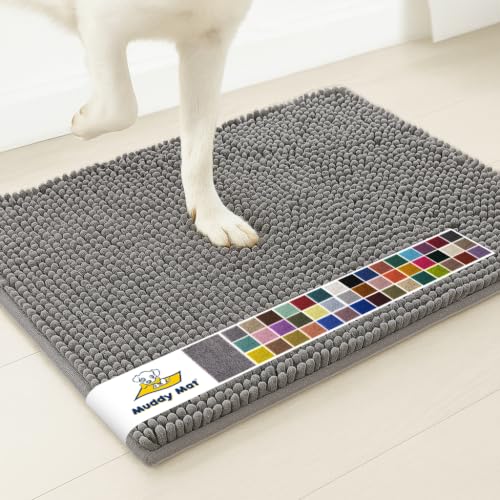 Muddy Mat Original Absorbent Door Mat A one-inch chenille pile the maker says absorbs five times its own weight | Wet dog paws | 8.5/10 | $22.70 - View on Amazon #ad affiliate link · Price as of October 18, 2026 |
Wet dog paws
Muddy Mat Original Absorbent Door Mat
A one-inch chenille pile the maker says absorbs five times its own weight - the deepest-pile mainstream option, and the one that most often will not clear a door.
Muddy Mat is the brand most people in this category have already heard of, and the demand data agrees - it is the single highest-volume product query in the entryway-mat space. The reason it earns that position is the pile. The maker states roughly a one-inch chenille layer that soaks up to five times its own weight, and depth is genuinely what separates a mat that holds a wet dog from a mat that smears one down the hall.
That same inch is the reason this mat needs a placement decision rather than a purchase decision. A standard interior door is hung with roughly half an inch to three-quarters of an inch of clearance above the finished floor. A one-inch pile does not fit under that. It will compress a little, and it will still catch. If the mat is going behind an inward-opening door, this is the wrong mat and no amount of liking it changes the arithmetic - put a low-profile mat at the swing and put this one just past it.
Where it belongs is the strip immediately inside the door, past the swing, or in a mudroom where the door opens outward. That is also where a wet dog actually shakes. The 60 by 24 inch runner is the size worth considering for a dog household: paw prints are not a doorway problem, they are a first-four-strides problem, and a 28-inch mat gets you one stride.
Cleaning is straightforward but has one rule people skip: shake or hose the mat before it goes in the machine. Chenille holds grit as effectively as it holds water, and washing a mat still full of dry mud puts that mud into your drum and back into the pile. Drying is the other honest limitation - a one-inch pile takes meaningfully longer to dry than a quarter-inch one, so a single mat in a two-dog household will spend part of its week damp. Two mats in rotation is the practical answer, and it is cheaper than a replacement floor. See our dog and paw mat picks for the full comparison.
What works
- The deepest published pile in this comparison - it holds a genuinely wet dog
- Runner size covers the first strides after the door, where paw prints actually land
- Machine washable, so the mud leaves rather than accumulating
What does not
- A 1-inch pile will not clear a standard interior door undercut - a placement decision, not a preference
- Deep pile takes noticeably longer to dry than a low-profile mat
- Needs shaking out before washing or the mud goes into your machine
Who should buy it
Buy it if you have a spot past the door swing where a wet dog reliably stops, you want deep pile rather than a thin scraper, and you will actually put it through the machine. It is well made - double stitched, TPE backed, thick - and it is the Official Anti-Mud Mat of the American Kennel Club, which is a licensing arrangement rather than a test result but does indicate a brand with something to lose.
Do not buy it for the inside of an inward-opening front door, where the one inch pile will not clear. Do not buy it expecting it to scrape caked mud off paws, because deep chenille absorbs rather than scrapes and that job belongs to a paw cleaning mat or a washer. And do not buy the largest size unless you have measured your washing machine first.
Questions people ask
How thick is a Muddy Mat?
Will a Muddy Mat fit under my door?
How absorbent is a Muddy Mat?
Can you machine wash a Muddy Mat?
Sources
- Muddy Mat Super Water Absorbent Door Mat Indoor, Grey 30x19 - Amazon detail page (size field 19in x 30in, chenille, pile height High Pile, TPE back material, bullets state a thick layer of plush 1-inch chenille soaking up to 5X its weight, textured TPE backing, double stitching, machine wash cold on gentle and tumble dry low on gentle, and the Official Anti-Mud Mat of the American Kennel Club; structured item dimensions field reads 31.5in L x 5in W, the rolled package)
- Dog Gone Smart Dirty Dog Doormat - Amazon detail page, cited here for the competing published figures (3000 GSM, soaks up to 7 times its weight)
Next stage
The stage after the mat
A mat takes what the paw stands on. A towel takes what the mat misses, and the towels publish GSM.
Keep goingAbout the author
Scooter M.
An enthusiast who is genuinely into this. I read the manuals, compile the published specs, and do the math on door clearances. No lab coat, no test bench, and nothing here is a product I have used - which is exactly why every claim carries a source.
Published by Slate Mill Group, with the Mud & Mat team. Published October 3, 2026; last updated October 3, 2026. Editorial policy.
Read next
Specialist or Generalist
Muddy Mat vs Gorilla Grip
A specialist that publishes absorbency against a generalist that publishes backing durability and certification - and which one your household actually needs.

Door Clearance Data
Low-profile mats and door clearance
Published mat thicknesses against the real door undercut - the arithmetic nobody else prints.

Best for Muddy Paws
Best dog door mats for muddy paws
Six mats ranked on pile depth, published density and drying speed - plus the placement that makes any of them work.
Brand Head-to-Head
Muddy Mat vs OLANLY vs Smiry
Depth vs clearance vs price - the three brands people cross-shop, and the trade each one is actually making.
Head to Head
WaterHog vs Muddy Mat
Published 3/8in against a stated 1in - the clearance decision that settles this before absorbency does.