By Scooter M. · Last updated October 17, 2026
Mud & Mat earns a commission when you buy through the links on this page, at no extra cost to you. It does not change what we recommend, and we publish a skip-this verdict on products we could otherwise earn from. Full disclosure.
Buy the WaterHog if the mat has to go under a door, outdoors, or last for years - it publishes 3/8 inch of thickness and is built from 24 oz per square yard recycled polyester on a rubber backing. Buy the Muddy Mat if the job is a wet dog on open floor, where its maker-stated 1 inch of chenille pile takes water off paws in the few seconds a dog stands still. The decision is usually settled by clearance rather than performance: a standard interior door is undercut around half to three-quarters of an inch, so the WaterHog fits in a door swing and the Muddy Mat does not. These are the two brands people compare most often and they are not really substitutes.
This comparison comes up constantly and it is almost always framed as which mat is better, which is the wrong question. They are built on opposite philosophies - one is scaled-down commercial entrance matting, the other is a domestic pet product - and the right answer depends on a measurement, not a preference.
The specs, side by side
Published and maker-stated specifications for both mats
One detail in that table deserves attention because it is unusual in this category: WaterHog publishes a fabric weight, 24 ounces per square yard. Almost nobody else does. Fabric weight is the closest thing this market has to a durability spec - it tells you how much material is actually in the mat - and the fact that it is published at all is part of why the WaterHog is treated as the serious option.
Why clearance usually decides it
If the mat is going immediately inside an inward-opening door, this comparison is over before absorbency is discussed. An interior door is commonly undercut by about half an inch to three-quarters of an inch. A 3/8 inch mat passes under that with room to spare. A one-inch chenille pile does not - it jams against the door, or the door drags across it and wears a visible arc into the pile within a season.
This matters because the inside-the-door position is exactly where most buyers intend to put a Muddy Mat. It is the most-searched absorbent dog mat in America and the position people picture for it is the one it does not fit. That is not a flaw in the mat; it is a mismatch between the product and the placement, and it is why this site measures published pile heights against real door gaps.
Published thickness vs the door gap
A standard interior door is hung with roughly 0.5 in to 0.75 in of clearance above the finished floor, and NFPA 80 caps a fire-rated door's undercut at 0.75 in. Every figure below is a manufacturer- or retailer-published specification. Nothing here is estimated, and “Not published” means the maker states no thickness at all.
Measure your own gap rather than trusting the range - flooring gets replaced and doors get rehung. A US quarter is about 0.069 in thick, so a stack of four is roughly 0.28 in. Full workings in low-profile mats and door clearance.
Where the Muddy Mat genuinely wins
Having spent two sections on the clearance problem, the other side is real. A dog does not press its paws into a mat the way a shoe does - it stands on it for a few seconds and moves on. With that little contact time, pile depth does the work, and a full inch of plush chenille wrapping around a paw removes far more water than 3/8 inch of dense low loops. The WaterHog is the better mat and the worse dog mat.
- Open floor just inside the door, clear of the swing. This is the Muddy Mat's position and it is excellent in it.
- At the bottom of stairs or outside a crate, where a wet dog pauses anyway.
- Anywhere you want to put the mat in a washing machine. The Muddy Mat is machine washable; the WaterHog is a hose-and-air-dry product.
- On hardwood you are protecting from water, which is as much about the TPE backing as the pile - see dog mats and hardwood floors.
Where the WaterHog wins
- Under a door. Published 3/8in, verifiable before you buy.
- Outdoors and permanently exposed. Rated for it; the Muddy Mat is an indoor product.
- Over years rather than seasons. 24 oz per square yard on a rubber backing is commercial-entrance construction, scaled down.
- Shoes and boots rather than paws. A dense low loop pile scrapes and holds grit from a tread, which is a different mechanism from wicking water off a paw.
- Where you cannot wash a mat. No machine needed; hose it and stand it on edge.
Quick picks
Ranked against the criteria below. Tap a row to jump to the full write-up; the price button goes straight to Amazon.
| # | Product | Best for | Score | Price |
|---|---|---|---|---|
| 1 | 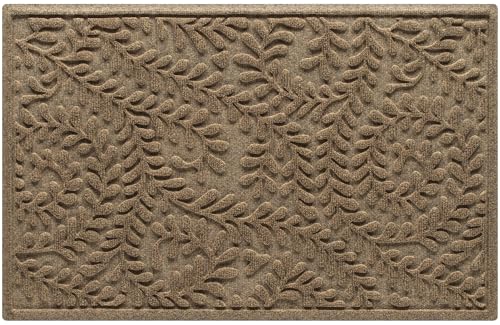 WaterHog Indoor/Outdoor Door Mat (Boxwood) The domestic version of the mat that has been in commercial lobbies for decades: published 3/8-inch construction, 24 oz per square yard PET, and made in the USA. | The commercial-grade option | 8.9/10 | $44.95 - View on Amazon #ad affiliate link · Price as of October 18, 2026 |
| 2 | 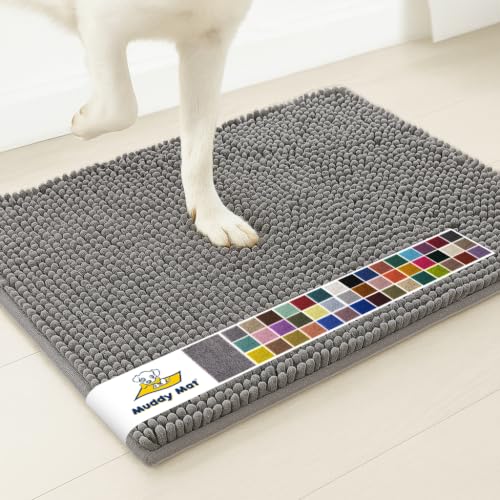 Muddy Mat Original Absorbent Door Mat A one-inch chenille pile the maker says absorbs five times its own weight Our skip-this pick | Wet dog paws | 8.5/10 | $22.70 - View on Amazon #ad affiliate link · Price as of October 18, 2026 |
The commercial-grade option
WaterHog Indoor/Outdoor Door Mat (Boxwood)
The domestic version of the mat that has been in commercial lobbies for decades: published 3/8-inch construction, 24 oz per square yard PET, and made in the USA.
WaterHog is the mat you have already walked on hundreds of times without noticing - it is the standard entrance mat in commercial lobbies, and Bungalow Flooring sells domestic-sized versions of the same construction. Buying it is buying a specification rather than a look.
That specification is the most complete on this page. The Classic construction is published at three-eighths of an inch thick with a gripper backing, or closer to a quarter inch with the smooth backing intended for hard floors, using a 24 ounce per square yard PET fabric. Two numbers - thickness and fabric weight - are two more than most of this category publishes, and together they tell you almost everything: how much it holds, and whether your door will clear it.
The construction detail that matters is bi-level. The raised ridges hold the walking surface up while grit falls into the channels below, so the dirt you scrape off is not the dirt you then walk back over. That is why commercial buildings use it in the second zone of an entry system, and it works the same way at a domestic front door.
The honest downside is cleaning. This is not a mat you put in a washing machine. It hoses down well and it dries reasonably fast, but that is an outdoor job on a dry day rather than a laundry-day job. If the appeal of a mat for you is that it goes in the wash, buy chenille - see best absorbent chenille mats. If the appeal is that it will still be flat and still be working in five years, buy this.
What works
- Published thickness and published fabric weight - the most complete spec sheet here
- Bi-level construction traps grit below the walking surface instead of on it
- Beveled edges reduce the trip hazard and stop the corners curling
What does not
- Not machine washable - cleaning is a hose and a drying rack
- Costs meaningfully more than the chenille mats it sits beside
- Stiffer underfoot than an absorbent mat; it is built for traffic, not comfort
Wet dog paws
Muddy Mat Original Absorbent Door Mat
A one-inch chenille pile the maker says absorbs five times its own weight - the deepest-pile mainstream option, and the one that most often will not clear a door.
Skip this one
Skip the Muddy Mat for the position most people buy it for: behind an inward-opening door. Its maker-stated 1-inch chenille pile against a standard half- to three-quarter-inch door undercut means it will jam or drag. It is the right mat on open floor and the wrong mat in a door swing.
Muddy Mat is the brand most people in this category have already heard of, and the demand data agrees - it is the single highest-volume product query in the entryway-mat space. The reason it earns that position is the pile. The maker states roughly a one-inch chenille layer that soaks up to five times its own weight, and depth is genuinely what separates a mat that holds a wet dog from a mat that smears one down the hall.
That same inch is the reason this mat needs a placement decision rather than a purchase decision. A standard interior door is hung with roughly half an inch to three-quarters of an inch of clearance above the finished floor. A one-inch pile does not fit under that. It will compress a little, and it will still catch. If the mat is going behind an inward-opening door, this is the wrong mat and no amount of liking it changes the arithmetic - put a low-profile mat at the swing and put this one just past it.
Where it belongs is the strip immediately inside the door, past the swing, or in a mudroom where the door opens outward. That is also where a wet dog actually shakes. The 60 by 24 inch runner is the size worth considering for a dog household: paw prints are not a doorway problem, they are a first-four-strides problem, and a 28-inch mat gets you one stride.
Cleaning is straightforward but has one rule people skip: shake or hose the mat before it goes in the machine. Chenille holds grit as effectively as it holds water, and washing a mat still full of dry mud puts that mud into your drum and back into the pile. Drying is the other honest limitation - a one-inch pile takes meaningfully longer to dry than a quarter-inch one, so a single mat in a two-dog household will spend part of its week damp. Two mats in rotation is the practical answer, and it is cheaper than a replacement floor. See our dog and paw mat picks for the full comparison.
What works
- The deepest published pile in this comparison - it holds a genuinely wet dog
- Runner size covers the first strides after the door, where paw prints actually land
- Machine washable, so the mud leaves rather than accumulating
What does not
- A 1-inch pile will not clear a standard interior door undercut - a placement decision, not a preference
- Deep pile takes noticeably longer to dry than a low-profile mat
- Needs shaking out before washing or the mud goes into your machine
The answer most households actually need
Both, in different positions, and that is not a dodge - it follows from the specs. The WaterHog goes where weather and the door are: outside the threshold or immediately inside it under the swing. The Muddy Mat goes on open floor past the door, where the dog stands and the pile depth can do its job. Each one is then being asked to do the thing it was built for.
If the budget is one mat and there is a dog, buy the Muddy Mat and put it clear of the door swing. If the budget is one mat and there is no dog, buy the WaterHog. If you want the full three-position argument, it is in layered entryway defense, and the individual deep dives are in our WaterHog review and Muddy Mat review.
Questions people ask
Is a WaterHog or a Muddy Mat better?
Will a Muddy Mat fit under my door?
Which is better for dogs?
Can you machine wash a WaterHog?
Can a Muddy Mat go outside?
Which lasts longer?
Sources
- WaterHog Boxwood - Amazon detail page (PET recycled polyester, 24 oz per square yard, published 3/8in thickness, rubber backing, indoor/outdoor rating, published sizes)
- Muddy Mat Original - Amazon detail page (microfiber chenille, maker-stated 1in pile, textured TPE backing, machine washable, published sizes)
Next stage
The answer is often both
These two mats are good at different halves of the same problem. A WaterHog outside and a Muddy Mat on open floor inside is a coherent setup.
Keep goingAbout the author
Scooter M.
An enthusiast who is genuinely into this. I read the manuals, compile the published specs, and do the math on door clearances. No lab coat, no test bench, and nothing here is a product I have used - which is exactly why every claim carries a source.
Published by Slate Mill Group, with the Mud & Mat team. Published October 17, 2026; last updated October 17, 2026. Editorial policy.
Read next
Premium or Budget
WaterHog vs Gorilla Grip
The commercial-grade mat against the Amazon best-seller, on published specs only - and what the extra money actually buys.

Specialist or Generalist
Muddy Mat vs Gorilla Grip
A specialist that publishes absorbency against a generalist that publishes backing durability and certification - and which one your household actually needs.
Single-Product Review
WaterHog mat review
The commercial entrance mat sold in domestic sizes - published thickness, published fabric weight, and the two backings that decide which floor it suits.

Muddy Mat Review
Muddy Mat review
Published 1 inch chenille pile, a 5x absorbency claim and a TPE backing - and the door-clearance problem that comes with all three.

Door Clearance Data
Low-profile mats and door clearance
Published mat thicknesses against the real door undercut - the arithmetic nobody else prints.