By Scooter M. · Last updated September 21, 2026
Mud & Mat earns a commission when you buy through the links on this page, at no extra cost to you. It does not change what we recommend, and we publish a skip-this verdict on products we could otherwise earn from. Full disclosure.
Buy an entryway table on published depth first and published top load second. Depths here run from 9.4 to 11.8 inches, which is the difference between a hall you can walk down and one you edge along. Top loads run from 88 to 121 pounds where they are published at all, and one table publishes none. The number that would tell you whether a boot fits underneath - the clearance height of the bottom shelf - is not published by any of them.
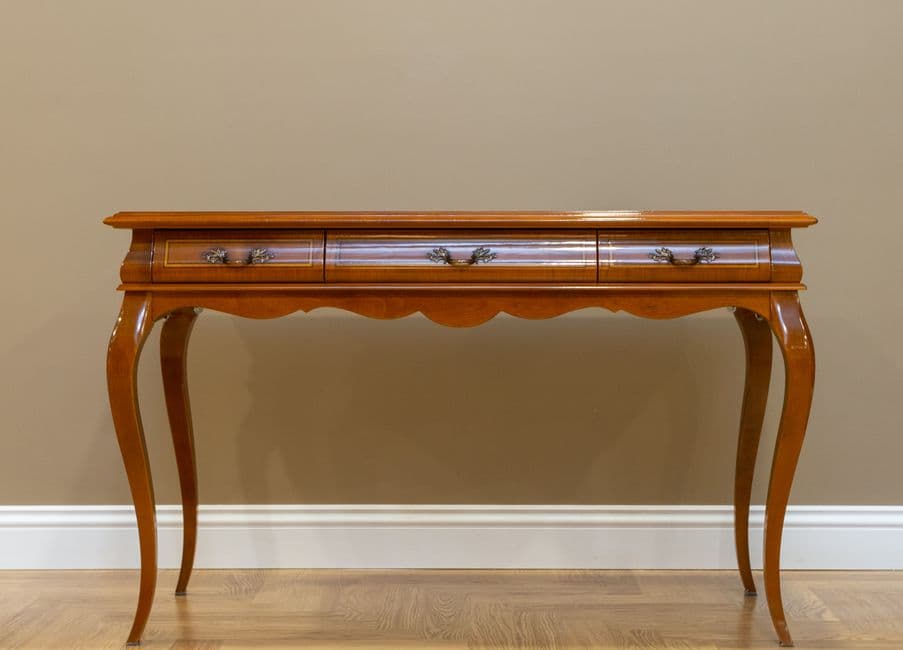
A console table in an entry is sold as a decorative object and bought as a storage one. The top takes keys, post and a lamp; the shelf underneath is where the shoes actually go, and it is why people search for an entryway table with shoe storage rather than an entryway table. That shelf is what this page judges.
It is also a format worth being clear-eyed about. A table is not a shoe cabinet - it hides nothing, holds fewer pairs than a rack, and puts a wooden surface directly above footwear that may be wet. What it buys is a surface at waist height in a hall too narrow for a hall tree and too public for an open rack.
How we picked
How we picked
- Published depth off the wall. The binding constraint in any hallway, and the figure our narrow cabinet roundup treats as decisive. Two of these publish 9.4 inches, which is genuine narrow-furniture territory; the others are 11.4 and 11.8, and in a tight hall those two extra inches are the whole decision.
- Published top load. The top of an entry table gets a bag of shopping dropped on it within a week of arriving. Three of these publish a figure - 88, 110 and 121 pounds - and one publishes nothing at all, which is the main reason it is the skip.
- What the shelf is actually for. Two makers name shoes explicitly as the intended contents of the bottom shelf; the others describe it as storage. Mesh shelving beats a solid board above damp footwear, for the same airflow reason this site prefers open racks to closed cabinets.
- Whether the listing's own numbers agree. One table here gives three different and inconsistent size strings in its specification fields, and another gives its height two different ways. We read these listings closely and report what they say rather than tidying them up.
- Material against a wet entry. Particleboard and MDF do not forgive standing water, and three of these four are built from it. Solid wood and metal frames tolerate the position better, and we say which is which rather than treating materials as interchangeable.
We have not physically tested these products. We do not own them, we have no lab, and we do not accept free product. Everything above is compiled from published manufacturer specifications, published care guidance and live retailer data - and we tell you which is which on every claim. How we pick.
The number none of them publishes
Every table on this page publishes an overall height - 29.5, 29.9, 30.7 and 31.5 inches. Not one publishes the clear height between the floor and the underside of the bottom shelf, and that is the only measurement that answers the question a buyer actually has, which is whether the shoes they own will stand underneath.
The gap matters because footwear heights vary enormously. A flat or a sneaker needs a few inches. An ankle boot needs more. A wellington or a riding boot standing upright needs the better part of a foot and a half and will not go under any table here at all. Without a published clearance you cannot tell in advance which category your hall falls into.
The workaround is to buy on overall height and expect the bottom shelf to sit somewhere in the lower third of it, then plan for shoes rather than boots. If boots are the problem, they belong in a boot rack or on a tray, not under a console table - and that is true of every table in this category rather than a criticism of any one of them.
Maker-published figures from each product's own retailer listing. 'Not published' means the listing states nothing, not that the product lacks the property.
Read the depth column first and the load column second, and notice what is missing from the table entirely: there is no shelf-clearance column, because there is nothing to put in it. Four listings, four overall heights, no clear height under the shelf.
Quick picks
Ranked against the criteria below. Tap a row to jump to the full write-up; the price button goes straight to Amazon.
| # | Product | Best for | Score | Price |
|---|---|---|---|---|
| 1 |  HOOBRO 29.5in Narrow Console Table 9.4 inches deep with two mesh shelves the maker names for shoes, a published 88 lb top load and every dimension stated | A hall that cannot spare a foot | 8.1/10 | |
| 2 |  VASAGLE LIRY 63in Console Table Five feet three of table at a published 9.4 inches deep, with a 121 lb tabletop rating, three drawers and a bottom shelf the maker states is for shoes. | A long wall and a lot of shoes | 8.0/10 | |
| 3 |  Furologee 47in Console Table, 3 Drawers Forty-seven inches of table on a metal frame with a published 110 lb load, three non-woven fabric drawers and a bottom wooden shelf | Fabric drawers and a middle-of-the-road footprint | 7.2/10 | |
| 4 |  ChooChoo 39in Entryway Table Pine and rubberwood rather than particleboard, at 11.8 inches deep and 34.5 lb Our skip-this pick | Solid wood, if you can live without the numbers | 5.8/10 | $99.99 - View on Amazon #ad affiliate link · Price as of October 18, 2026 |
A hall that cannot spare a foot
HOOBRO 29.5in Narrow Console Table
9.4 inches deep with two mesh shelves the maker names for shoes, a published 88 lb top load and every dimension stated - the shallowest entry table here by a clear margin.
Depth is the number that decides whether entryway furniture is possible at all, and this table is the only one on the page that reaches the 9.4 inches our narrow cabinet roundup treats as the threshold for a hallway you still have to walk down. At that depth it stops competing with the corridor and starts being free storage.
The shelves are the second reason it leads. They are mesh rather than solid board, and HOOBRO names shoes among the things they are for. Mesh above and below damp footwear is a meaningfully better surface than a sealed wooden panel, for the same reason this site prefers open shoe racks to closed cabinets - air gets at the shoe instead of being trapped under it.
The published data is the most complete here: all three dimensions, the maker's own weight, a 40 kilogram maximum and both materials named. The one wobble is that the height appears as 29.5 inches in the specification table and 29.3 in the bullets, which is a fifth of an inch and matters to nobody, but is worth noting on a site that reads these listings closely.
Two honest limits. Eighty-eight pounds is the lowest top load on this page - fine for keys, post, a lamp and a bag, not for sitting on or stacking with grocery boxes. And like every table here it publishes no clearance height under the bottom shelf, so whether a work boot stands underneath is a measurement you take after delivery rather than before.
What works
- 9.4 inches deep is narrow-cabinet territory - it fits halls that reject normal furniture
- Mesh shelves rather than solid boards, which is the right surface above damp shoes
- Publishes all three dimensions, a load rating, its own weight and both materials
What does not
- 88 lb is the lowest published top load here, so it is a keys-and-post table rather than a luggage one
- No shelf clearance height published, so whether a boot stands under it is unknown until it arrives
- The listing gives the height as 29.5in in the specification table and 29.3in in the bullets
A long wall and a lot of shoes
VASAGLE LIRY 63in Console Table
Five feet three of table at a published 9.4 inches deep, with a 121 lb tabletop rating, three drawers and a bottom shelf the maker states is for shoes.
Sixty-three inches of table at 9.4 inches deep is an unusual combination and it is the reason this one is here. Most furniture that long is also deep; this keeps the narrow-hall footprint our small-space guide argues for and spends the extra capacity along the wall, which is the dimension you were not walking through anyway.
The division of storage is well judged for an entry. Three closed drawers take the small clutter that otherwise colonizes the top - keys, post, gloves, dog leads - and the open bottom shelf takes shoes, which VASAGLE states explicitly. Closed for the small stuff, open for the footwear is exactly the right way round, because it is the footwear that needs air.
The 121 pound tabletop rating is the strongest published load on this page and, more usefully, it is quoted per surface rather than as a vague whole-unit figure. That is enough for a heavy lamp, a bowl, a stack of parcels and somebody leaning on it while they pull a boot off.
Two cautions. This is particleboard and MDF sitting immediately above wet shoes, and neither material forgives standing water - keep genuinely soaked boots on a tray rather than on the shelf. And at nearly four feet of length beyond the shortest table here, it needs a wall most halls do not have.
What works
- 9.4 inches deep across 63 inches of wall - the most storage per inch of corridor on this page
- A published 121 lb tabletop is the highest here, and the only one stated per surface rather than for the whole table
- Three closed drawers for the small clutter plus an open shelf for shoes is the right division of an entryway's mess
What does not
- Five feet three is more wall than most entries have, and at 48.9 lb it is not a piece you reposition casually
- Particleboard and MDF directly above wet footwear is the wrong material in the wrong place
- No shelf clearance height is published, so boot fit is unknown before delivery
Fabric drawers and a middle-of-the-road footprint
Furologee 47in Console Table, 3 Drawers
Forty-seven inches of table on a metal frame with a published 110 lb load, three non-woven fabric drawers and a bottom wooden shelf - the compromise pick on width and depth.
This is the middle option in every dimension that matters. Forty-seven inches long against 29.5 and 63, 11.4 inches deep against 9.4 and 11.8, and a published 110 pound load between the 88 and the 121 at either end. For a hall that is neither tight nor generous it is the sensible shape.
Two construction details are better than the price suggests. The top is stated as a single integral shelf with no splices and no gaps, which on an entry surface matters more than it sounds - a seam in a console top is where grit and dust collect and stay. And the feet are adjustable, which is the difference between a stable table and a rocking one on the uneven floor most halls actually have.
The fabric drawers are the divisive part. Non-woven fabric is light, lets air through and keeps dust off what is inside, and it is easy to pull out and empty. It is also the part of this table most likely to look tired first, and the listing says nothing about whether the drawers can be cleaned. In an entryway that sees wet gloves and dog leads, that is a gap worth knowing about.
The depth is the reason it ranks below the two 9.4-inch tables here. Two extra inches of projection is not much in a wide hall and is decisive in a narrow one, and our drop-zone guide puts the practical ceiling for tight entries at about twelve inches. This sits just inside that, with nothing to spare.
What works
- A published 110 lb load on a metal frame, with adjustable feet for an uneven hall floor
- The seamless one-piece top is stated to have no splices or gaps, which is a real detail on a surface that collects grit
- 47 inches splits the difference between the 29.5in and 63in options here
What does not
- 11.4 inches deep is two full inches more corridor than the narrow options on this page
- Non-woven fabric drawers are described as breathable and dust-resistant, with nothing published about cleaning them
- P2 particleboard above shoes has the same moisture problem as the other wood tables here
Solid wood, if you can live without the numbers
ChooChoo 39in Entryway Table
Pine and rubberwood rather than particleboard, at 11.8 inches deep and 34.5 lb - and the only table here that publishes no load rating and gives three different size strings.
Skip this one
Skip this one until the listing improves, and that is genuinely the only reason. The materials are the best on the page - hardwood solids with a natural rubberwood top and pine, where the three tables we rank above it are particleboard or MDF - and at 34.5 pounds it is reassuringly solid for its size. The problem is the data. There is no published load capacity anywhere, on a table whose top is the first place anybody puts a heavy bag, and the three competitors here publish 88, 110 and 121 pounds. Worse, the specification fields contain three different size strings that do not agree with each other, alongside the 11.8 by 39.4 by 31.5 inches given as the product dimensions, and one of the size fields is filled with a dimension rather than a size name. When a listing cannot keep its own measurements consistent, the figures you would rely on to plan a hallway are not figures you can rely on. It is also the deepest table here in a category where depth is the whole decision. Buy it if you have seen one in person and the wood matters to you more than the specification does.
On materials this is the pick of the page. Hardwood solids in the frame, a natural rubberwood top, pine and MDF elsewhere - against three competitors built largely from particleboard and engineered wood. At 34.5 pounds it has the mass that usually means a table stays put when somebody yanks a drawer, and 39.4 inches is a length that suits an ordinary hall.
Then you look for the numbers and they are not there. No load capacity is published anywhere on the listing, which on an entryway table is the specification that matters most - the top is where a bag of shopping, a heavy lamp or somebody's elbow lands every single day. The three tables ranked above it publish 88, 110 and 121 pounds respectively.
The size data is worse. Alongside the product dimensions of 11.8 by 39.4 by 31.5 inches, the specification fields carry three further and mutually inconsistent size strings, and one field that should hold a style name holds a dimension instead. None of that means the table is badly made. It means you cannot plan a hallway around what the listing tells you, which on this site is the thing we are ranking.
It is also the deepest table here at 11.8 inches, in the one furniture category where depth is the binding constraint rather than a preference. If you want solid wood in an entry and you are prepared to accept an unpublished load rating, it is a reasonable object. If you are choosing from specifications, three tables on this page tell you more. How we pick.
What works
- Real wood in the structure - hardwood solids with a natural rubberwood top - where most of this category is particleboard
- 34.5 lb of table is substantial for its size, which usually means it does not shift when a drawer is pulled
- 39.4 inches is a practical length for an average hall
What does not
- Publishes no load capacity at all, while all three competitors here state one
- The listing carries three separate and inconsistent size strings in its specification fields
- 11.8 inches deep is the deepest table on this page, in a category where depth is the binding constraint
Why depth decides this category
A hallway you can still walk down usually has under twelve inches of spare depth against one wall. That single measurement is what our small-space storage guide and our narrow cabinet page both build on, and it applies identically here. At 9.4 inches a console table is furniture you forget is there; at 11.8 it is furniture you turn sideways past when carrying a laundry basket.
The difference sounds trivial written down and is not in use. In a 36-inch hall, a 9.4-inch table leaves 26.6 inches of corridor and an 11.8-inch table leaves 24.2 - and that is before anything is on the shelf. A pair of boots projecting past the front edge takes several more inches out of both.
Do the arithmetic at the narrowest point of the hall rather than the average, which usually means at a door architrave or a radiator. A table that fits the average width and fouls the pinch point is a table you will be returning.
Wood above wet shoes
Three of these four tables are built substantially from particleboard or MDF, which is normal for the price and a real consideration in this specific position. Engineered wood panels swell where water sits on them, and the underside of a shelf directly above a pair of dripping boots is not a dry location.
Two things make that manageable. Mesh shelving lets water and air through rather than holding a puddle against a panel - one table here has mesh shelves and names shoes as their purpose. And a boot tray on the bottom shelf turns the whole problem into a wipeable one, which is the same move our layered-defense guide recommends everywhere else in the entry.
What does not work is putting genuinely soaked footwear straight onto a solid wooden shelf and closing the front door on it. Give boots their drying time somewhere designed for it, and use the table shelf for the shoes that are already dry.
Stability, and the floor it stands on
A console table is tall, narrow and gets leaned on, which is a different structural problem from a bench. Published weights here run from 13.7 to 48.9 pounds, and the lightest table is also the shallowest - a 9.4-inch footprint at under fourteen pounds is a piece of furniture that will move if somebody drags a drawer open with one hand.
One table publishes adjustable feet, which is the feature that matters most on the uneven floor a hallway usually has, and one publishes a one-piece top with no splices - a real detail on a surface that collects grit in every seam. Neither is mentioned in a product photograph, and both are worth more day to day than the finish is.
Table, cabinet or hall tree?
- You want a surface at waist height - a table. Nothing else in this category gives you somewhere to put keys and post as you come through the door.
- You want the shoes hidden - a narrow shoe cabinet at 9.4 inches deep conceals them behind a flip drawer, which a table never will.
- You want to sit down to take boots off - a hall tree or a cubby bench. A console table has no seat and that is the behavior that gets boots off at the door.
- You need maximum pairs - a shoe rack. One shelf under a table is a fraction of what a three-tier rack holds in the same floor space.
- The hall is under about ten inches of usable depth - only the 9.4-inch tables here fit at all, and a wall-mounted option may be the better answer.
Questions people ask
How deep should an entryway table be?
Will boots fit under an entryway table?
How much weight can an entryway console table hold?
Is an entryway table better than a shoe cabinet?
Can wet shoes go on the shelf under a console table?
What length entryway table should I buy?
Sources
- HOOBRO 29.5in Narrow Console Table, 3-Tier - Amazon detail page (9.4 x 29.5 x 29.5in, 6.2 kg, 40 kg maximum, metal frame, 2 mesh shelves stated for baskets, shoes and boxes)
- VASAGLE LIRY 63in Narrow Console Table with 3 Drawers - Amazon detail page (9.4 x 63 x 29.9in, 48.9 lb, 121 lb tabletop load, open bottom shelf stated as ideal for shoes)
- Furologee 47in Console Table with 3 Drawers - Amazon detail page (11.4 x 47.2 x 30.7in, 31.6 lb, 110 lb load capacity, P2 particleboard with metal frame, non-woven fabric drawers, adjustable feet)
- ChooChoo 39in Entryway Table with Drawers and Storage Shelf - Amazon detail page (11.8 x 39.4 x 31.5in, 34.5 lb, hardwood solids with rubberwood top; no load capacity published)
Next stage
Stage 3 - contain
Shoes under a wooden table still drip. A tray under the shelf is what catches it.
Keep goingAbout the author
Scooter M.
An enthusiast who is genuinely into this. I read the manuals, compile the published specs, and do the math on door clearances. No lab coat, no test bench, and nothing here is a product I have used - which is exactly why every claim carries a source.
Published by Slate Mill Group, with the Mud & Mat team. Published September 21, 2026; last updated September 21, 2026. Editorial policy.
Read next
Best Narrow Cabinet
Best narrow shoe cabinets
Published depth, pairs stored and load limits - plus the boots that flip drawers cannot take.
Best Hall Tree
Best hall trees
Published bench load ratings from 198 to 300 lb and depths from 11.8 inches - the two numbers that decide a hall tree.
Drop-Zone Setup
Entryway drop zone setup
The physical arrangement that makes the sequence take five seconds instead of thirty.
Best for Small Spaces
Best small-space shoe storage
Published depths from 9.4 inches, pairs per square foot of floor, and why vertical beats clever in a tight entry.