By Scooter M. · Last updated September 6, 2026
Mud & Mat earns a commission when you buy through the links on this page, at no extra cost to you. It does not change what we recommend, and we publish a skip-this verdict on products we could otherwise earn from. Full disclosure.
Buy on the published bench load rating first and the published depth second. A hall tree is a bench, a coat rack and a shoe store sold as one object, and the bench is the part that does the real work - sitting down is the single behavior that gets wet boots off at the door rather than in the hallway. Published ratings in this set run from 198 to 300 pounds and published depths from 11.8 to 13.8 inches. Everything else on the spec sheet is preference.
Hall trees are sold on the picture: coats hanging neatly, a basket on the shelf, two pairs of shoes below. What that photograph does not tell you is whether the bench will take an adult dropping onto it to lever a wet boot off, which is the thing the furniture actually has to survive several times a day.
Fortunately this is one of the few categories on this site where the makers do publish the number that matters. All four units here state a static load rating for the bench, which puts hall trees ahead of door mats, boot trays and most shoe benches for spec-sheet honesty.
How we picked
How we picked
- Published bench load rating, first. It is the only figure that describes whether the unit does its primary job. A maker who publishes it is telling you something checkable; a maker who describes a bench as sturdy is not, and on this site that difference decides rankings.
- Published depth, second. A hall tree lives in a corridor, and depth is what it takes out of one. We put every published depth against a real hallway width rather than quoting inches in isolation.
- Open or closed storage, treated as a trade rather than a tier. Closed hides the mess and traps damp; open dries footwear and shows it. Neither is better in general and we say which household each suits.
- Whether wet footwear can live in it at all. Most of these units have particleboard panels, which are strong in compression and unforgiving when soaked. We are explicit that a hall tree stores dry shoes, and that wet boots belong on a tray first.
- Stability hardware in the box. These are 70-inch freestanding units that get loaded at the top. Anti-tip provision is not an accessory here; we note where the maker supplies it and treat its use as mandatory.
We have not physically tested these products. We do not own them, we have no lab, and we do not accept free product. Everything above is compiled from published manufacturer specifications, published care guidance and live retailer data - and we tell you which is which on every claim. How we pick.
Published figures, side by side
Manufacturer- or retailer-published figures only.
The spread on the load rating is the interesting part: 300 pounds against 198 is a difference of half again, and it does not track price in the direction you would expect. The most expensive unit here publishes 220 pounds. That is worth knowing before you assume the premium is buying strength.
Quick picks
Ranked against the criteria below. Tap a row to jump to the full write-up; the price button goes straight to Amazon.
| # | Product | Best for | Score | Price |
|---|---|---|---|---|
| 1 |  VASAGLE Hall Tree with Bench and Shoe Cabinet (7 Double Hooks) A published 300-pound bench rating with a closed shoe cabinet underneath and adjustable shelves inside it | The highest published load rating | 8.8/10 | |
| 2 | 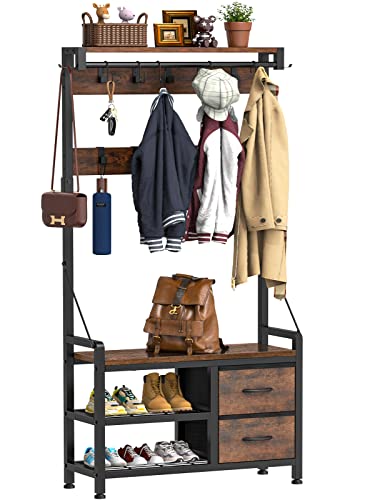 Lulive 5-in-1 Hall Tree with Bench and Drawers Published at 11.8 inches deep with a 275-pound bench and 17 hooks, and it splits into a bench plus a separate wall rack | The shallowest footprint | 8.5/10 | |
| 3 |  VASAGLE 4-in-1 Hall Tree with Hanging Rod A published 198-pound bench, a full-width hanging rod and nine repositionable hooks at roughly half the price of the heavy models | The best value with a published rating | 8.3/10 | |
| 4 |  MJADUE Narrow Hall Tree with Fluted Doors Closed fluted-door cabinets top and bottom on a published 220-pound bench Our skip-this pick | Hiding the shoes completely | 8.0/10 | Check price on Amazon #ad affiliate link · no live price for this item |
The highest published load rating
VASAGLE Hall Tree with Bench and Shoe Cabinet (7 Double Hooks)
A published 300-pound bench rating with a closed shoe cabinet underneath and adjustable shelves inside it - the most capable hall tree we compiled, and the only one over 275 lb.
A hall tree is three products welded into one purchase - a bench, a coat rack and a shoe store - and the one specification that decides whether it works is the bench rating. Sitting down is what a bench is for; sitting down is also the single behavior that most reliably gets wet boots off at the door instead of in the hallway. This one publishes 300 pounds, which is the highest figure in this set.
The storage underneath is a closed cabinet rather than an open rack, with shelves that adjust to three heights and lift out completely. That last detail is the one to notice: a fixed-shelf cabinet is a cabinet that will not take an ankle boot, and removing a shelf turns two useless short compartments into one usable tall one. The maker states up to 12 pairs.
Seven double hooks is the hanging provision, and it is enough for a household - a double hook takes a coat and a bag rather than a coat or a bag. The frame is steel with particleboard panels, which is the standard construction at this price and is genuinely strong in compression.
Two honest limits. It is 13.8 inches deep, and in a hallway under about 40 inches wide that is a real loss - measure before you buy, and consider the narrow options if the number does not work. And a closed cabinet traps damp: wet boots want a tray in the open air for a night before they go behind a door, or the cabinet becomes the reason your hall smells.
What works
- 300 lb is the highest published bench rating in this set, and the spec a bench lives or dies on
- Shelves adjust to three heights and come out entirely, so tall boots actually fit
- Closed cabinet hides the shoes, which is the whole reason people buy a hall tree over a rack
What does not
- 13.8 inches deep - a genuine loss of hallway width in a narrow entry
- Particleboard: strong in compression, unforgiving if it ever gets soaked
- A closed cabinet holds damp - wet boots need to dry before they go in it
The shallowest footprint
Lulive 5-in-1 Hall Tree with Bench and Drawers
Published at 11.8 inches deep with a 275-pound bench and 17 hooks, and it splits into a bench plus a separate wall rack - the one that fits a hallway the others do not.
Depth is the constraint that rules hall trees out of most real hallways, and this is the one that answers it. Published at 11.8 inches deep, it is two full inches shallower than the rest of this set - which does not sound like much until you are trying to get a pushchair past it. In a 36-inch hall, two inches is the difference between a squeeze and a corridor.
It does not pay for that with strength. The published bench rating is 275 pounds, second only to the 300-pound model and well above the cheaper open-shelf units. The frame is metal with engineered wood panels and the whole thing weighs 24.2 pounds, which is light enough for one person to position and heavy enough not to walk around.
The unusual feature is that it comes apart. The two-tier structure detaches into a bench and a wall rack, so if the entry arrangement changes - or you move - the same purchase becomes two separate pieces rather than one awkward one. Two anti-tipping straps and four adjustable foot pads are supplied, and on a 70-inch unit you should use them.
The honest trade is capacity. Two shoe shelves at 11.8 inches deep will take flat shoes comfortably and let a large boot overhang, and there is no concealment at all - this is open storage. Seventeen hooks is also more of a suggestion than a load rating: hanging seventeen wet coats on a light frame is not what the number 275 refers to. For a household that needs to hide the shoes, the closed-door options are the other direction.
What works
- 11.8 inches deep - two full inches shallower than the rest, which is the difference in a tight hall
- 275 lb published bench rating despite the shallow footprint
- Splits into a bench and a wall-mounted rack, so it can adapt to a different room later
What does not
- Seventeen hooks on a 31.5-inch frame is more hanging points than the structure invites you to load
- Open shoe shelves - no concealment at all
- Shallow depth means a large boot overhangs the shelf front
The best value with a published rating
VASAGLE 4-in-1 Hall Tree with Hanging Rod
A published 198-pound bench, a full-width hanging rod and nine repositionable hooks at roughly half the price of the heavy models - the sensible default if nobody in the house is heavy-handed with furniture.
This is the hall tree to buy if the goal is to stop the pile by the door rather than to furnish a mudroom. It publishes a 198-pound bench rating, which is enough for an adult to sit and lever a boot off and is not enough to stand on, and the maker is clear about the number rather than describing the bench as sturdy and leaving you to guess.
The feature that separates it from the more expensive units is the hanging rod across the top. Hooks hold a coat by its collar loop, which is why coats on hooks end up on the floor; a rod takes actual hangers, and a wet coat on a hanger dries in its own shape. There are also nine hooks in two rows, all removable and repositionable, so a household with a six-foot adult and a five-year-old can set both heights.
Open shoe shelves are the trade against the closed-cabinet models. Open is worse for tidiness and better for wet footwear: air gets to a damp boot on an open shelf, and does not get to one behind a door. Which of those matters more is genuinely a household decision, and we set out both sides in open vs closed shoe storage.
Two things to check before ordering. It is 28.3 inches wide, which is narrow for a family entry - the same line is sold at 33.1 inches and that is the one most households should take. And use the supplied anti-tip kit. A 72-inch freestanding unit loaded with coats at the top and nothing at the bottom is exactly the geometry that goes over when a child hangs off it.
What works
- The hanging rod is the feature the expensive models drop - hangers, not just hooks
- Nine hooks that move, so a household of different heights can set their own
- Anti-tip hardware is in the box rather than sold as an accessory
What does not
- 198 lb is the lowest published rating here - fine to sit on, not a step stool
- Open shoe shelves, so the shoes are visible and the dust is not contained
- At 28.3 inches wide it is narrow for a family; the 33.1-inch version is the one to size up to
Hiding the shoes completely
MJADUE Narrow Hall Tree with Fluted Doors
Closed fluted-door cabinets top and bottom on a published 220-pound bench - the one that makes an entryway look like furniture rather than like storage.
Skip this one
Skip this one if you are buying for structure rather than for looks. Its published 220-pound bench rating is respectable and it is below two cheaper units on this page, so the money is going into fluted doors and appearance rather than into a stronger or deeper piece of furniture. That is a completely legitimate thing to buy - an entry visible from a living room is a real requirement, and this is the unit that answers it. It is not, on the published figures, the one to buy if what you want is the most capable hall tree for the money.
Almost every hall tree is honest about being storage. This one is trying to be furniture, and for a lot of households that is the actual requirement: the entry is visible from the living room, and an open rack of school shoes is not what anybody wants to look at from the sofa. Fluted doors close over the shoe cabinets, and the unit reads as a hallway cupboard.
The bench publishes 220 pounds, which sits in the middle of this set, and the maker supplies anti-tip devices. Interior shelves adjust, which is the detail that decides whether a cabinet is genuinely usable - a fixed shelf at sneaker height makes an ankle boot impossible, and there is always at least one pair of ankle boots.
What you are paying for is the door. It costs several times what the open-shelf hall trees cost and its published bench rating is not higher than theirs, so the money is going into appearance and concealment rather than into structure. That is a legitimate thing to buy; it just should not be mistaken for buying a stronger unit.
Two limits. Four double hooks is the fewest here, so a family of four with coats, bags and dog leads will run out of hanging points quickly. And the same warning that applies to every closed cabinet applies double behind a solid door: a wet boot put away damp will still be damp in the morning and the cabinet will start to smell. Boots dry on a tray in the open and get put away after.
What works
- Fluted doors conceal the shoes entirely, which no open rack can do
- Adjustable interior shelves, so boots and sneakers can share the cabinet
- Anti-tip devices supplied rather than assumed
What does not
- Costs multiples of the open-shelf hall trees for the same published bench rating band
- Only 4 double hooks - fewer hanging points than everything else here
- Closed doors and wet boots are a bad combination; this wants dry footwear
Why the bench rating is the whole argument
Here is the behavioral chain that a hall tree is really buying. If there is somewhere to sit at the door, boots come off at the door. If there is not, people either balance on one leg - which most adults will do once, badly, and then stop - or they walk into the house wearing the boots and take them off where there is a chair. That is how mud gets past every mat you own.
So the bench has to be genuinely sittable, repeatedly, by the heaviest person in the household plus the force of dropping onto it rather than lowering. A 198-pound rating is fine for a light adult sitting deliberately. It is not what you want if a 200-pound adult flops down twice a day in work boots, and the maker is not hiding that - it published the number.
This is the same argument we make about shoe benches generally, and it is why our storage bench roundup carries an explicit non-recommendation for a bench whose maker publishes no load figure at all.
Depth is the second constraint
Hall trees are deep. The shallowest here projects 11.8 inches from the wall and the deepest 13.8, which in a 36-inch hallway leaves you 24.2 and 22.2 inches of corridor respectively. Both are usable; neither is generous, and the two-inch difference between them is the difference between passing someone and turning sideways.
There is a shape trade hidden in that number. The shallow unit gets its space back by having open shelves that a large boot overhangs; the deep unit encloses the shoes properly and costs you the corridor. If depth is genuinely tight, the alternative worth considering is not a shallower hall tree but a different format entirely - see small-space shoe storage and the narrow cabinets.
Closed doors and wet boots
The closed-cabinet models are the better-looking product and the worse place for anything damp. A cabinet with a door has no airflow, so a boot put away wet on Monday is a boot that is still wet on Tuesday, and after a few weeks the smell belongs to the cabinet rather than to the boot. Particleboard panels do not enjoy the process either.
The workable arrangement is a tray beside the hall tree for today's wet footwear and the hall tree itself for everything dry. That is not a compromise forced by cheap furniture - it is what the layered arrangement says should happen anyway, with a hall tree taking the storage stage and a tray taking the containment stage.
Hooks, rods, and what actually gets used
Hook count is the specification makers compete on and it is close to meaningless. Seventeen hooks on a 31-inch frame is not seventeen usable hanging points, because a coat is wider than the space between hooks - load them all and you have a solid wall of fabric that never dries. Four to seven well-spaced double hooks is a more honest number for a household of four.
A hanging rod is worth more than extra hooks. Hooks hold a coat by its collar loop, which is why coats on hooks end up on the floor and why wet coats on hooks dry in a bunched shape. A rod takes actual hangers, and a wet coat on a hanger dries in its own shape with air on both sides. Only one unit here publishes one.
If the floor cannot take a hall tree at all, the coats still need a place, and the same two rules carry over to a plain wall rack: spacing beats hook count, and a rod beats hooks for anything that arrives wet. Best entryway coat racks ranks the wall-mounted options on published load, width per hook and depth off the wall - including two listings that state their load limit two different ways.
Buy it this way
- Somebody heavy takes work boots off here twice a day - buy the highest published rating, which is 300 lb.
- A tight hall - buy the 11.8-inch depth and accept open shelves.
- The entry is visible from a living space - buy the closed doors, knowing you are paying for the doors.
- Coats need to dry, not just hang - buy the unit with a hanging rod rather than the one with the most hooks.
- Any hall tree at all - fix the anti-tip hardware, and keep wet boots on a tray beside it rather than inside it.
If the hall cannot take something this substantial, a console table gives you the surface and the shoe shelf without the bench or the height. Best entryway tables with shoe storage compares them on published depth, which runs from 9.4 to 11.8 inches, and on published top load.
Questions people ask
What is a hall tree?
How much weight should a hall tree bench hold?
How deep is a hall tree?
Do hall trees need to be attached to the wall?
Can wet boots go in a hall tree?
Is a hall tree better than a bench and separate hooks?
Sources
- VASAGLE Hall Tree with Bench and Shoe Storage - Amazon detail page (300 lb bench rating, 13.8 x 31.9 x 70.9in, 12 pairs, adjustable shelves)
- Lulive Hall Tree - Amazon detail page (275 lb bench rating, 11.8 x 31.5 x 70.9in, 17 hooks, detachable structure, anti-tipping straps)
- VASAGLE 4-in-1 Hall Tree - Amazon detail page (198 lb bench rating, 13.3 x 28.3 x 72.1in, hanging rod, 9 removable hooks, anti-tip kit)
- MJADUE Narrow Hall Tree - Amazon detail page (220 lb bench rating, 13.78 x 31.42 x 70.08in, fluted doors, adjustable shelves)
Next stage
Stage 3 - contain
A hall tree stores dry footwear. Wet boots need a tray in the open air before they go near it.
Keep goingAbout the author
Scooter M.
An enthusiast who is genuinely into this. I read the manuals, compile the published specs, and do the math on door clearances. No lab coat, no test bench, and nothing here is a product I have used - which is exactly why every claim carries a source.
Published by Slate Mill Group, with the Mud & Mat team. Published September 6, 2026; last updated September 6, 2026. Editorial policy.
Read next
Best Storage Bench
Best shoe storage benches
Published load ratings, wet tolerance and depth - and the bench that publishes no load rating at all.
Storage Decision
Bench vs cabinet vs rack
Behavior, concealment or capacity - pick the one your entry actually lacks.
Best for Small Spaces
Best small-space shoe storage
Published depths from 9.4 inches, pairs per square foot of floor, and why vertical beats clever in a tight entry.
Drop-Zone Setup
Entryway drop zone setup
The physical arrangement that makes the sequence take five seconds instead of thirty.